
Maintaining correct tire pressure is one of the most straightforward yet critical aspects of vehicle safety, handling, and fuel efficiency. However, finding the right electric air pump requires looking beyond basic specifications to understand how a device fits into your daily routine and storage setup. Whether you are managing a family SUV, a daily commuter motorcycle, or a high-performance road bicycle, the ideal inflator must match your specific tire volumes, valve types, and access to power.
For drivers living in urban environments like Singapore, where multi-storey carparks and shared parking spaces are the norm, power accessibility is often the deciding factor. A driver who cannot easily run an extension cord from their home to their vehicle must rely on portable, self-powered, or vehicle-powered alternatives. By evaluating your vehicle mix and identifying where you will perform routine maintenance, you can select an electric air pump that is both convenient to use and reliable in an emergency.
Identify Your Tire Pressure and Valve Requirements
Before comparing different pump designs, you must establish the baseline physical and pneumatic requirements of your tires. The first step is locating the manufacturer’s recommended cold tire pressure. This specification is typically found on a placard inside the driver-side door jamb, on the inside of the fuel filler door, or in the vehicle owner’s manual. It is important to use these recommended figures rather than the maximum pressure rating molded onto the tire sidewall, as the sidewall figure represents a safety limit rather than an optimal operating pressure.
Products mentioned in this guide
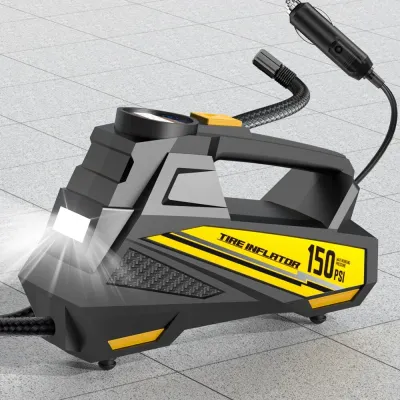

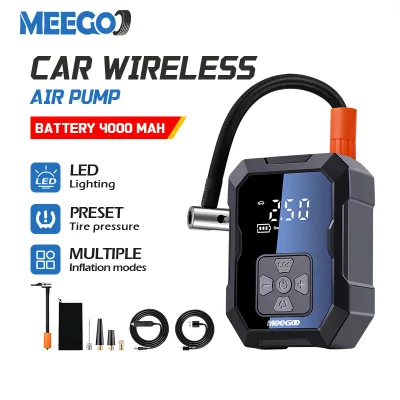
![[SG Seller]Portable Car Electric Inflator portable air pump car electric pump wireless air pump car electric pump汽车充气泵](https://img.lazcdn.com/g/p/11d7062f8a657612c19945cd3cdafcdb.jpg_400x400q80.jpg_.webp)
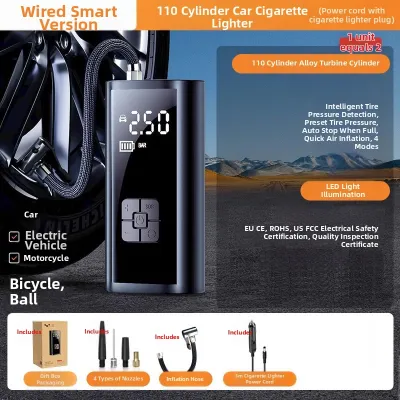
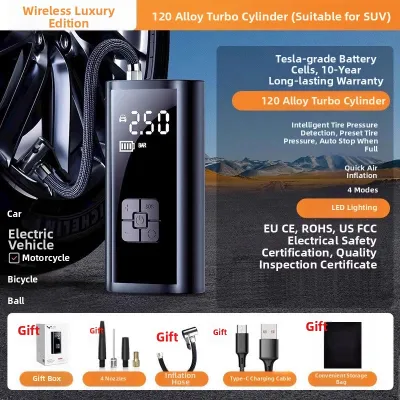
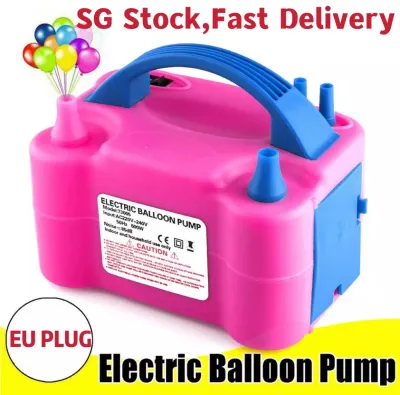
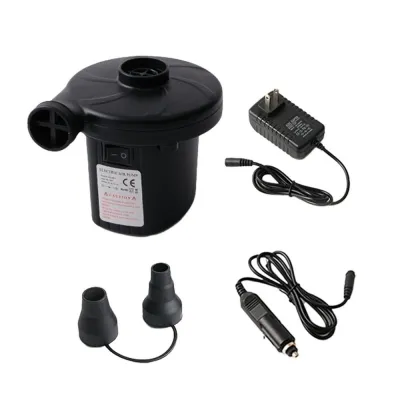
Prices are valid at publication and may change. Please refer to the product page for the latest price.
Next, identify the valve stem types used across your vehicles. Most passenger cars, SUVs, motorcycles, and utility bicycles utilize a wider Schrader valve. In contrast, many high-performance road and mountain bicycles use a narrower Presta valve. If your household has a mix of these vehicles, verify that any electric air pump you consider includes the necessary brass or plastic nozzle adapters, or features a smart dual-chuck head that accommodates both valve types without air leakage.
Finally, take note of the absolute maximum pressure limit printed on your tire sidewalls. This serves as a hard safety ceiling that your equipment must never exceed. While standard passenger car tires generally operate between 30 and 35 PSI, high-pressure bicycle tires can require upwards of 100 PSI. Understanding these limits ensures you select a pump with an operating range that comfortably covers your highest-pressure tire without straining the motor.
Choose the Right Pump Form Factor for Your Vehicles
Selecting the right form factor requires balancing portability, power source availability, and storage constraints. The market generally divides electric air pumps into three main categories: 12V corded inflators, cordless battery-powered pumps, and stationary AC-powered units. Each design serves a distinct operational purpose, and choosing the wrong one can lead to frustration during routine maintenance or roadside emergencies.

Evaluate whether your primary need is emergency roadside assistance, routine garage maintenance, or lightweight portability for two-wheelers. Consider the trade-offs between continuous power availability and physical mobility. A pump that relies on an external power source never runs out of battery, but its reach is physically limited by its cord. Conversely, a battery-powered unit offers total freedom of movement but requires proactive charging.
12V Corded Inflators for Cars and SUVs
A 12V corded inflator is a classic choice for car and SUV owners who want a reliable emergency tool stored in the boot. This type of pump plugs directly into your vehicle’s 12V accessory socket (commonly known as the cigarette lighter port). Because it draws power directly from the vehicle, it is ready to use at any time, provided your car battery has a charge.
To prevent draining your car’s battery during operation, always keep the vehicle’s engine running while using a 12V inflator. This ensures a steady voltage supply to the pump’s motor and protects your vehicle’s electrical system. While 12V inflators offer continuous runtime without the risk of internal battery degradation over years of storage, their mobility is strictly limited by the length of the power cord and the air hose. Ensure the combined length can comfortably reach all four tires from the accessory socket.
Cordless Portable Pumps for Motorcycles and Bicycles
For riders of motorcycles, bicycles, or those who park in communal spaces without easy access to power outlets, a cordless portable pump is often the most practical choice. These compact devices are completely independent of external power sources during operation, allowing you to top up tire pressure anywhere, from a multi-storey carpark to a remote roadside.
However, cordless pumps require routine battery maintenance. The internal lithium-ion cells naturally lose charge over time and must be recharged periodically—even when the pump is not in use—to prevent deep discharge and permanent battery degradation. Additionally, because of their compact size, cordless pumps have smaller motors and heat sinks. Always check the manufacturer’s stated duty cycle in the user manual to avoid overheating the internal motor when inflating larger, high-volume car tires.
Stationary AC Pumps for Home Garage Use
If you live in a landed property with a private garage or have a dedicated utility workspace with access to standard wall outlets, a stationary AC-powered pump is an excellent investment. These units plug directly into a standard household AC outlet, delivering consistent, high-output power without the need to manage internal batteries or keep a car engine running.
Stationary pumps are typically heavier and bulkier than their portable counterparts, making them unsuitable for carrying on a motorcycle or storing in a bicycle saddlebag. They are ideal for multi-vehicle households, seasonal tire pressure adjustments, and completing routine maintenance on multiple cars in a single session without thermal shutdown.
Verify Essential Features and Safety Specs Before Buying
When shopping for an electric air pump, compile a checklist of non-negotiable specifications to ensure safety and usability. First, verify that the pump’s maximum PSI (pounds per square inch) output rating comfortably exceeds the highest pressure requirement among all your vehicles. For example, while standard car tires require around 30 to 35 PSI, some road bicycle tires require 80 to 100 PSI or more, which demands a pump with a higher pressure threshold.
Ensure the unit features an automatic shutoff mechanism. This safety feature allows you to preset your target pressure, automatically stopping the inflation process once that level is reached to prevent dangerous over-inflation. Confirm the accuracy of the digital gauge. Even high-quality consumer inflators can have slight variances, so plan to cross-check the pump’s reading with a separate, trusted manual tire pressure gauge. Review the physical design of the nozzle adapters and the hose length. The hose should be flexible enough to connect to valve stems positioned at the top of a tire rotation without putting structural strain on the valve itself.
Safe Operation and When to Stop Inflating
Operating an electric air pump safely requires active monitoring and adherence to equipment limitations. Always monitor the temperature of the pump housing and the air hose during use. Compression naturally generates heat, and these components can become hot to the touch; stop operation immediately if the unit feels excessively hot.
Never exceed the maximum pressure rating molded into the tire sidewall, regardless of the pump’s maximum capability or your target pressure. If the pump emits unusual odors, excessive vibration, or abnormal noises, halt operation immediately and consult the user manual to check for internal faults or blockages. Allow the pump to cool down completely according to the manufacturer’s specified duty cycle before attempting to inflate additional tires, preserving the lifespan of the motor seals.
Frequently Asked Questions (FAQ)
Can I use a low-PSI bicycle pump for my car tires?
While the nozzle of a bicycle pump might physically fit a standard Schrader valve on a car tire, using a low-pressure, high-volume bicycle pump is highly impractical. Car tires contain a massive volume of air compared to bicycle tires, meaning a low-output pump will take an exceptionally long time to make a noticeable difference in pressure. Pushing a small pump to fill such a large volume risks overheating the motor and exceeding its intended duty cycle, which can lead to permanent equipment failure.
Do I need to calibrate my electric air pump?
Most consumer-grade electric air pumps do not feature user-calibratable pressure sensors. Over time, environmental factors, physical impacts, or sensor wear can cause the digital display to drift from actual pressure values. To ensure ongoing accuracy and safety, you should periodically verify your pump’s digital readings against a high-quality, standalone mechanical or digital tire pressure gauge.

Community discussion
Share your experience or ask a question. Comments are reviewed before publication.