
Choosing between Shell Advance and Castrol Power1 4T is not a matter of finding a single, universal winner. Both are highly regarded lubricants produced by global energy companies, but their suitability depends entirely on your motorcycle’s specific mechanical requirements. To make the correct choice, you must match your engine manufacturer’s specified viscosity grade, JASO and API standards, and the appropriate product tier for your riding habits. By focusing on verifiable label specifications rather than marketing slogans, you can select the oil that ensures optimal engine protection, smooth clutch engagement, and long-term reliability on the road.
Check Your Motorcycle's Engine Oil Requirements First
Before comparing brands, you must establish your motorcycle’s baseline oil specifications. The owner’s manual is your primary authority, detailing the exact viscosity grades (such as 10W-40 or 15W-50) and performance classifications required for your engine. Viscosity grades indicate how the oil flows at low temperatures (the number before the ‘W’) and its resistance to thinning at operating temperatures (the number after the ‘W’).
Wet Clutch Compatibility
You must also verify wet clutch compatibility. Most motorcycles share a single oil reservoir for the engine, gearbox, and clutch. These systems require oils meeting the JASO MA or MA2 standard, which ensures sufficient friction to prevent clutch slippage. Conversely, automatic scooters with dry clutches and continuously variable transmissions (CVTs) require JASO MB oils, which contain friction modifiers to maximize fuel efficiency. Using a JASO MB oil in a wet clutch system can cause severe clutch slippage and damage.
Products mentioned in this guide
![🇸🇬 MOTUL 7100 4T 10W40 10W50 15W50 100% Synthetic Ester Engine Oil Motorcycle Oil [1L]](https://img.lazcdn.com/g/p/00450279a13a350708397ff343c39c19.png_400x400q80.png_.webp)
Prices are valid at publication and may change. Please refer to the product page for the latest price.
Urban Riding Conditions
Urban riding conditions in Singapore demand careful viscosity selection. Stop-and-go traffic on congested expressways combined with high ambient temperatures and humidity subjects motorcycle engines to extreme thermal stress. Under these conditions, engine temperatures rise rapidly, making a stable viscosity crucial. Always select a viscosity grade that falls within your manufacturer’s approved range for high-temperature environments to prevent the oil film from breaking down.
Shell Advance 4T: Product Tiers and Label Specifications
Shell Advance 4T offers a structured lineup categorized into distinct product tiers. The premium tier is Shell Advance Ultra, a fully synthetic oil designed for modern, high-performance motorcycles. For mid-range performance, Shell Advance AX7 is a semi-synthetic option, while Shell Advance AX5 and Plus serve as mineral-based oils for older or lower-displacement engines. These tiers are clearly indicated on the product labels to help riders match the oil to their engine’s design.

Shell’s primary marketed focus for this range is its Active Cleansing Technology. According to product packaging, this formulation is designed to prevent dirt particles from sticking together to form harmful engine deposits. By keeping internal components cleaner, the oil aims to maintain consistent power delivery and protect the engine from wear over the course of the drain interval.
Common viscosity options available in Singapore include 10W-40 and 15W-50. The 10W-40 variant is widely used for daily commuting on standard street bikes, providing a balanced flow during startup and reliable protection at operating temperatures. The heavier 15W-50 variant is typically recommended for larger-displacement engines or longer journeys where sustained high temperatures are common.
Castrol Power1 4T: Product Tiers and Label Specifications
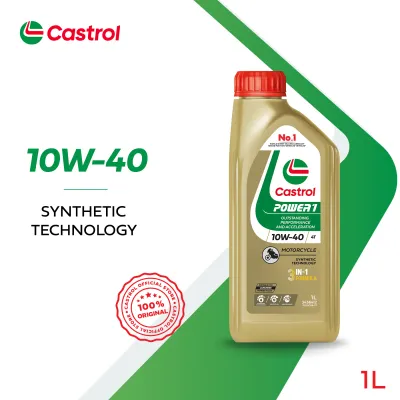
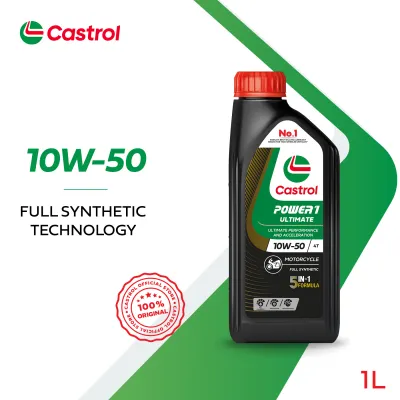
Castrol Power1 4T is organized into tiers designed to address different performance expectations. The top-tier product is Castrol Power1 Ultimate, a fully synthetic lubricant formulated for high-stress environments. The standard Castrol Power1 serves as the semi-synthetic offering, providing a balance of protection and value, while Castrol Activ represents the brand’s entry-level or mineral-based options.
Castrol’s marketing emphasizes friction reduction and acceleration. The product packaging often highlights technologies designed to optimize clutch grip and reduce internal engine drag. By minimizing friction within the engine and gearbox, these formulations aim to provide faster throttle response and smoother power transfer, particularly in sporty riding scenarios.
In Singapore, Castrol Power1 is commonly found in 10W-40, 10W-50, and 15W-50 viscosities. The 10W-40 and 10W-50 fully synthetic options are popular among sportbike riders who require rapid oil circulation at startup alongside robust high-temperature protection. The semi-synthetic 10W-40 and 15W-50 options are frequently selected for daily utility motorcycles and scooters requiring reliable wear protection.
Compare Shell and Castrol Using Objective Label Metrics
To compare Shell Advance and Castrol Power1 objectively, you must look past marketing terms and evaluate the technical specifications printed on the back labels. The base oil classification is your first point of comparison. Fully synthetic oils offer superior thermal stability and resistance to oxidation compared to semi-synthetic or mineral oils, making them better suited for high-performance engines or extended drain intervals in hot climates.
Next, verify the API (American Petroleum Institute) and JASO (Japanese Automotive Standards Organization) certifications. Look for the official JASO registration square on the back of the bottle, which displays a unique code confirming the oil has been independently tested and certified. An oil labeled API SP or SN offers higher resistance to high-temperature deposits and sludge compared to older standards like API SL.
Price-per-liter value should be evaluated by comparing equivalent tiers at local workshops or authorized retailers in Singapore. While prices fluctuate based on promotions and retail channels, fully synthetic options from both brands generally command a premium over semi-synthetic alternatives. When comparing costs, ensure you are matching equivalent product tiers (e.g., Shell Advance Ultra versus Castrol Power1 Ultimate) rather than comparing a semi-synthetic oil from one brand to a fully synthetic oil from the other.
| Product Tier | Shell Advance Equivalent | Castrol Power1 Equivalent | Typical Standards | Common Viscosities |
|---|---|---|---|---|
| Fully Synthetic | Shell Advance Ultra | Castrol Power1 Ultimate | JASO MA2, API SN/SP | 10W-40, 15W-50, 10W-50 |
| Semi-Synthetic | Shell Advance AX7 | Castrol Power1 4T | JASO MA2, API SM/SN | 10W-40, 15W-50 |
| Mineral | Shell Advance AX5 / Plus | Castrol Activ 4T | JASO MA2, API SL | 15W-40, 20W-50 |
Decision Framework: Which Oil Fits Your Ride?
Choosing between these two brands requires a systematic approach based on your motorcycle’s current status and your riding profile.
Choose Shell Advance if:
- Your manufacturer's required viscosity and JASO standards are met, and you prioritize deposit control and engine cleanliness.
- This is often preferred by riders who cover high daily mileages in stop-and-go traffic and want to minimize internal carbon buildup.
- Local pricing or availability at your preferred workshop makes it the more convenient option.
Choose Castrol Power1 if:
- Your required specifications are met, and you prefer a focus on throttle responsiveness and smooth clutch engagement.
- This option is popular among riders seeking a sportier feel and those whose preferred local workshops stock Castrol as their primary lubricant.
- The specific viscosity grade you need (such as 10W-50) is more readily available in Castrol's local lineup.
Verify First
If your motorcycle is under an active manufacturer warranty, you must strictly adhere to the OEM-approved specifications, including the exact viscosity and certification standards. Using an unapproved oil grade can void your warranty. Additionally, if you are switching base oil types (such as moving from mineral to fully synthetic) on a high-mileage engine, monitor the oil level closely. Synthetic oils have higher detergency and can sometimes wash away old deposits that were sealing worn gaskets, occasionally revealing minor oil leaks.
Remember that neither brand may be suitable if their local product lineup does not offer the exact viscosity or JASO standard specified by your motorcycle manufacturer. Never compromise on the required specifications just to use a specific brand.
Safe Oil Change and Maintenance Practices
Regardless of the brand you choose, proper maintenance practices are essential for engine longevity. Regularly check your oil level using the sight glass or dipstick while the motorcycle is on a level surface. The oil level should always sit between the minimum and maximum markers. If the oil appears milky, excessively dark, or smells strongly of fuel, it should be changed immediately regardless of mileage.
Always follow the motorcycle manufacturer’s recommended drain intervals and filter replacement schedules. Relying solely on oil brand marketing to extend drain intervals can lead to premature engine wear, as local riding conditions in Singapore accelerate oil degradation.
If you are performing the oil change yourself, ensure the engine has cooled completely to avoid severe burns from hot oil or exhaust components. Always use the correct torque specifications for the drain bolt to prevent stripping the engine casing threads.
When performing an oil change, ensure safe and environmentally responsible disposal of the used oil and filter. In Singapore, used motor oil is classified as toxic industrial waste and must never be poured down household drains or disposed of in general waste bins. Take your used oil to a licensed recycling point or a participating local workshop that handles proper chemical disposal. If you observe severe sludge, metal flakes, or abnormal mechanical noises during the oil change, stop operating the vehicle and consult a qualified professional immediately.

Community discussion
Share your experience or ask a question. Comments are reviewed before publication.