
Selecting the right motorcycle engine oil requires balancing your manufacturer’s mechanical specifications with your actual riding habits. Motul’s prominent product lines—the 5100, 7100, and 300V series—each serve distinct operational profiles, ranging from daily urban commuting to dedicated track racing. To make the correct choice, you must look beyond marketing labels and align the oil’s formulation, viscosity grade, and industry certifications with your motorcycle’s engine design and operating environment.
Decoding Motul's Formulations: 5100, 7100, and 300V
To choose the correct lubricant, you must first understand how Motul structures these three distinct product lines. Each line uses a different base oil formulation and additive package tailored to specific operating conditions and thermal demands.
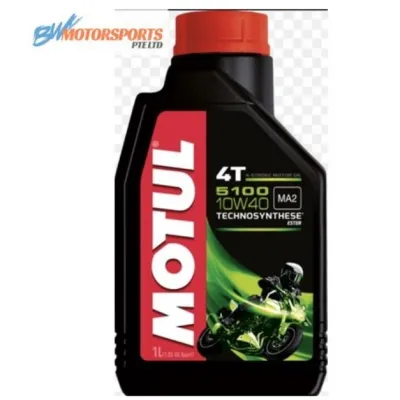
The Motul 5100 series is formulated using Motul’s proprietary Technosynthese technology, which is a high-quality synthetic blend designed for everyday reliability. This formulation is engineered to provide stable lubrication for standard commuting, urban riding, and routine daily transport. It offers a practical balance of wear protection and cost-effectiveness for standard or lower-displacement engines that do not experience extreme thermal or mechanical stress.
Products mentioned in this guide
Prices are valid at publication and may change. Please refer to the product page for the latest price.
The Motul 7100 series represents a significant step up, featuring a 100% synthetic formulation that incorporates ester technology. Esters are highly polar molecules that naturally cling to metal surfaces, providing a persistent protective film even when the engine is turned off. This line is engineered for high-performance street riding, long-distance touring, and high-revving engines that require robust thermal stability and shear resistance under sustained operating temperatures.
The Motul 300V series, part of Motul’s Factory Line, is a dedicated racing formulation utilizing advanced organic base stocks and specialized additive packages. It is engineered specifically for track use, closed-course racing, and extreme engine stress where maximizing power output and maintaining oil pressure under extreme heat are the primary goals. However, because it is optimized for racing conditions, it often prioritizes immediate shear strength and boundary lubrication over the long-term chemical stability and detergent properties required for extended street use.
Because lubricant formulations and product tiers can change over time, always read the physical product label on the bottle to verify the exact formulation details, ester content claims, and intended applications. Manufacturers periodically update their blends to meet evolving industry standards, making the physical label your primary source of truth.
Selecting the Correct Viscosity and Clutch Compatibility
Regardless of which Motul product line appeals to your riding style, your selection must comply with the mechanical constraints of your motorcycle’s engine and transmission.

The absolute authority for selecting your oil’s viscosity grade is your motorcycle’s owner’s manual. Manufacturers specify viscosity grades, such as 10W-40, 15W-50, or 20W-50, based on the engine’s internal clearances, oil pump tolerances, and operating temperature ranges. No aftermarket oil brand or marketing claim overrides these original equipment manufacturer specifications; using an incorrect viscosity can lead to inadequate lubrication, oil starvation, or excessive internal drag.
For motorcycles that share a single oil reservoir for the engine, gearbox, and clutch—commonly referred to as a wet clutch system—you must verify clutch compatibility. Look for the Japanese Automotive Standards Organization (JASO) certifications on the back of the bottle. Specifically, the oil must carry a JASO MA, MA1, or MA2 certification, which guarantees that the lubricant contains the correct frictional properties to prevent clutch slippage under load.
Climate plays a critical role in how viscosity behaves inside your engine. In tropical environments like Singapore, where ambient temperatures remain consistently high year-round, engines experience elevated baseline operating temperatures. If your owner’s manual provides a temperature-viscosity chart that allows for a higher hot-viscosity rating (such as moving from a 10W-40 to a 10W-50 or 15W-50 in hot climates), you may consider this adjustment to maintain a more robust oil film under sustained heat.
Finally, you must cross-reference the American Petroleum Institute (API) service classification on the label. Ensure the oil meets or exceeds the minimum API rating (such as SM, SN, or SP) specified by your motorcycle manufacturer to guarantee compatibility with modern emissions systems and internal engine components.
Decision Matrix: Matching the Oil to Your Riding Style
Choosing between these three formulations comes down to a realistic assessment of your riding habits, machine type, and maintenance budget.
You should choose Motul 5100 if your motorcycle is primarily a daily commuter, a standard street bike, or a lower-displacement machine. If your riding consists of routine urban trips, moderate speeds, and standard maintenance intervals, the Technosynthese formulation provides excellent protection while keeping your routine servicing costs manageable.
You should choose Motul 7100 if you ride a high-performance sportbike, a heavy touring motorcycle, or if you engage in aggressive street riding and long-distance highway cruising. The 100% synthetic, ester-based formulation of the 7100 series provides the necessary film strength and thermal stability to protect your engine during sustained high-RPM operation and under the intense heat generated during stop-and-go traffic.
You should choose Motul 300V only if your motorcycle is dedicated to track days, competitive racing, or frequent closed-course high-performance riding. The 300V series is designed to deliver maximum protection under extreme mechanical stress, but it requires you to accept the maintenance trade-offs of a racing oil, which typically includes much shorter drain intervals.
Before making your final purchase, verify whether your motorcycle is currently under a manufacturer’s warranty. Some warranties strictly mandate the use of OEM-branded lubricants or specific synthetic blends, and using a racing-focused oil like 300V might complicate warranty claims. Additionally, check if your street-legal motorcycle features sensitive exhaust catalysts, as certain high-performance additive packages in racing oils can accelerate catalyst degradation over time.
Assessing Cost, Drain Intervals, and Authenticity
Maintaining your motorcycle involves looking at both the immediate cost of the oil and the long-term expenses associated with your service intervals.
In terms of relative price tiering, Motul 5100 represents the most accessible entry point, offering reliable protection at a lower cost per liter. Motul 7100 sits in the premium street tier, reflecting its 100% synthetic formulation and advanced ester technology. Motul 300V is positioned as a top-tier investment, carrying a premium price tag that reflects its specialized racing heritage and performance-focused chemistry.
However, the total cost of ownership is heavily influenced by your drain intervals and filter replacements. While a premium street oil like 7100 can safely run for the full service interval recommended in your owner’s manual, a racing oil like 300V is formulated for short-term performance and lacks the long-term chemical buffers of street oils. Consequently, using 300V requires more frequent oil changes and filter replacements, significantly increasing your long-term maintenance costs.
To protect your engine from catastrophic damage, you must ensure you are purchasing genuine Motul products. The rise of counterfeit lubricants on online marketplaces makes sourcing a critical step. Always purchase your oil from authorized distributors, official brand flagship stores, or reputable local workshops. When inspecting a bottle, check for physical indicators of authenticity, such as high-quality label printing, an intact induction seal under the cap, precise laser-etched batch codes, and official holographic security labels where applicable.
Frequently Asked Questions (FAQ)
Can I mix different Motul oil lines like 7100 and 5100?
The general mechanical consensus is that mixing different oil formulations, such as a semi-synthetic like 5100 with a full synthetic like 7100, is discouraged because it can disrupt the balance of the specialized additive packages in each oil. In an emergency top-up situation where your oil level is critically low, matching the correct viscosity grade and JASO wet-clutch specification is far more important than matching the exact product line. If you must mix formulations to top up your engine, you should perform a full oil flush and filter replacement as soon as practical to restore uniform lubrication properties.
Is Motul 300V practical for daily street commuting?
Motul 300V is not practical or recommended for daily street commuting. While it offers exceptional high-temperature film strength, racing formulations are engineered for short, intense track sessions and often lack the robust detergent and dispersant additives that street-focused oils use to prevent sludge and neutralize combustion acids over thousands of kilometers. Using 300V for daily commuting results in rapid oil degradation, requiring highly frequent oil changes that dramatically increase your maintenance costs. For high-performance street riding, Motul 7100 provides the ideal balance of ester protection and long-term chemical stability.
How can I verify the authenticity of Motul oils purchased online?
To verify the authenticity of Motul oils purchased on e-commerce platforms, start by inspecting the physical bottle for high-quality, clear label printing with no spelling errors or blurred text. Genuine bottles feature an intact induction seal beneath the cap, a precise laser-etched batch code on the lower portion of the bottle, and often include official holographic security labels. Avoid purchasing from unverified third-party sellers offering prices that are significantly lower than the standard market rate in S$, as unusually cheap oil is a primary indicator of counterfeit products. Stick to official brand stores or authorized local distributors to guarantee product integrity.

Community discussion
Share your experience or ask a question. Comments are reviewed before publication.