
Viscosity grades like 10W-40 and 15W-50 on a bottle of motorcycle engine oil 4t indicate how the oil flows at different temperatures. These alphanumeric codes are not quality ratings or performance scores. Instead, they represent flow resistance measurements defined by the Society of Automotive Engineers (SAE), helping riders select an oil that matches their engine’s design and operating environment.
Choosing the correct viscosity grade ensures that your motorcycle engine receives immediate lubrication during startup and maintains a strong protective barrier under intense heat. Using an incorrect grade can lead to accelerated component wear, poor clutch performance, or inadequate oil pressure.
Decoding the SAE Viscosity Numbers
The SAE viscosity grade is divided into two distinct parts, separated by a hyphen. The first part of the grade, which includes the letter “W,” stands for “Winter” and represents the oil’s cold-flow characteristics. A lower number before the “W” indicates that the oil remains more fluid at low temperatures, allowing it to pump quickly through the engine during a cold start. For example, a 10W oil flows more easily in cooler conditions than a 15W oil, reducing initial friction and wear on internal components.
Products mentioned in this guide
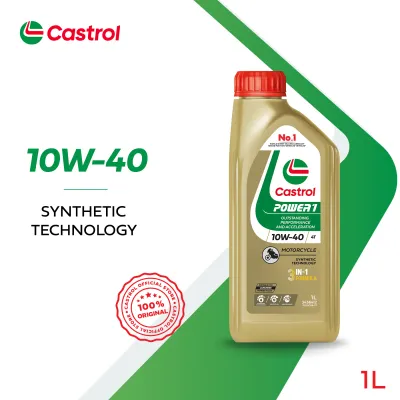
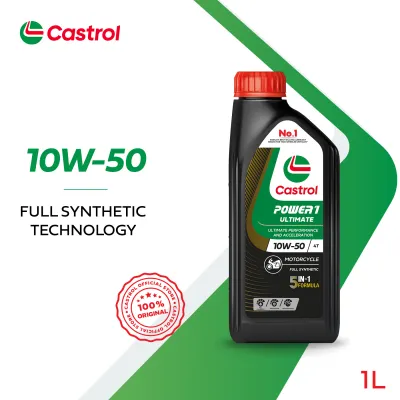
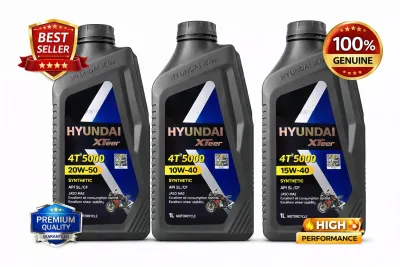
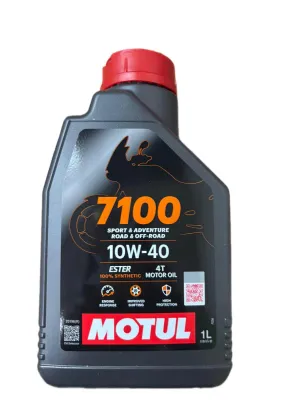
![🇸🇬 MOTUL 7100 4T 10W40 10W50 15W50 100% Synthetic Ester Engine Oil Motorcycle Oil [1L]](https://img.lazcdn.com/g/p/00450279a13a350708397ff343c39c19.png_400x400q80.png_.webp)

Prices are valid at publication and may change. Please refer to the product page for the latest price.
Even in consistently warm tropical climates, cold-start protection remains highly relevant. A cold start refers to any time the engine is started after sitting long enough to cool down to ambient temperature. During these moments, gravity has pulled most of the oil back down into the sump. An oil with an appropriate cold-flow rating travels rapidly up to the cylinder head and valve train the moment the starter motor engages.
The second number in the grade, such as 40 or 50, represents the oil’s kinematic viscosity at 100°C, which is the standard benchmark for a fully warmed-up engine. A higher second number indicates a thicker, more viscous oil film at operating temperatures. A 15W-50 oil will maintain a thicker protective layer under extreme heat than a 10W-40 oil, which can be beneficial for air-cooled engines or motorcycles subjected to heavy loads.
It is crucial to understand that these numbers are relative measurements of flow resistance rather than absolute quality indicators. A 15W-50 oil is not inherently superior to a 10W-40 oil. Each grade is engineered to meet specific mechanical tolerances, oil pump capacities, and thermal demands. Using an oil that is too thick can restrict flow and increase internal drag, while an oil that is too thin may fail to prevent metal-on-metal contact.
Why 4T Motorcycle Engines Have Specific Viscosity Needs
Four-stroke (4T) motorcycle engines operate under vastly different mechanical conditions than typical passenger car engines. In most modern motorcycles, a single oil volume is shared across a unified sump. This means the motorcycle engine oil 4t must simultaneously lubricate the hot engine cylinders, protect the high-shear gears in the transmission, and facilitate the correct amount of friction for the wet clutch system.

This shared environment places unique demands on the oil’s viscosity. The transmission gears subject the oil to extreme mechanical shearing, which physically chops polymer chains and can cause temporary or permanent viscosity loss. If the oil thins out too much under these shear forces, the protective film between gear teeth can rupture, leading to premature pitting and gearbox wear.
At the same time, the wet clutch relies on the oil’s viscosity and additive package to operate smoothly. If the oil is too thick, the clutch plates may drag, making it difficult to shift gears or find neutral. Conversely, if the oil is too thin or contains improper friction-reducing additives, the clutch plates may slip under acceleration, reducing power transfer to the rear wheel and generating excessive heat.
Because motorcycle engines typically rev much higher than car engines, they generate substantial internal heat and mechanical stress. Manufacturers design the oil passages, clearances, and oil pumps around specific viscosity profiles to ensure consistent pressure and flow. Adhering to these specified grades is essential for maintaining the delicate balance between engine protection, gear durability, and clutch engagement.
How to Select the Correct Grade for Your Ride
The most reliable way to choose the correct viscosity grade is to consult your motorcycle’s owner’s manual or the manufacturer’s specification label. Manufacturers perform extensive testing to determine which viscosity grades provide optimal protection across various operating conditions. Always prioritize the primary recommended grade listed in your vehicle documentation.
Many manuals include an ambient temperature chart that allows for alternative viscosity grades based on local weather conditions. In regions with consistently high ambient temperatures, a manufacturer might approve switching from a 10W-40 to a 15W-50 to provide enhanced thermal stability. However, these substitutions should only be made within the official boundaries defined by the manufacturer.
Avoid arbitrarily changing viscosity grades based on anecdotal advice or general assumptions. Switching to a significantly heavier oil in an engine designed for a lighter grade can reduce oil flow to critical upper-engine components during startup and increase operating temperatures due to fluid friction. Conversely, using an excessively thin oil can compromise the oil film strength, leading to accelerated wear on bearings and gear faces.
When purchasing motorcycle engine oil 4t, always verify that the product meets both the required SAE viscosity grade and the appropriate industry standards, such as the JASO MA or MA2 specifications. These standards ensure the oil has been tested for wet clutch compatibility and shear stability, confirming it is safe for use in your specific motorcycle configuration.
Frequently Asked Questions (FAQ)
Can I mix 10W-40 and 15W-50 motorcycle oils?
Mixing different viscosity grades is generally not recommended because it alters the final viscosity of the oil in an unpredictable manner. While mixing may not cause immediate mechanical failure in an emergency top-up scenario, it can disrupt the balance of viscosity index improvers and friction modifiers. This imbalance can affect wet clutch performance and oil flow characteristics. For optimal protection, always drain the system and refill it with a single, consistent viscosity grade as specified by your manufacturer.
Is it safe to use car engine oil in a 4T motorcycle?
No, standard automotive engine oils are not suitable for 4T motorcycles with shared sumps. Car oils often contain friction modifiers designed to maximize fuel economy, which can cause a motorcycle’s wet clutch to slip, glaze, and wear out prematurely. Additionally, passenger car oils are not formulated to withstand the extreme shear forces generated by motorcycle gearboxes. Always use dedicated 4T motorcycle engine oil that carries the JASO MA or MA2 certification to ensure proper clutch grip and gear protection.

Community discussion
Share your experience or ask a question. Comments are reviewed before publication.