
To protect your Skoda Kodiaq’s interior from intense heat and ultraviolet (UV) radiation, the best front windshield sun shades are those designed specifically for custom-fit coverage or high-quality, highly adjustable flexible shades that can accommodate the vehicle’s large glass area and prominent central sensor housing. Because the Skoda Kodiaq features a spacious cabin with an expansive front windshield, standard off-the-shelf universal shades often fall short, leaving significant gaps at the corners or failing to secure properly around the rearview mirror. Selecting a shade that matches the precise dimensions of this mid-sized SUV ensures maximum heat rejection, protects the sensitive dashboard electronics, and keeps the cabin comfortable even when parked under direct sunlight.
Understanding Windshield Dimensions and Fit Requirements
The Skoda Kodiaq is known for its commanding road presence, which is partly due to its tall, wide, and slightly curved front windshield. This expansive glass surface allows excellent forward visibility while driving, but it also acts as a massive greenhouse when the vehicle is parked. The windshield features a distinct trapezoidal shape, tapering slightly as it ascends toward the roofline, and exhibits a subtle horizontal curvature that requires a sun shade with sufficient flexibility to sit flush against the glass.
Standard universal sun shades, which are typically designed in simple rectangular shapes or rigid square panels, struggle to conform to this specific geometry. When you attempt to fit a generic shade into a Kodiaq, you will often find that the corners do not reach the A-pillars, leaving wide vertical strips of exposed glass on either side. Furthermore, the Kodiaq’s windshield base is deep, meaning a shade that is too short vertically will slide down, leaving the upper portion of the cabin exposed to direct sunlight.
Products mentioned in this guide
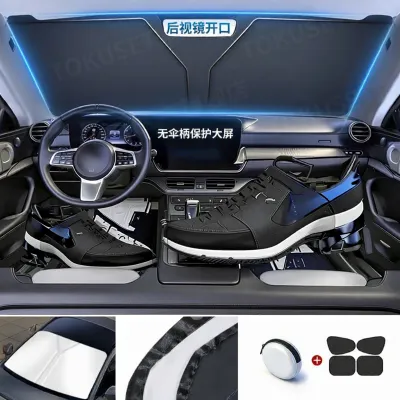
Prices are valid at publication and may change. Please refer to the product page for the latest price.
Another critical factor is the prominent housing located behind the rearview mirror. In modern Skoda Kodiaq models, this area contains an array of sensors, rain detectors, and driver-assistance cameras. A universal shade without a dedicated cutout or a flexible hook-and-loop strap will either press forcefully against this housing—potentially misaligning the sensitive sensors—or fail to mount at all, sagging in the middle and allowing heat to bypass the barrier.
To avoid these fitment issues, owners should measure the windshield dimensions manually before making a purchase. To do this accurately, use a flexible measuring tape and measure the maximum width along the bottom edge near the cowl, the width along the top edge near the headliner, and the vertical height from the center of the dashboard to the top of the glass. Comparing these measurements with product specifications is the most reliable way to ensure a snug fit, especially if you are opting for a semi-custom or highly adjustable aftermarket shade.
Types of Sun Shades and Their Coverage Capabilities
Foldable accordion-style sun shades are a popular choice for many SUV owners due to their structural rigidity. These shades are typically constructed from thick, multi-layered materials, such as bubble insulation sandwiched between reflective foil layers. Because they are stiff, they stand up easily against the windshield without sagging, and they can be quickly folded along pre-creased lines for storage. However, their rigidity means they cannot easily bend around the Kodiaq’s central sensor housing, so you must ensure the model you choose features a deep, pre-cut slot for the rearview mirror.

Roll-up and retractable sun shades offer a different set of advantages and drawbacks. Roll-up models are usually made of flexible, reflective materials that roll into a cylinder when not in use. While they are highly durable and have no fold lines that can wear out over time, they tend to retain a curled shape at the edges. This curling can cause the corners to pull away from the A-pillars, creating gaps where sunlight can penetrate. Retractable models that mount permanently to one side of the windshield offer convenience but can permanently clutter the passenger-side view and rarely cover the entire glass area of a large SUV like the Kodiaq.
The debate between custom-fit and universal-fit options ultimately comes down to a trade-off between precision and cost. Custom-fit shades are laser-measured to match the exact contour, width, height, and sensor cutout of the Skoda Kodiaq’s windshield. They slide into place with minimal effort, require no suction cups, and are held securely by simply folding down the vehicle’s sun visors. While they represent a higher initial investment, often costing more than basic alternatives, their ability to block virtually all incoming light and heat makes them highly effective for long-term interior preservation.
Universal-fit shades, by contrast, are mass-produced in standard sizes to fit a wide range of vehicles. While they are highly affordable and widely available at local automotive accessory shops, they almost always require compromises. You may find yourself having to overlap the panels or bend the edges to make them fit, which can damage the shade over time and leave unsightly gaps that let heat seep into the cabin.
Umbrella-style sun shades have emerged as a modern alternative, deploying like a standard rain umbrella with a tensioned fabric canopy and a central shaft. When opened inside the cabin, the canopy presses flat against the windshield. While they are compact when folded and easy to store in the door pocket, their mechanical design poses risks in a Skoda Kodiaq. The central metal pole can press against the sensitive infotainment screen or scratch the leather-wrapped dashboard if not positioned with extreme care, and the rigid metal ribs can put undue pressure on the rearview mirror housing.
Key Selection Criteria for Full Coverage and Heat Reduction
When evaluating sun shades for heat reduction, the material composition is the most critical factor. High-quality shades utilize a multi-layer construction to tackle heat transfer through radiation, conduction, and convection. The outermost layer is typically a highly reflective material, such as metalized polyester film or aluminum foil, which reflects solar radiation back through the glass. Beneath this reflective surface, an insulating core—often made of closed-cell foam or polyethylene bubble wrap—acts as a thermal barrier, slowing down the conduction of heat from the hot outer layer to the cooler cabin air.
The innermost layer, which faces the cabin, is usually finished with a soft, non-abrasive fabric or a neutral-colored backing. This layer prevents the shade from scratching the dashboard and helps absorb any residual heat. When shopping, look for shades that specify their thermal properties or feature multiple layers of insulation, as single-layer fabric shades, while lightweight, offer significantly less thermal resistance under intense tropical sun conditions.
Structural integrity is another essential criterion, particularly for preventing the shade from sagging over time. The edges of the shade should be finished with high-quality, double-stitched binding tape to prevent fraying and separation of the layers. For pop-up or flexible ring shades, the internal spring wire must be made of high-tensile steel that maintains its shape after hundreds of folding cycles. If the wire is too thin or weak, the shade will sag in the middle, creating large gaps at the top of the windshield where hot air can accumulate and enter the cabin.
A well-designed rearview mirror cutout is vital for achieving full coverage in the Skoda Kodiaq. Because the Kodiaq’s sensor array is relatively wide, a simple slit in the shade may not be sufficient. The best designs feature a wide, contoured cutout with a hook-and-loop strap or a fabric flap that closes securely around the neck of the rearview mirror. This design allows the shade to sit flush against the glass behind the mirror, blocking out the light that typically streams through the center of the windshield while protecting the sensitive forward-facing cameras from overheating.
Finally, consider the mounting and stability mechanisms of the shade. Many custom-fit and rigid shades rely entirely on the vehicle’s built-in sun visors to hold them in place. This is the most reliable and clean method, as it eliminates the need for suction cups or adhesives. Suction cups are prone to losing their grip and falling off when the windshield reaches high temperatures, and they can leave unsightly circular residue marks on the glass. Static cling options are generally unsuitable for front windshields due to the steep angle and the need for frequent removal.
How to Verify Compatibility Before Purchasing
Verifying compatibility before finalizing your purchase is essential to avoid the hassle of returning an ill-fitting product. The Skoda Kodiaq has undergone updates and generational changes since its initial launch, which can affect the design of the windshield area. For instance, facelifted models or different trim levels may feature larger sensor housings behind the rearview mirror to accommodate advanced driver-assistance systems (ADAS). Always cross-reference the product listing with your vehicle’s exact model year and trim level to ensure the shade’s cutout matches your specific configuration.
When shopping on online marketplaces or through local automotive accessory retailers, pay close attention to the sizing charts and fitment guarantees. Reputable manufacturers of custom-fit shades will list the exact vehicle models they support, rather than using broad categories like “fits most SUVs.” If you are purchasing from an online platform, look for sellers that offer a clear return policy or a fitment guarantee, allowing you to exchange or return the shade if it does not sit flush against your Kodiaq’s windshield.
User reviews and feedback sections are invaluable resources for verifying real-world compatibility. Search specifically for reviews written by other Skoda Kodiaq owners. These reviews often highlight practical details that sizing charts miss, such as whether the shade interferes with a mounted dashcam, how easy it is to fold within the tight confines of the cabin, or if there are any noticeable gaps around the A-pillars. If multiple owners report that a specific shade is too small or sags, it is best to look for alternative options.
Be cautious of red flags in product listings. Vague descriptions such as “universal fit for Skoda” or listings that lack detailed dimensional diagrams should be approached with skepticism. A high-quality sun shade listing should provide precise measurements of the shade itself, clear instructions on how it mounts, and detailed photos of the product installed in an actual vehicle. If a seller cannot provide these details, the product is likely a generic shade rebranded with a vehicle name, which rarely provides the snug fit required for optimal heat protection.
Installation, Storage, and Daily Usage Tips
Proper deployment is key to maximizing the effectiveness of your sun shade and protecting your Skoda Kodiaq’s interior. When installing the shade, start by placing the bottom edge flat against the base of the windshield, ensuring it slides as deep as possible into the gap where the glass meets the dashboard. Gently guide the upper portion of the shade around the rearview mirror and sensor housing, securing any hook-and-loop straps. Finally, pull down both the driver and passenger sun visors to press the top edge of the shade firmly against the glass, eliminating any gaps where hot air could enter.
When removing the shade, handle it with care to avoid scratching the leather-wrapped steering wheel, dashboard, or the sensitive infotainment screen. For flexible wire-frame shades, use a smooth, twisting motion to fold the loops into a compact circle. Avoid forcing the frame, as aggressive bending can snap the internal steel wire or cause it to warp permanently, rendering the shade unusable. Store the folded shade in its protective sleeve and place it in a convenient location, such as the door pocket, under a seat, or in the trunk, to keep it clean and prevent it from rolling around the cabin.
Take extra precautions if your Kodiaq is equipped with aftermarket accessories mounted on the windshield or dashboard. Dashcams, GPS mounts, and electronic toll collection units (such as the local In-Vehicle Unit or On-Board Unit) can be easily dislodged or misaligned when deploying a rigid sun shade. Ensure the shade does not press directly against these devices. If necessary, you can make minor adjustments to the positioning of the shade or choose a highly flexible fabric model that can gently contour around these accessories without putting pressure on their mounts.
Over time, constant exposure to intense heat and UV radiation will cause any sun shade to degrade. Perform a routine inspection of your shade every few months. Look for signs of wear such as peeling reflective coatings, flaking insulation material, or frayed edge stitching. A degrading shade not only loses its thermal efficiency but can also leave fine reflective dust or debris on your dashboard and seats. If you notice the internal wire frame is bent out of shape or the reflective layer is flaking off, it is time to replace the shade to maintain optimal protection for your vehicle.
Frequently Asked Questions (FAQ)
Will a universal sun shade completely block sunlight in the Skoda Kodiaq?
Universal sun shades are designed to fit a broad spectrum of vehicles, meaning they are rarely a perfect match for the unique dimensions and curvature of the Skoda Kodiaq’s windshield. Because they lack the precise cutouts for the Kodiaq’s large central sensor housing and the exact width-to-height ratio of its glass, they almost always leave gaps. These gaps, typically found around the A-pillars, the bottom corners, and the rearview mirror, allow direct sunlight to penetrate the cabin. This light leakage not only reduces the shade’s overall heat-rejection performance but also exposes parts of your dashboard to localized UV damage. For complete, edge-to-edge coverage, a custom-fit shade is highly recommended.
Can a rigid sun shade damage the Kodiaq's dashboard or infotainment screen?
Yes, a poorly designed or improperly handled rigid sun shade can potentially scratch or scuff the Skoda Kodiaq’s interior surfaces. The Kodiaq features high-quality materials on the dashboard, steering wheel, and central infotainment screen, which can be sensitive to abrasive contact. Rigid accordion shades with exposed, sharp edges or umbrella-style shades with metal ribs and central shafts pose the highest risk. To prevent physical damage, choose a shade with soft fabric edge binding, padded rims, or protective rubber caps on any metal components. When deploying or folding the shade, always move slowly and avoid dragging the edges across the screen or leather trim.
Do I need to remove the sun shade every time I drive?
Yes, you must completely remove and securely store the front windshield sun shade before operating your vehicle. Driving with a sun shade in place is extremely dangerous as it completely blocks your forward visibility, and doing so is a serious traffic violation under road safety regulations in Singapore. Even partially blocking the windshield with a folded or sagging shade is illegal and unsafe. Before starting your journey, fold the shade into its compact form, place it in its storage bag, and secure it in the door pocket, under a seat, or in the boot so that it cannot slide under the pedals or distract you while driving.

Community discussion
Share your experience or ask a question. Comments are reviewed before publication.