
Finding the right sun shades for your Toyota Harrier XU60 requires moving away from one-size-fits-all solutions and focusing on precision-engineered, custom-fit options. The XU60 generation, produced from 2013 to 2020, features a distinctively sleek, aerodynamic profile with a highly raked front windshield and uniquely tapered side windows. Standard off-the-shelf sun shades rarely accommodate these specific angles, leaving significant gaps that let in harsh sunlight, accelerate cabin heat buildup, and expose your interior to damaging ultraviolet (UV) rays. To achieve complete coverage and seamless aesthetic integration, you must select shades tailored specifically to the XU60 chassis dimensions.
In regions with intense tropical sunlight, such as Singapore, an unprotected cabin can quickly turn into an oven. When parked in unsheltered open-air car parks or on the top decks of multi-storey car parks, the interior of your Harrier is subjected to extreme thermal stress. Investing in a set of high-quality, custom-fit sun shades is not just about passenger comfort; it is a crucial maintenance step to preserve the vehicle’s premium cabin materials and onboard electronics over the long term.
Why Generic Shades Fail on the Harrier XU60
The Toyota Harrier XU60 is celebrated for its coupe-like SUV silhouette, but this design presents unique challenges for interior sun protection. The front windshield is exceptionally large and set at a steep, aggressive angle. This raked design creates a massive dashboard surface area that acts as a heat sink when exposed to direct sunlight. Generic rectangular or circular wire-ring shades are simply not shaped to fill this deep, wedge-like space. They often sag in the middle, slide down the glass, or leave wide triangular gaps at the lower corners near the A-pillars, allowing intense sunlight to stream directly onto the dashboard.
Products mentioned in this guide
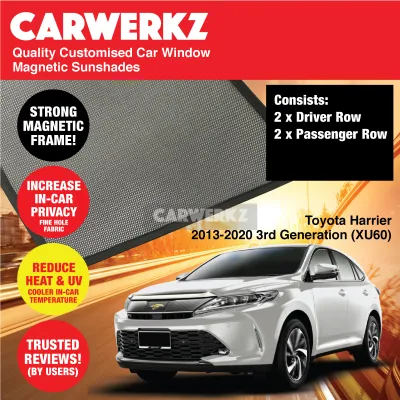
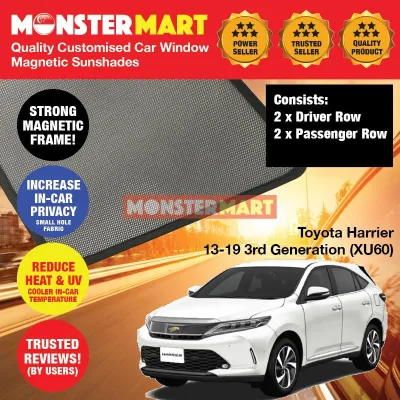
Prices are valid at publication and may change. Please refer to the product page for the latest price.
The side windows of the XU60 present a similar challenge. Moving from the front doors to the rear, the window line tapers upward, creating non-standard geometric shapes. Universal side shades, which are typically square or oval, cannot conform to these shifting angles. They either leave large sections of the glass exposed or overlap awkwardly with the interior door trim, preventing a secure fit. This lack of coverage defeats the purpose of installing shades, as even small gaps can allow enough solar radiation to enter and significantly raise the cabin’s ambient temperature.
Leaving these gaps unprotected has serious consequences for the Harrier’s premium cabin. The XU60 features high-quality soft-touch plastics, synthetic or genuine leather upholstery, and delicate electronic displays that are highly susceptible to UV degradation. Over time, prolonged exposure to intense solar radiation causes dashboard materials to dry out, fade, and eventually crack. It can also lead to the premature aging of leather seats and steering wheel covers. Furthermore, the greenhouse effect inside an unprotected cabin can drive interior temperatures to extreme levels, putting additional strain on your air conditioning system when you start the vehicle. To prevent this, owners should measure their specific window frames or cross-reference official vehicle schematics if a seller’s listed dimensions seem vague or generic.
How to Verify Material and Heat Protection Claims
When shopping for custom-fit sun shades, you will encounter a wide array of materials, each offering different levels of thermal insulation and light blockage. Reflective foil shades, often constructed with a double-sided aluminum layer over a bubble or foam core, are highly effective at bouncing solar radiation away from the vehicle. These shades act as physical radiant barriers, significantly reducing the transfer of heat through the glass. However, they are typically rigid and must be rolled or folded into large panels, which can take up considerable storage space in your Harrier’s cabin.

Collapsible fabric shades, usually made from high-density nylon or polyester stretched over a flexible spring-steel frame, offer a more compact alternative. These shades can be twisted and folded down into small discs that easily fit into the door pockets or the glove compartment. While highly convenient, their heat-rejection capabilities depend heavily on the density of the fabric weave and the presence of specialized reflective coatings. Some premium fabric options utilize multi-layered construction with a black out-facing layer to absorb light and a silver inner-facing layer to reflect heat, providing a balanced solution.
For the side windows, magnetic mesh shades are a popular choice. These shades use a fine mesh fabric that blocks a portion of incoming sunlight while still allowing some visibility. They are excellent for passenger comfort during transit, but they do not offer the total light blackout provided by solid reflective materials. When selecting mesh shades, pay attention to the density of the mesh; a tighter weave offers better UV protection but may slightly reduce visibility.
To cut through marketing jargon, you must look for verifiable product labels and manufacturer specifications. Reliable manufacturers will provide clear ratings for UV rejection (often expressed as a percentage, such as 99% UV blockage) and Infrared (IR) rejection, which is the primary driver of solar heat. Look for standardized testing certifications on the product packaging, such as UPF (Ultraviolet Protection Factor) ratings. Avoid products that make vague claims like “maximum heat reduction” without providing concrete material specifications or testing standards.
Additionally, consider how the thickness and layering of the material affect daily usability. A thicker, multi-layered shade will generally offer superior thermal insulation, but it will also be heavier and more cumbersome to install and store. Balance your need for maximum heat rejection with the practical realities of folding and stowing the shade within your Harrier’s interior. If space is at a premium, a high-density collapsible fabric shade may be more practical than a bulky roll-up foil option.
Choosing Safe and Secure Attachment Mechanisms
The method used to secure your sun shades is critical for both convenience and safety. Friction-fit shades are designed to match the exact perimeter of the window frame, allowing them to stay in place simply through tension and the support of the vehicle’s built-in sun visors. This is often the cleanest solution for the front windshield, as it requires no adhesives, suction cups, or additional hardware. The precise cut of a custom-fit shade ensures it wedges snugly into the window frame without slipping.
For side windows, magnetic frames are highly popular. These shades feature small, powerful magnets sewn into the fabric border, which cling directly to the metal window frame of the door. This allows for incredibly fast installation and removal. However, you must verify that your Harrier’s window frames have exposed metal surfaces; if the interior trim completely covers the metal frame with plastic or leather, magnetic shades will not hold securely. In such cases, clip-on or friction-fit mesh shades are a better alternative.
Suction cups and static-cling films are alternative options, but they come with distinct drawbacks. Suction cups can lose suction over time due to temperature fluctuations and can leave unsightly circular residue marks on the glass. Static-cling shades require a perfectly clean window surface to adhere properly and can peel off at the corners if exposed to moisture or dust. Furthermore, repeated application and removal can degrade the cling properties of the film.
Safety must be your primary consideration when installing any interior accessory. The Toyota Harrier XU60 is equipped with advanced safety features, including the Toyota Safety Sense suite. This system relies on a camera and sensor pod mounted on the windshield behind the rearview mirror. Your front sun shade must be designed with a precise cutout to accommodate this sensor housing. A poorly fitting shade that presses against or covers this pod can misalign the camera, block the sensors, or damage the delicate mounting bracket.
Furthermore, never use opaque or highly restrictive shades on the front windshield or front side windows while the vehicle is in motion. Doing so severely obstructs your view of the road, side mirrors, and blind spots, creating an immediate safety hazard and violating local traffic laws. Ensure that any side window shades used while driving are made of high-visibility mesh and do not interfere with your line of sight. Avoid using unverified adhesives or strong aftermarket magnetic strips on the window glass or rubber weather stripping, as these can permanently damage window tints, degrade the rubber seals, or interfere with the operation of power windows.
Pre-Purchase Checklist for Exact Fitment
Before finalizing your purchase of custom-fit sun shades for your Toyota Harrier XU60, go through this systematic checklist to ensure a perfect fit and avoid the hassle of returns:
First, confirm the vehicle generation. Double-check that the product is explicitly labeled for the Toyota Harrier XU60 generation (model years 2013 to 2020). Shades designed for the older XU30 (2003–2013) or the newer XU80 (2020–present) will not fit, as the window dimensions and windshield angles are completely different. Even a minor discrepancy in the model year can result in a shade that is either too small, leaving gaps, or too large, causing it to buckle.
Second, account for facelift variations. The XU60 underwent a mid-cycle facelift in 2017. While the overall glass dimensions remained largely the same, changes were made to the front grille, headlights, and, crucially, the safety sensor housing behind the rearview mirror. Ensure the shade’s cutout matches your specific model year’s sensor configuration to avoid physical interference with the camera pod.
Third, evaluate the attachment method. Confirm whether your vehicle’s door frames have exposed metal for magnetic shades, or if you will need friction-fit or clip-on options. If you have aftermarket window tint installed, avoid suction cups or harsh adhesives that could peel or scratch the tint film upon removal.
Fourth, review the seller’s return policy. Only purchase from reputable sellers or online marketplaces that offer a clear, hassle-free return policy specifically covering fitment issues or manufacturing defects. If the shade arrives with edge gaps or saggy frames, you should be able to return it for a full refund or exchange without incurring high return shipping fees.
Fifth, analyze customer feedback. Look closely at verified buyer reviews. Search for keywords like “Harrier,” “XU60,” “fitment,” “sagging,” or “gaps.” Pay attention to any photos uploaded by customers showing the shades installed in an actual Harrier cabin to verify real-world coverage and quality.
Finally, check for sun visor and dashboard clearance. Ensure the front windshield shade does not interfere with the operation of your sun visors, dashcam mountings, or dashboard-mounted accessories. A well-designed custom shade should fold neatly around your dashcam without displacing it.
Frequently Asked Questions (FAQ)
Can I use sun shades designed for other Toyota SUVs on the Harrier XU60? (FAQ)
No, you should avoid using sun shades designed for other Toyota SUVs, such as the RAV4 or Fortuner, on your Harrier XU60. Even though these vehicles may share some platform elements or design languages, their glass geometries, windshield rakes, and window frame dimensions are distinct. Attempting to use a non-specific shade will inevitably result in edge gaps, light leaks, or physical interference with the rearview mirror and safety sensor pods. To ensure maximum heat rejection and a clean aesthetic, always purchase shades engineered specifically for the XU60 chassis.
Do custom-fit side window shades interfere with rolling down the windows? (FAQ)
This depends entirely on the design of the shade and whether the vehicle is stationary or in motion. Magnetic mesh shades that attach to the metal frame of the door frame (rather than the glass itself) allow you to roll down the window glass freely while keeping the shade in place, providing shade and ventilation. However, static-cling shades or those that attach directly to the glass via suction cups will move with the window and can get jammed inside the door panel if you roll the window down. For safety and mechanical preservation, always remove any glass-attached shades before operating your windows, and never drive with opaque shades on the front side windows.

Community discussion
Share your experience or ask a question. Comments are reviewed before publication.