
Selecting the best digital pressure gauge for your car and motorcycle requires looking beyond generic marketing claims and focusing on the technical compatibility between the tool and your vehicles. The ideal gauge is one that matches the specific pressure ranges of your tires, fits easily onto your valve stems despite tight wheel clearances, and provides verifiable accuracy under real-world conditions. Rather than relying on a single universal recommendation, you must evaluate the physical design and technical specifications of available models against the requirements detailed in your vehicle owner’s manuals.
Tires are the only contact point between your vehicle and the road, making precise pressure maintenance a fundamental safety practice. Inconsistent or incorrect tire inflation directly compromises braking distances, cornering stability, and tread life. By choosing a gauge with the correct pressure limits, chuck design, and display features, you ensure that routine safety checks are both convenient and highly accurate.
Key Specifications to Check Before Buying a Digital Pressure Gauge
Before purchasing any digital tire pressure gauge, you must verify its core technical specifications on the product packaging or manufacturer’s official specification sheet. The first and most critical parameter is the maximum pressure range limit. Most passenger cars require cold tire pressures between 30 and 40 PSI, while motorcycles typically operate within a similar or slightly higher range. However, some heavy-duty vehicles or specialized tires require much higher pressures. You must ensure the gauge’s maximum rated limit comfortably exceeds your tires’ maximum cold pressure to prevent over-pressurizing and permanently damaging the internal digital sensor.
Products mentioned in this guide
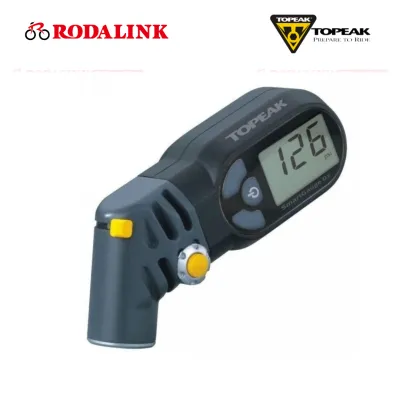
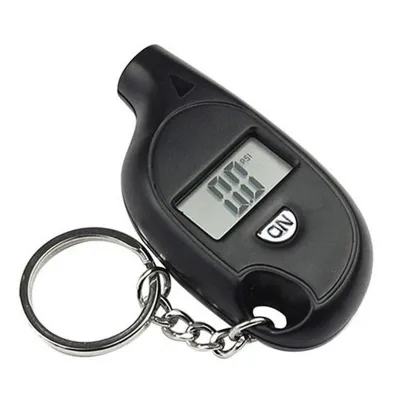
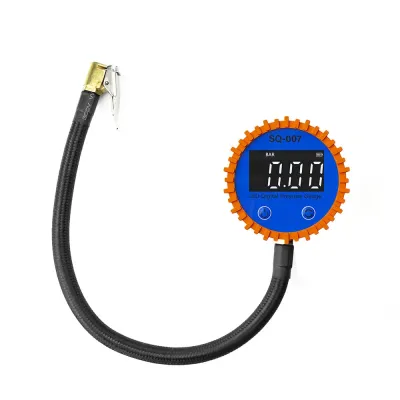
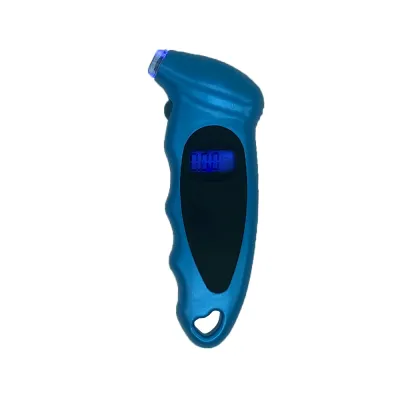
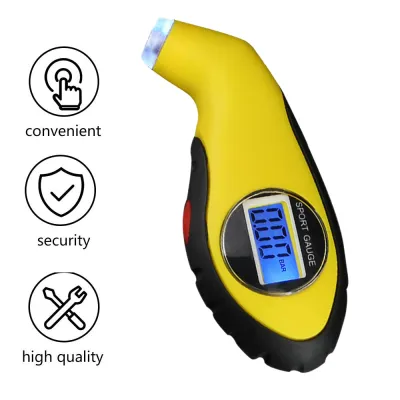
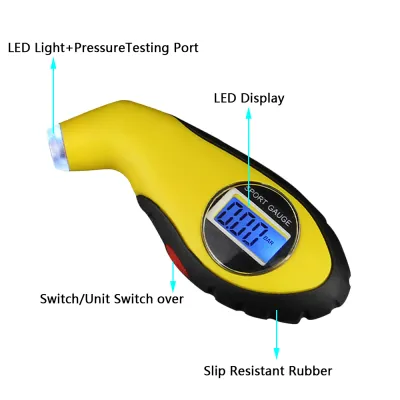
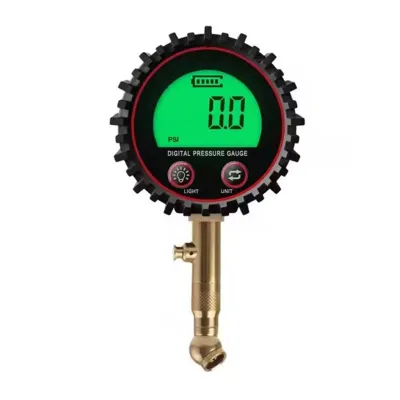
Prices are valid at publication and may change. Please refer to the product page for the latest price.
Measurement units are another essential specification to cross-reference with your vehicle’s documentation. While PSI (pounds per square inch) is widely used, many vehicle manufacturers specify recommended pressures in bar or kPa (kilopascals). To avoid manual conversion errors, look for a digital gauge that features a unit-switching button, allowing you to toggle between PSI, bar, and kPa. This ensures you can read the measurement in the exact unit printed on your vehicle’s tire information placard, which is typically located on the driver’s side door pillar or inside the fuel filler flap for cars, and on the swingarm or chain guard for motorcycles.
Display readability is highly dependent on your typical usage environment. If you frequently check your tires in dimly lit areas, such as multi-storey car parks or residential garages, a high-contrast digital screen is indispensable. Look for manufacturer specifications that explicitly mention an integrated LED or LCD backlight. The display should remain legible from various angles, allowing you to read the pressure clearly even when crouching in tight spaces around the wheels.
Power management features directly impact the long-term reliability of a digital gauge. Unlike mechanical analog gauges, digital models rely on internal batteries to power the sensor and display. Check the product specifications to identify the battery type required, such as standard AAA batteries or button cells, and consider how easily you can source replacements. Additionally, verify if the device includes an automatic shutoff function. This feature automatically powers down the screen after a brief period of inactivity, preventing the battery from draining completely if the gauge is accidentally left on inside your glovebox or tool bag.
Matching the Gauge Design to Cars and Motorcycles
The physical layout of car and motorcycle wheels differs significantly, meaning a gauge design that works perfectly for one vehicle may be highly impractical for the other. Valve stem accessibility is often the greatest challenge when checking motorcycle tires. Motorcycle wheels frequently feature large brake discs, drive chains, and closely spaced spokes that leave very little physical clearance around the valve stem. A straight, rigid digital gauge may not fit between these components. To resolve this, look for a gauge equipped with a 90-degree angled head or a flexible rubber hose extension, which allows you to access the valve stem from a comfortable angle without bending or damaging the valve.

The chuck mechanism—the part of the gauge that connects directly to the tire valve—also requires careful consideration based on your wheel design. Push-on chucks require you to hold the gauge firmly against the valve stem throughout the measurement, which is highly effective if you have a clear, straight path to the valve. Clip-on or screw-on chucks, on the other hand, lock securely onto the valve threads. This hands-free connection is particularly useful for deep-dish car wheels or complex motorcycle rims, as it prevents air leakage while you position yourself to read the digital display.
Portability requirements vary depending on where you plan to store the tool. For car owners, a slightly larger gauge can easily be kept in the glove compartment, door pocket, or trunk organizer. For motorcyclists, however, storage space is extremely limited. If you plan to carry the gauge on rides, look for a compact, lightweight design that fits easily into an under-seat storage compartment, a tank bag, or a portable tool roll. The housing should be streamlined, without protruding parts that could snag or break when packed tightly alongside other tools.
Finally, you must consider the pressure nuances between different tire types. While both cars and motorcycles generally operate within moderate pressure ranges, some smaller scooters or specialized motorcycle tires may require lower or higher pressures than standard passenger cars. Ensure the digital gauge you select has a minimum readable limit low enough to register lower pressures accurately, as some high-pressure industrial gauges may fail to provide precise readings at the lower end of their scale.
How to Evaluate and Compare Available Digital Gauges
When comparing different digital pressure gauges on online marketplaces or in automotive specialty stores, you should rely on verifiable manufacturer specifications rather than subjective marketing claims. Start by evaluating the stated accuracy tolerances. Reputable manufacturers will print an accuracy rating on the product packaging or in the user manual, often expressed as a percentage (e.g., ±1%) or a specific pressure value (e.g., ±0.5 PSI) across a defined temperature range. Avoid gauges that do not disclose their accuracy tolerances, as they may use lower-grade sensors that drift over time.
Build quality and environmental resistance are critical for tools used in outdoor or garage settings. Look for gauges that feature a protective rubber sleeve or housing designed to absorb shocks from accidental drops on concrete floors. If you plan to use the gauge in wet weather or dusty environments, check for an Ingress Protection (IP) rating. An IP rating, such as IP54, indicates that the device has been tested to resist dust entry and water splashes, ensuring the sensitive internal electronics remain protected during outdoor roadside checks.
Calibration and warranty terms provide a clear indication of a manufacturer’s confidence in their product’s durability. Review the warranty period offered, and check if the manufacturer provides instructions or services for recalibration. Over years of use and exposure to temperature fluctuations, all digital sensors can experience minor calibration drift. A manufacturer that outlines a clear process for verifying or resetting the gauge’s zero point offers a more sustainable long-term tool than one that must be discarded when readings become inconsistent.
Lastly, always confirm the availability of a comprehensive user manual. A proper manual should provide clear operational instructions, battery replacement steps, and safety warnings. It should also outline the specific error codes the device might display. Access to this documentation, whether printed in the box or downloadable from the manufacturer’s official website, ensures you can troubleshoot minor issues and operate the tool safely without guessing.
Ensuring Accurate Readings and Maintaining Your Gauge
To get the most out of your digital pressure gauge and maintain its accuracy over time, you must follow correct measurement and maintenance procedures. Always measure tire pressure when the tires are cold. In warm tropical climates like Singapore, ambient temperatures remain relatively consistent throughout the day, but driving even a short distance heats up the air inside the tire, causing it to expand and temporarily increasing the internal pressure. For the most accurate results, check the pressure before driving the vehicle, or at least three hours after it has been parked. This ensures the readings match the cold inflation pressures recommended by your vehicle’s manufacturer.
Proper chuck seating is essential to prevent air loss during measurement. When placing the gauge onto the valve stem, press it down firmly, quickly, and squarely. If you hear a continuous hissing sound, air is escaping around the seal, which will result in an inaccurate, lower reading. Re-align the chuck and press again until the hissing stops and the digital display locks onto a stable reading.
Protecting the internal sensor is vital for preserving the gauge’s calibration. The small measurement port inside the chuck is highly sensitive to dirt, moisture, and debris. Always ensure your tire valve stems are clean and fitted with valve caps to prevent road grime from entering the gauge during use. When not in use, store the digital gauge in a dedicated protective case or pouch, away from extreme heat, direct sunlight, and high humidity, which can degrade the battery and electronic components.
You must establish clear stop conditions to ensure safety. If the gauge displays an error code, fails to return to zero when removed from the valve, or shows visible cracks in the housing, cease using it immediately. Using a damaged or uncalibrated gauge can lead to severe under-inflation or over-inflation, both of which compromise your vehicle’s road safety. In such cases, consult the manufacturer’s troubleshooting guide or replace the unit to ensure your safety checks remain reliable.
Frequently Asked Questions (FAQ)
Can I use the same digital pressure gauge for both my car and motorcycle?
Yes, you can use the same digital pressure gauge for both vehicles, provided the gauge’s technical specifications and physical design accommodate both. First, verify that the gauge’s rated pressure range fully covers the recommended cold tire pressures for both your car and motorcycle. Second, ensure the physical design of the chuck or hose attachment can easily access the motorcycle’s valve stems—which are often obstructed by spokes or brake discs—without forcing or bending the valve assembly.
How often should I calibrate my digital tire pressure gauge?
You should follow the specific calibration interval or replacement schedule outlined in your gauge’s user manual. For general consumer use, verifying the gauge’s accuracy once a year against a known reliable reference, such as a professional gauge at a reputable service center, is a practical step. If the device fails to read zero when disconnected, displays inconsistent readings, or has been subjected to a hard drop, stop using it and seek professional verification or replacement.
Does a digital pressure gauge need to be reset after measuring high pressure?
Refer to your specific device’s user manual for any required power-cycle or reset procedures. For most modern digital gauges, measuring standard automotive and motorcycle pressures within the manufacturer’s rated limits does not require a manual sensor reset. The gauge’s internal microchip typically resets the sensor to zero automatically when the device is powered off and on again, or when it detects atmospheric pressure after being removed from the valve stem.

Community discussion
Share your experience or ask a question. Comments are reviewed before publication.