
Finding the right full-surround floor mats for the Honda Freed depends entirely on matching the mat’s precise molding to your vehicle’s specific generation, seating layout, and drivetrain. Because the Freed has undergone multiple design iterations—such as the popular second-generation GB5/GB6 petrol and GB7/GB8 hybrid models—a generic “one-size-fits-all” approach will fail. The ideal brand is one that offers dedicated 3D-scanned designs tailored to your exact chassis code, ensuring that the high edges do not obstruct the sliding door mechanisms, seat tracks, or, most importantly, the driver’s pedals.
In Singapore’s tropical climate, where sudden downpours are common, full-surround mats are highly sought after to protect the cabin floor from water, mud, and humidity. However, because the Freed’s interior is highly modular, choosing a brand requires a systematic comparison of fitment accuracy, material stability, and safety compliance. Rather than relying on brand names alone, owners must evaluate how well a manufacturer accounts for the Freed’s unique floor pan variations, particularly between petrol models and hybrid variants where the high-voltage battery pack alters the floor profile under the front seats.
Identifying Honda Freed Cabin Challenges for Floor Mats
The Honda Freed features a low, flat floor with sliding doors on both sides. The step-in height is exceptionally low, meaning the floor mats must sit perfectly flush near the door sills. If a full-surround mat has an excessively thick edge or a poorly molded lip near the sliding door entry, it can catch on the bottom of the door or obstruct the lower guide rollers. This can cause the automatic sliding doors to detect an obstacle and reverse, or worse, strain the electric door motors over time.
Products mentioned in this guide
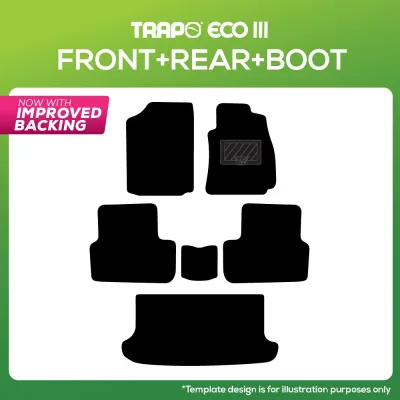
Prices are valid at publication and may change. Please refer to the product page for the latest price.
Seating configurations also play a massive role in floor coverage. The Freed is available in various layouts, most notably the 6-seater version with second-row captain seats and a walk-through aisle, and the 7-seater version with a 60:40 split-folding second-row bench. A mat designed for a 7-seater will not cover the central aisle of a 6-seater, while a 6-seater mat will have excess material that cannot be tucked away in a 7-seater. Furthermore, the sliding tracks for the second-row seats require precise cutouts. If the mat material is too stiff or wide, it will bunch up when the seats are slid forward or backward, restricting the cabin’s modularity.
Finally, the third-row folding mechanisms and under-seat storage rails require precise mat cutouts. The third-row seats in the Freed fold up against the side windows, and the mounting brackets and latch points on the floor must remain completely unobstructed. Additionally, some models feature under-seat storage or rear air-conditioning ducting on the floor. Full-surround mats must feature precise, heat-molded recesses or cutouts that align perfectly with these elements without exposing large areas of the original carpet to dirt and moisture.
Core Criteria to Compare Full-Surround Mat Brands
The primary appeal of full-surround mats is their raised vertical walls, but these walls must be rigid enough to retain their shape over years of use while remaining flexible enough not to interfere with seat adjustment levers. Compare brands based on the structural integrity of their side walls. High-quality options use thermoplastic elastomers (TPE) or reinforced multi-layer synthetic leather that stands upright without sagging, ensuring spills are contained within the tray rather than seeping onto the factory carpet.

Honda vehicles utilize specific floor anchor pegs to keep the driver’s mat from sliding forward. Any reputable mat brand must feature matching eyelets or retention clips that lock securely onto these factory anchors. When comparing brands, verify whether they provide custom-molded mounting points that align perfectly with the Freed’s floor pegs. Avoid brands that rely solely on generic hook-and-loop fasteners or friction backings, as these can degrade over time and allow the mat to slip under the pedals.
The floor pan of the Freed has complex contours, especially around the footrests, center console base, and seat pedestals. Rigid materials may lift or create air pockets underneath, which reduces foot room and creates tripping hazards. Look for brands utilizing high-precision 3D laser scanning to map the floor pan. Materials like high-density TPE offer an excellent balance of flexibility, durability, and water resistance, making them ideal for humid environments where damp carpets can quickly lead to mold and unpleasant odors.
The Honda Freed has distinct generations, such as the first-generation GB3/GB4/GP3 and the second-generation GB5/GB6/GB7/GB8. A common mistake is purchasing a mat labeled simply for “Honda Freed” without verifying the chassis code. Hybrid models (GP3, GB7, GB8) have a different floor topography compared to their petrol counterparts due to the placement of the hybrid battery under the front seats. Ensure the brand explicitly distinguishes between these chassis codes in their product catalog.
How to Verify Brand Compatibility Before Purchase
Before committing to a purchase, obtain the manufacturer’s official fitment catalog or specification sheet. Cross-reference your vehicle’s logbook or chassis plate (usually located on the door pillar or under the bonnet) to identify your exact model code. If a brand’s compatibility list groups all Freed models from 2016 to the present under a single product SKU, treat this as a warning sign. True full-surround fitment requires separate SKUs for petrol and hybrid variants.
Carefully read the product descriptions on retail or manufacturer websites. Look for specific exclusions such as “does not fit hybrid models” or “only compatible with 6-seater captain chair configuration.” If you are purchasing from an online marketplace, use the platform’s inquiry tool to ask the seller directly about the layout of the second and third rows. Requesting actual photos of the mats installed in a matching Freed variant can help you verify if the cutouts for the seat rails and seatbelt mounts are correctly positioned.
Customer reviews on local automotive forums, social media owner groups, and ecommerce platforms provide invaluable real-world data. Look specifically for feedback regarding edge curling, gaps along the door sills, and difficulty during installation. If multiple users report that they had to trim the mat with scissors to get it to fit around the seat tracks or that the sliding doors rub against the mat edges, it indicates poor manufacturing tolerances. A well-designed full-surround mat should drop into place with minimal manipulation.
Safety and Installation Checks for Full-Surround Mats
The most critical safety aspect of any aftermarket floor mat is its relationship with the driver’s pedals. Before driving, install the driver’s side mat and manually depress both the accelerator and brake pedals to their absolute limits. There must be a clear, unobstructed gap between the pedals and the edge of the mat throughout their entire range of motion. If the mat is too thick or sits too high in the footwell, it can catch the edge of the pedal, leading to dangerous unintended acceleration or restricted braking force.
Never overlay a new full-surround mat on top of existing carpet or rubber mats. Always remove the factory floor mats entirely before installing the new set. Ensure the retention clips on the driver’s mat are firmly locked into the vehicle’s floor anchors. If your Freed’s factory anchors are damaged or missing, consult a qualified professional to have them replaced before installing any floor mats. A loose mat can shift forward during sudden braking, trapping the pedals and compromising vehicle control.
After installing the rear mats, slowly slide the second-row seats through their full range of travel. Check that the seat runners do not pinch, tear, or bunch up the mat material. Next, operate the sliding doors—both manually and using the power function—to ensure the bottom edge of the door clears the mat’s outer lip. If you hear any rubbing sounds or if the power door safety reverse mechanism is triggered, remove the mat immediately. Do not attempt to modify or trim safety-critical areas of the mat yourself; instead, contact the manufacturer or seek professional installation assistance to ensure road legality and passenger safety.
Frequently Asked Questions (FAQ)
Do full-surround mats interfere with the Honda Freed's sliding doors?
Poorly fitted or excessively thick full-surround mats can interfere with the Honda Freed’s sliding doors. Because the step-in height is low, the clearance between the bottom of the sliding door and the cabin floor is minimal. If the mat’s outer lip is too high, too thick, or fails to sit flush against the door sill, the door may rub against the mat. This friction can damage the mat, scratch the door’s inner trim, or trigger the automatic door’s safety auto-reverse mechanism. Always verify that the mat lies completely flat along the door sills and does not obstruct the lower guide tracks.
Can I use generic full-surround mats if they claim to fit the Honda Freed?
It is highly discouraged to use generic full-surround mats, even if the seller claims they are compatible with the Honda Freed. Generic mats are designed to fit a wide range of vehicles and lack the precise 3D-scanned contours required to clear the Freed’s unique floor layout, sliding seat tracks, and hybrid battery humps. Furthermore, generic mats rarely align with the factory floor retention anchors on the driver’s side, posing a severe safety risk if the mat slips forward and jams the pedals. For safety, proper fitment, and complete coverage, always choose mats specifically molded for your Freed’s exact chassis code and seating configuration.

Community discussion
Share your experience or ask a question. Comments are reviewed before publication.