
Selecting the right car air pump requires balancing the pump’s maximum pressure capacity (measured in PSI) with its flow rate (measured in CFM or L/min) to match your vehicle’s tire dimensions. Standard passenger vehicles like sedans and compact hatchbacks generally require moderate pressures (30 to 35 PSI) and low air volumes, making them highly compatible with compact 12V plug-in or handheld cordless pumps. Conversely, large SUVs, MPVs, and off-road vehicles feature high-volume tires that require high-flow-rate pumps, such as heavy-duty direct-to-battery models, to complete inflation within a reasonable timeframe without overheating the motor.
To ensure safe operation and longevity, a pump’s maximum rated PSI should always comfortably exceed your tire’s target inflation pressure. Operating a compressor near its absolute engineering limit causes excessive heat and rapid motor wear. By matching your vehicle type to the appropriate power source, flow rate, and duty cycle, you can secure a reliable tool that keeps your tires properly inflated, ensures optimal fuel efficiency, and provides peace of mind during roadside emergencies.
Identify Your Tire's PSI and Volume Requirements
Before shopping for a car air pump, you must identify the precise inflation specifications of your vehicle’s tires. Many drivers mistakenly look at the maximum pressure rating molded into the tire’s sidewall. This number represents the absolute maximum pressure the tire can safely hold under maximum load, not the correct daily operating pressure for your specific vehicle.
Products mentioned in this guide
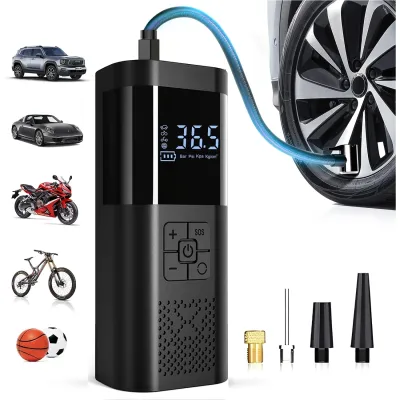
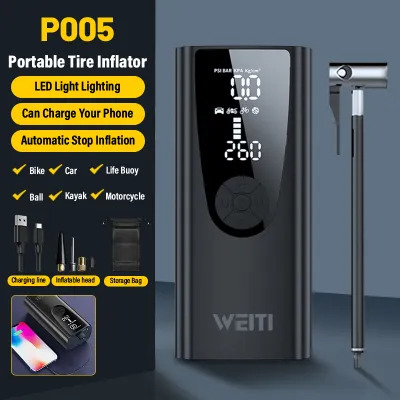
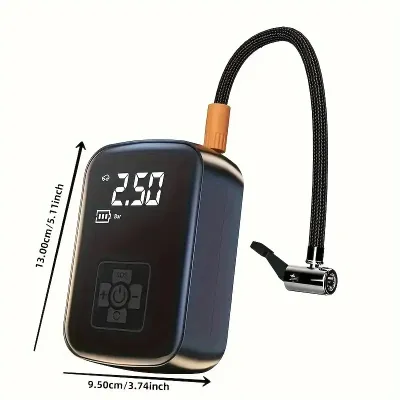
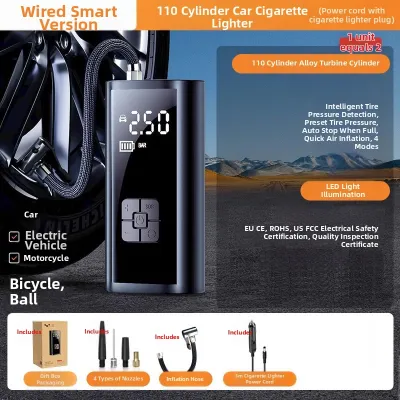
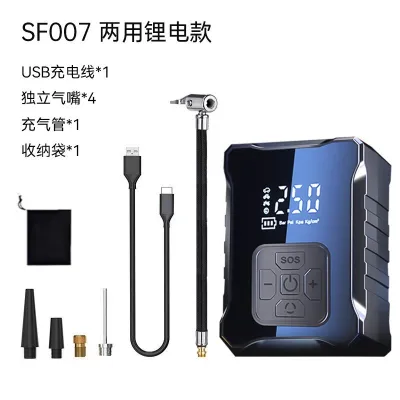
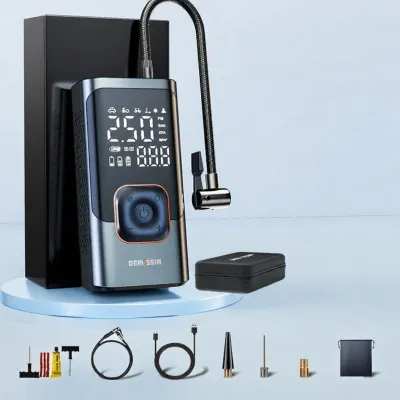
Prices are valid at publication and may change. Please refer to the product page for the latest price.
Instead, locate the recommended cold tire pressure specified by your vehicle manufacturer. This is typically printed on a placard or sticker on the driver’s side door jamb, inside the fuel filler flap, or detailed in the owner’s manual. For most passenger cars, this value ranges between 30 and 36 PSI, while larger commercial vehicles or heavy SUVs may require 40 PSI or higher.
While target pressure determines the force needed, tire volume determines the total amount of air required. Tire volume is governed by the tire’s physical dimensions: its width, aspect ratio, and rim size (for example, 225/55R17). A wider tire with a taller sidewall holds significantly more air than a low-profile tire on a compact hatchback, even if both require the exact same operating pressure of 32 PSI.
Inflating a high-volume tire with a low-capacity pump takes a long time. If the pump’s flow rate is too low for the tire’s volume, the motor may run continuously for 15 to 20 minutes, exceeding its thermal limits and risking permanent damage.
In Singapore’s tropical climate, temperature management is critical when assessing tire pressure. High ambient temperatures and solar radiation heating the asphalt can cause tire pressures to rise by 3 to 5 PSI during driving. Always check and inflate your tires when they are “cold”—meaning the vehicle has been parked in the shade or a sheltered multi-storey car park for at least three hours, or driven less than 1.6 kilometres. Checking hot tires will yield false high readings, leading to under-inflation once the tires cool down.
Compare Car Air Pump Types by Power and Performance
Car air pumps are broadly categorised by how they draw power. This design choice directly dictates their performance, portability, and suitability for different tire sizes.

12V Plug-In Portable Pumps
These classic portable inflators plug directly into your vehicle’s 12V auxiliary power outlet (commonly known as the cigarette lighter socket). Because they draw power directly from your car’s electrical system, you do not have to worry about charging an internal battery before use. They are highly reliable emergency tools that can sit in your boot for months, ready to deploy at a moment’s notice.
However, these units are limited by the electrical capacity of your car’s 12V socket. Most vehicle accessory circuits are protected by a 10-ampere or 15-ampere fuse. To prevent blowing this fuse, manufacturers must limit the draw of the pump’s motor, which inherently restricts the flow rate. Additionally, you are physically constrained by the length of the power cable; you must ensure the cord can reach from the dashboard outlet to all four wheels.
- Ideal User: Owners of standard sedans, hatchbacks, and compact crossovers who want a compact, budget-friendly emergency tool for occasional pressure top-ups.
Battery-Powered Cordless Pumps
Cordless pumps rely on rechargeable lithium-ion batteries, making them entirely self-contained. Without any power cords to untangle or stretch, you can move freely around the vehicle. Many models feature compact, handheld designs resembling a power tool or a large smartphone, making them highly portable and easy to store in a glove compartment or side door pocket.
The primary drawback of cordless pumps is battery maintenance. Lithium-ion batteries naturally lose charge over time and can degrade if left in a hot car boot in Singapore’s high ambient temperatures. Furthermore, inflating a completely flat, high-volume tire requires substantial energy; a cordless pump’s battery may drain completely or overheat before completing a full set of four tires.
- Ideal User: Tech-savvy drivers who value cable-free convenience, drive smaller vehicles, and want a single, versatile tool to inflate bicycle tires, sports equipment, or inflatable leisure items.
Heavy-Duty Direct-Battery Pumps
For high-volume tires, heavy-duty pumps connect directly to your vehicle’s 12V battery terminals using heavy-duty alligator clips. By bypassing the restrictive cabin fuse box, these pumps can draw 30 amperes of current or more. This massive power draw allows for larger, more robust motors and dual-cylinder compressors that deliver exceptionally high flow rates.
The trade-off for this performance is size, weight, and convenience. These pumps are bulky, heavy, and require you to pop the bonnet and clamp the leads onto the battery terminals every time you use them. They are also generally more expensive, typically starting from around S$80 to over S$200 for premium off-road brands.
- Ideal User: Owners of large SUVs, off-road 4x4s, pickup trucks, and commercial vans who frequently need to inflate large-volume tires quickly or adjust pressures for off-road driving.
Evaluate Core Specifications: Maximum PSI vs. Flow Rate
When shopping for a car air pump, you will encounter various technical specifications on the product packaging. Understanding how these numbers translate to real-world performance will prevent you from buying an inadequate tool.
Maximum PSI
Many budget air pumps prominently display high maximum pressure ratings, such as 120 PSI or 150 PSI. While this sounds impressive, it is often a marketing distraction. Most passenger car tires only require 30 to 35 PSI. The critical factor is not how high the pump can go, but how comfortably it operates at your target pressure.
Operating a pump close to its maximum rated limit puts immense strain on the internal motor and seals. A pump rated for a maximum of 50 PSI will run hot, loud, and slowly when trying to inflate a tire to 35 PSI. Ideally, choose a pump with a maximum rating that is at least double your tire’s recommended pressure. For a standard 35 PSI tire, a pump rated for 100 PSI to 120 PSI provides a safe operating margin, ensuring the motor runs efficiently without premature wear.
Flow Rate (CFM or L/min)
While PSI represents the force of the air, flow rate represents the volume of air delivered over time. This is measured either in Cubic Feet per Minute (CFM) or Litres per Minute (L/min). Flow rate is the single most accurate indicator of how fast a pump will inflate your tire.
A high-PSI pump with a low flow rate (e.g., 15 L/min) will take a very long time to inflate a large SUV tire, even though it is technically capable of reaching the target pressure. For standard passenger cars, a flow rate of 25 to 35 L/min is highly efficient. For large SUVs or light trucks, look for heavy-duty pumps offering 50 L/min to 70 L/min or more to avoid spending 15 minutes standing by the roadside for a single tire.
Duty Cycle
The duty cycle is the amount of time a compressor can operate continuously before it must be turned off to cool down, expressed as a percentage of a 30- or 40-minute period, or simply as a run-time limit. For example, a pump with a “15-minute duty cycle” must be switched off and allowed to cool for 15 minutes after 15 minutes of continuous operation.
Cheaper, smaller pumps often have very short duty cycles (sometimes as low as 5 to 10 minutes). If you try to inflate four large tires sequentially, you will easily exceed this limit, causing the motor to overheat and potentially melt internal components. Always check the manufacturer’s specified duty cycle and ensure it is sufficient to inflate at least two of your tires from flat without needing a cooling break.
Check Essential Safety and Convenience Features
Beyond the core motor specifications, several safety and design features can make the difference between a frustrating roadside experience and a smooth, safe inflation process.
Auto-Shutoff (Preset Pressure)
Modern digital air pumps frequently feature an auto-shutoff function. This allows you to program your desired target pressure (e.g., 32.5 PSI) into the digital display. Once the pump detects that the tire has reached this exact pressure, it automatically shuts off the motor. This prevents dangerous over-inflation, which can compromise handling, increase tire wear, and risk a blowout. It also means you do not have to watch the gauge constantly during operation.
Thermal Protection
Air compression naturally generates significant heat. High-quality pumps are equipped with built-in thermal overload protection. If the internal temperature of the motor rises to a dangerous level, an automatic sensor cuts power to the unit. This safety feature prevents permanent motor burnout and reduces fire risks, which is especially important when operating in hot tropical environments.
Hose and Cord Length
Before purchasing, verify the physical reach of the device. For 12V corded models, calculate the combined length of the DC power cable and the high-pressure air hose. The total reach must comfortably extend from your cabin’s 12V outlet to the rear tires on the opposite side of the vehicle, with enough slack to prevent the cable from being pulled taut. For larger family MPVs or long-wheelbase SUVs, a combined reach of at least 4 to 5 metres is highly recommended.
Gauge Type and Lighting
A pump’s pressure gauge must be highly accurate and easy to read. Digital gauges with backlit LCD screens are generally preferred over traditional analog dial gauges, as they display precise decimal readings and are easier to read in low-light conditions. Additionally, look for a pump with an integrated LED work light. If you suffer a puncture at night along a poorly lit stretch of the road or in a dark basement car park, a bright built-in light is invaluable for illuminating the tire valve and surrounding work area.
Final Decision Framework: Choose the Right Pump for Your Vehicle
To make your final decision, match your specific vehicle type and driving habits to the correct pump category. Use this structured framework to guide your purchase:
Choose a 12V Portable Pump if:
- You drive a standard hatchback, sedan, or compact crossover (e.g., Honda Civic, Toyota Corolla, or Mazda CX-30).
- You want a compact, low-maintenance emergency tool that can live permanently in your spare tire well.
- You only need to perform occasional monthly pressure top-ups or handle minor punctures.
Choose a Cordless Battery Pump if:
- You value maximum convenience and dislike managing tangled power cords.
- You own a compact vehicle and also want to inflate bicycle tires, motorcycle tires, or sports equipment.
- You are disciplined enough to regularly check and recharge the unit's battery every few months.
Choose a Heavy-Duty Direct-Battery Pump if:
- You drive a large SUV, MPV, pickup truck, or off-road vehicle (e.g., Toyota Fortuner, Mitsubishi Pajero, or Ford Ranger).
- You frequently carry heavy passenger loads or cargo, requiring precise high-pressure adjustments.
- You require the fastest possible inflation times and a robust motor with a high duty cycle.
Crucial Pre-Purchase Verification Checks:
- Run-Flat Tires: If your vehicle is equipped with run-flat tires (common on many premium European models), be aware that driving on a completely deflated run-flat can cause hidden, irreversible structural damage to the sidewall. Always inspect the tire carefully. If in doubt, consult a professional tire specialist before attempting to reinflate and drive.
- TPMS Calibration: Many modern vehicles feature a Tire Pressure Monitoring System (TPMS). After inflating your tires to the correct pressure, you may need to perform a manual reset procedure via your car's infotainment system to clear any dashboard warning lights. Refer to your owner's manual for the exact calibration steps.
- Manufacturer Protocols: Always check your vehicle's owner's manual for any specific instructions regarding tire inflation, electrical load limits for the 12V socket, or recommended tire pressure variations based on vehicle load.
Frequently Asked Questions (FAQ)
Can I use a standard car air pump to inflate a completely flat run-flat tire?
Yes, a standard car air pump can physically pump air into a run-flat tire, provided the tire bead has not separated from the wheel rim and there is no massive puncture. However, if you have driven on a completely deflated run-flat tire—even for a short distance—the internal structural reinforcement of the tire may be compromised. Reinflating a structurally damaged tire is highly dangerous. Before driving on it, always consult your vehicle manufacturer’s guidelines and have the tire professionally inspected at a qualified workshop to ensure it is safe for continued use.
How often should I check and inflate my tires in Singapore's climate?
You should check your tire pressure at least once a month and always before embarking on long road trips. Singapore’s high ambient temperatures and hot asphalt transfer significant heat to your tires, causing the air inside to expand. This thermal expansion can mask under-inflation if you measure your tires when they are warm. For an accurate reading, always measure and adjust your tire pressure when the tires are completely cold—ideally in the morning before driving, or after the car has been parked in a shaded area for several hours.

Community discussion
Share your experience or ask a question. Comments are reviewed before publication.