
Choosing the right 10W-50 motorcycle oil in Singapore requires a clear understanding of your engine’s specific mechanical demands, local tropical climate conditions, and international performance standards. While several reputable global brands are widely available across local workshops, the most critical factor in your decision must always be compatibility with your motorcycle manufacturer’s exact specifications. Using an incorrect oil formulation can lead to premature engine wear, clutch slippage, or even void your vehicle’s warranty.
Singapore’s year-round high ambient temperatures and dense, stop-and-go traffic place unique thermal and mechanical stress on motorcycle engines. Whether you ride a high-performance sportbike, a large-displacement cruiser, or an air-cooled commuter, selecting a high-quality 10W-50 oil can help manage heat and protect critical internal components. This guide breaks down how to verify if 10W-50 is suitable for your bike, how to decode oil certifications, the differences between synthetic formulations, and how to safely source genuine products locally.
Is 10W-50 the Right Viscosity for Your Motorcycle?
Viscosity is a measure of an oil’s resistance to flow, and the “10W-50” rating refers to its performance under different temperature extremes as defined by the Society of Automotive Engineers (SAE). The first part of the rating, “10W,” represents the oil’s cold-flow properties, where the “W” stands for winter. Even though Singapore does not experience freezing temperatures, a lower winter rating ensures the oil remains sufficiently fluid at startup. This allows the oil pump to quickly circulate the fluid and coat critical engine components during those initial seconds of operation, minimizing startup wear.
Products mentioned in this guide
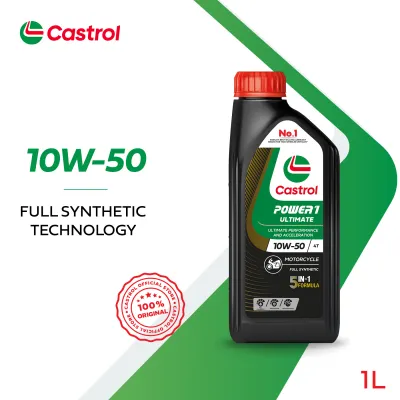
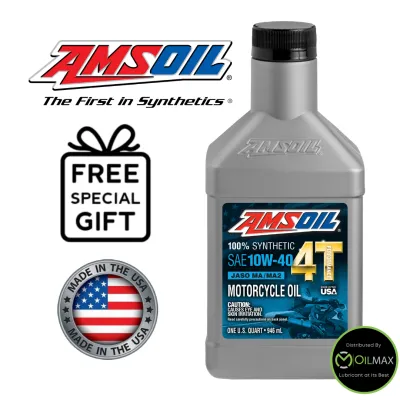
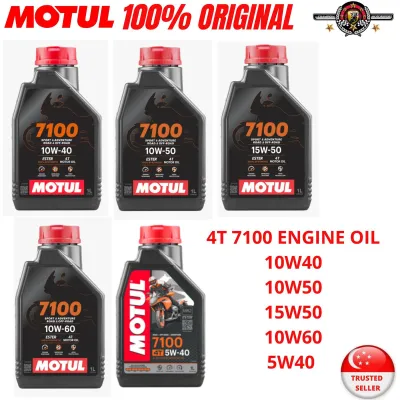
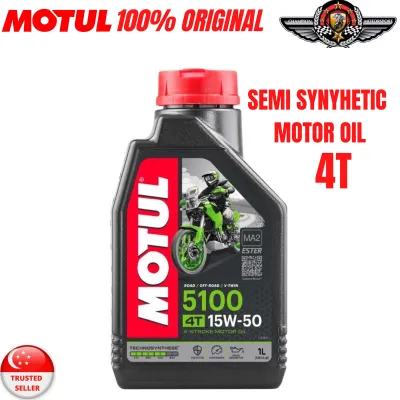
Prices are valid at publication and may change. Please refer to the product page for the latest price.
The second part of the rating, “50,” indicates the oil’s kinematic viscosity at 100°C, which is the typical operating temperature of a warmed-up engine. A higher number means the oil maintains a thicker, more robust protective film under extreme heat. In Singapore’s tropical climate, where ambient temperatures frequently exceed 30°C and engines run hot during prolonged idling at traffic lights or during heavy highway cruising, a 50-weight oil provides excellent shear resistance and prevents the oil film from thinning out excessively.
However, you must never assume that a higher viscosity rating is automatically better for your engine. Always consult your motorcycle’s owner’s manual to verify the manufacturer’s recommended viscosity grades. Using an oil that is thicker than specified can increase internal fluid drag, reduce fuel efficiency, restrict oil flow through narrow passages, and increase operating temperatures. Conversely, using an oil that is too thin may fail to provide an adequate protective barrier, leading to accelerated wear on bearings, pistons, and gear teeth.
Typical use cases for 10W-50 motorcycle oil include high-performance multi-cylinder engines, air-cooled or oil-cooled engines that rely heavily on the lubricant for heat dissipation, and large-displacement adventure or touring bikes. These engines generate substantial internal heat and mechanical loads, making the high-temperature stability of a 10W-50 oil highly advantageous for maintaining oil pressure and protecting moving parts under stress.
Decoding JASO and API Standards for Motorcycle Oil
Unlike passenger car engines, most motorcycles feature a unit construction design where a single oil reservoir lubricates the engine, the gearbox, and the wet clutch system. This multi-functional role requires specialized oil formulations that can handle high-pressure gear shearing while maintaining the precise friction characteristics needed for wet clutch engagement. To ensure an oil is safe for your motorcycle, you must look for specific certifications from the Japanese Automotive Standards Organization (JASO) and the American Petroleum Institute (API).

The JASO T 903 standard is the global benchmark for four-stroke motorcycle oils, classifying them based on their wet clutch friction performance. The primary categories you will encounter are JASO MA, MA1, and MA2. Oils certified under the JASO MA standard are formulated to prevent clutch slippage by delivering specific friction characteristics. JASO MA2 represents the highest friction performance category, specifically designed for high-torque motorcycles to ensure precise clutch engagement, smooth gear shifts, and zero slippage under heavy acceleration. On the other hand, JASO MB oils are low-friction lubricants designed strictly for automatic scooters with dry clutches or continuously variable transmissions (CVTs); using a JASO MB oil in a wet clutch system can cause severe clutch slippage and rapid clutch plate wear.
The API service categories indicate the oil’s chemical performance, oxidation resistance, and wear protection capabilities. These ratings are represented by a two-letter code starting with “S” (such as SG, SH, SJ, SL, SM, SN, or SP), where the second letter progresses through the alphabet to denote newer, more advanced formulations. Modern API standards like SN and SP offer improved deposit control, sludge prevention, and seal compatibility. However, some modern passenger car oils with these ratings contain friction modifiers designed to improve fuel economy, which can ruin a motorcycle’s wet clutch. Therefore, you must always verify that the oil carries both the appropriate API rating and the JASO MA or MA2 certification.
Before purchasing any oil, check the back label of the bottle for the official JASO classification square and the API specification list. Ensure these certifications align precisely with the requirements detailed in your motorcycle’s service manual. Never rely solely on the front label’s marketing claims; the official certification stamps are your only guarantee of compatibility and performance.
Fully Synthetic vs. Semi-Synthetic: Which Formulation Fits Your Ride?
When selecting a 10W-50 oil, you will generally choose between fully synthetic and semi-synthetic formulations. Fully synthetic oils are engineered from highly refined Group III, Group IV (Polyalphaolefins or PAO), or Group V (Esters) base stocks. These synthetic base oils feature uniform molecular structures that provide superior thermal stability, meaning they resist chemical breakdown and oxidation even when subjected to extreme combustion temperatures. They also offer exceptional shear stability, maintaining their 10W-50 viscosity rating despite the intense mechanical chopping action of the motorcycle’s transmission gears.
Semi-synthetic oils, often marketed as synthetic technology or synthetic blends, consist of a mixture of mineral and synthetic base oils. These formulations are designed to offer a balanced, cost-effective solution for daily commuting and moderate riding conditions. While they provide better oxidation resistance and engine protection than pure mineral oils, they generally degrade faster than fully synthetic oils under extreme thermal stress and high-RPM operation.
Choosing between these two formulations involves weighing upfront costs against long-term protection and riding habits. Fully synthetic 10W-50 oils carry a higher initial price per liter, often ranging from S$25 to S$45 depending on the brand and specific product line. However, their superior resistance to thermal degradation can help extend drain intervals (within manufacturer limits) and provide maximum protection for high-revving engines. If your daily route involves heavy stop-and-go traffic on major expressways like the PIE or AYE, or if you frequently take long-distance trips, the investment in a fully synthetic oil is highly justified. For relaxed, short-distance commuting on smaller displacement bikes, a semi-synthetic formulation may be entirely sufficient and more economical.
Recognized 10W-50 Motorcycle Oil Brands Available Locally
Singapore’s motorcycle aftermarket is highly mature, with numerous reputable global lubricant brands widely stocked by local workshops, distributors, and specialty retailers. Understanding the general positioning of these brands can help you narrow down your choices, though you must always verify that the specific product line meets your bike’s required standards.
Motul is highly recognized within the local riding community, particularly for its strong heritage in motorcycle racing. The brand is famous for its ester-based technology, found in premium product lines like the 300V series, as well as its highly popular 7100 fully synthetic range. Motul is generally positioned as a premium, high-performance brand favored by sportbike owners and track day enthusiasts who prioritize maximum thermal stability and engine responsiveness.
Castrol is a household name globally and locally, with its Power 1 range being a common sight in neighborhood workshops across Singapore. Castrol offers both fully synthetic and semi-synthetic 10W-50 options designed to provide reliable wear protection and smooth clutch engagement. The brand is positioned as an accessible, highly dependable choice suitable for a wide variety of daily commuters and touring motorcycles.
Shell is another major player, known for its Advance range of motorcycle lubricants. Shell utilizes gas-to-liquid (GTL) technology in its premium synthetic oils, converting natural gas into a crystal-clear base oil that is virtually free of the impurities found in crude oil. Shell Advance lubricants are widely distributed in Singapore, offering consistent quality, robust deposit control, and excellent availability from major service centers to heartland repair shops.
Liqui Moly, a German brand highly regarded for its specialized additives and premium formulations, offers a dedicated Motorbike line that includes high-quality 10W-50 options. Positioned as a premium, engineering-focused choice, Liqui Moly lubricants are designed to meet stringent European manufacturing standards, offering excellent shear stability and engine cleanliness for demanding riding conditions.
Regardless of which brand you choose, remember that brand reputation does not replace specification matching. Always check the physical bottle to ensure the specific product line carries the exact JASO MA/MA2 and API ratings required for your motorcycle’s make, model, and year.
Where to Buy and How to Avoid Counterfeit Oils
To ensure your engine receives the protection it needs, you must purchase your motorcycle oil from reliable sources. Counterfeit lubricants are a persistent issue globally, and using a fake or substandard oil can lead to catastrophic engine failure, severe clutch slippage, and rapid component wear.
Always purchase your oil through authorized local distributors, reputable physical motorcycle workshops, or official brand stores on established e-commerce platforms. Avoid buying from unverified third-party online sellers who offer prices that are significantly below the standard retail market rate. If a premium fully synthetic oil is being sold at a price that seems too good to be true, it is highly likely to be a counterfeit or expired product.
When inspecting a bottle of motorcycle oil, look for common red flags of counterfeit packaging. These include blurry or low-quality label printing, misaligned stickers, flimsy or poorly molded plastic bottles, and damaged or missing tamper-evident security seals. Genuine products will always feature clear, legible batch numbers, production dates, and country-of-origin markings stamped directly onto the bottle.
Many premium lubricant manufacturers now incorporate advanced security features to help consumers verify product authenticity. These can include unique QR codes, holographic stickers, or scratch-off verification codes on the bottle. Before pouring the oil into your engine, take a moment to scan these codes using the manufacturer’s official mobile application or verification website. If you have any doubts about the authenticity of a product, consult the official local distributor or purchase directly from a well-established, licensed workshop.
Before performing any oil change or maintenance, ensure you consult your vehicle’s original service manual for specific instructions, torque specifications for the drain bolt, and safety precautions. Changing engine oil involves handling hot fluids and components, which carries a risk of burns. Always allow the engine to cool sufficiently, wear appropriate protective gloves and eyewear, and ensure the motorcycle is securely stabilized on a center stand or paddock stand. If you are unsure of the procedure or lack the proper tools, seek assistance from a qualified professional mechanic.
Additionally, used engine oil is hazardous waste. In Singapore, do not dispose of used oil in household trash or pour it down public drains. It must be collected in a sealed container and disposed of at a licensed toxic industrial waste collector or a participating workshop that handles automotive fluid recycling.
Frequently Asked Questions (FAQ)
Can I mix 10W-50 with a different viscosity grade?
Mechanical experts generally advise against mixing different oil viscosities or formulation types, such as mixing a 10W-50 fully synthetic oil with a 10W-40 semi-synthetic or mineral oil. Mixing different oils can alter the overall viscosity of the lubricant and dilute the specialized additive packages of both products. This dilution can compromise the oil’s shear stability, reduce its wear protection capabilities, and negatively affect wet clutch performance.
In an emergency situation where your oil level is dangerously low and the exact 10W-50 formulation is unavailable, topping up with a different viscosity grade is preferable to running the engine dry, which would cause immediate and severe mechanical damage. However, if you must perform an emergency top-up with a different oil, you should schedule a complete oil and filter change as soon as possible to restore the correct, uniform formulation recommended by your manufacturer.
How often should I change 10W-50 fully synthetic motorcycle oil?
The primary and most reliable authority for oil change intervals is your motorcycle’s owner’s manual. Manufacturers design engines with specific tolerances, operating temperatures, and oil life expectations, and their recommended service intervals should always be your baseline.
However, local riding conditions in Singapore can accelerate oil degradation, requiring more frequent changes. Severe operating conditions include frequent stop-and-go traffic on congested roads, short commutes where the engine rarely reaches its full operating temperature, high ambient humidity, and high-stress riding such as track days. Under these conditions, the oil accumulates moisture, unburnt fuel, and combustion byproducts more rapidly. If you frequently ride in these environments, consider shortening your oil change interval—for example, changing the oil every 3,000 to 5,000 kilometers instead of the maximum interval specified in the manual.
Always replace the oil filter during every oil change. A dirty filter can restrict oil flow, reduce oil pressure, and contaminate your fresh oil with trapped debris and contaminants, rapidly degrading the new oil’s protective qualities.

Community discussion
Share your experience or ask a question. Comments are reviewed before publication.