
Finding the right battery air pump for your vehicle requires balancing pressure output and electrical capacity. For most standard passenger cars, a portable pump needs to reliably deliver between 30 and 35 PSI to match standard daily driving specifications. However, the total pressure rating of the pump is only half the equation; you must also ensure the internal battery holds enough energy to complete the job without dying mid-inflation.
Selecting an inadequate pump can leave you stranded with a half-inflated tire on the side of the road. By understanding how PSI ratings and battery capacities translate to real-world performance, you can select a tool that offers peace of mind during unexpected roadside emergencies.
Understanding PSI Requirements for Car Tires
To determine the exact pressure your tires require, always consult the manufacturer’s recommended inflation specifications. This information is typically located on a placard inside the driver’s door jamb or detailed within your vehicle’s owner’s manual. Avoid using the maximum PSI number molded directly onto the tire sidewall, as this figure represents the absolute limit the tire can safely hold under maximum load, not the daily operating pressure designed for your vehicle’s handling and safety.
Products mentioned in this guide
![🇸🇬[Ready Stock] Portable 6000mAh Wireless Electric Air Pump For Car/Motorcycle/Bicycle/Ball Cordless Electric Car Tyre Pump Tire Inflator](https://img.lazcdn.com/g/p/1eb9ab770037c04e5ff6d949b4e6f534.jpg_400x400q80.jpg_.webp)
![[SG 24H Ship]12000mAh Nitrogen Cordless Car Air Pump 150PSI Portable Tire Inflator for Car Motorcycle Bike](https://img.lazcdn.com/g/p/db8d65465d4e56efe7ecd2e3046fe2d8.jpg_400x400q80.jpg_.webp)
Prices are valid at publication and may change. Please refer to the product page for the latest price.
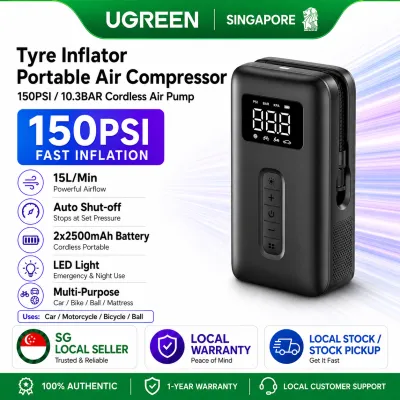
When shopping for a battery air pump, you will notice many models boast maximum pressure ratings of 120 to 150 PSI. While your car tires will never require this level of inflation, this high maximum rating provides a crucial performance buffer. A pump operating well below its maximum limit experiences significantly less motor strain, runs cooler, and inflates your tires much faster than a unit working at its absolute limit.
To ensure precise inflation and prevent dangerous overpressurization, prioritize pumps equipped with a built-in digital pressure gauge and an automatic shutoff feature. These systems allow you to pre-set your target PSI, automatically halting the inflation process once the correct pressure is reached. This safety feature protects your tire structure and ensures consistent handling across all four wheels.
Decoding Battery Capacity and Power Delivery
Battery capacity in portable tire inflators is typically measured in milliampere-hours (mAh) or Watt-hours (Wh). These metrics dictate how much energy the pump can store and, consequently, how many tires it can service on a single charge. A higher capacity rating generally means the pump can handle multiple inflation cycles before requiring a recharge, making it a more reliable companion for longer journeys.

For minor maintenance, such as topping up a tire that has dropped by 2 to 3 PSI, a compact pump with a modest battery capacity is usually sufficient. However, inflating a completely flat tire from zero requires a massive, sustained draw of electrical energy. If you drive a larger vehicle or want the security of being able to inflate multiple tires fully, you will need a heavy-duty battery capacity to avoid the tool losing power halfway through the process.
While larger battery capacities offer superior runtime, they also introduce specific trade-offs in terms of physical design. High-capacity units are inherently heavier and bulkier, which can make them more cumbersome to store in a glove compartment or small trunk organizer. Additionally, larger batteries require longer charging times to replenish, meaning you must plan ahead and keep the device charged before setting out on a trip.
Key Features That Affect Real-World Performance
Beyond pressure and battery capacity, the airflow rate—often measured in liters per minute (L/min)—plays a critical role in how quickly a pump performs. A higher airflow rate means the pump moves a larger volume of air into the tire each second, rapidly reducing the time you spend waiting on the roadside. Low-airflow pumps may take a long time to inflate a standard tire, which increases the risk of the motor overheating.
Every portable air pump has a specified duty cycle, which is the maximum amount of time the motor can run continuously before it requires a cooling period. Operating a pump past its duty cycle can permanently damage the internal seals and motor components. Always check the manufacturer’s instructions to understand these operational limits, especially when attempting to inflate multiple tires in succession.
Physical compatibility is another essential factor to verify before purchasing. Most passenger vehicles use standard Schrader valves, and your chosen pump must feature a compatible connector or include secure adapters. A loose or poorly fitting connection can leak air during operation, reducing efficiency and potentially damaging the valve stem.
How to Verify Compatibility and Safety Before Use
Before relying on a portable pump in an emergency, perform a physical check of the hose length and attachment mechanism. The hose must be long enough to reach the tire valve comfortably when the wheel is rotated to any position, preventing unnecessary tension on the valve stem. Screw-on connectors offer a highly secure seal, while quick-release clamps allow for faster attachment and removal.
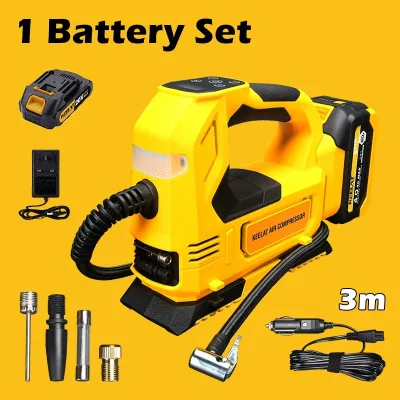
To safeguard against a dead battery during an emergency, consider selecting a hybrid pump that offers dual power options. Many models can run directly off your vehicle’s 12V accessory socket via an included adapter cable, bypassing the internal battery entirely when needed. This backup power capability ensures you can always inflate your tires, even if you forgot to charge the device beforehand.
Finally, take the time to thoroughly review the user manual supplied by the manufacturer. Pay close attention to specified temperature limits, storage guidelines, and safety warnings regarding electrical components. Understanding these boundaries ensures you operate the tool safely and preserve its operational lifespan.
Frequently Asked Questions (FAQ)
Can a standard battery air pump inflate SUV or light truck tires?
Standard compact battery air pumps often struggle with the sheer volume of air required by larger SUV or light truck tires. While they may have the pressure capability to match the specification, the massive volume can quickly deplete a small battery or cause the motor to overheat before inflation is complete. For larger vehicles, it is highly recommended to use a heavy-duty portable inflator or a dedicated 12V plug-in pump designed to handle high-volume tires.
Is it safe to store a battery air pump inside the car cabin?
Storing devices containing lithium-ion batteries inside a hot car cabin poses significant safety risks. During warm weather, temperatures inside a parked vehicle can rise rapidly, exceeding the safe storage limits specified by manufacturers and potentially leading to battery degradation, swelling, or thermal runaway. To ensure safety, store the pump in a cooler, shaded area of the vehicle, such as the trunk, or bring the device indoors when the vehicle is parked in direct sunlight for extended periods.

Community discussion
Share your experience or ask a question. Comments are reviewed before publication.