
Choosing the right Yamalube engine oil for your motorcycle requires matching your manufacturer’s specified viscosity grade and friction standard with your riding conditions. While Yamalube is formulated to optimize Yamaha engines, these oils are widely used across other motorcycle brands. Selecting the wrong oil can lead to poor lubrication, clutch slippage, accelerated engine wear, or reduced fuel efficiency. Whether you ride a daily commuter scooter or a high-performance sportbike, finding the correct oil requires evaluating your owner’s manual, understanding how oils react to heat, and choosing a formulation that matches your transmission type.
Decoding Yamalube Viscosity Numbers: What 10W-40 and 20W-50 Actually Mean
To make an informed choice, you must understand the alphanumeric codes printed on every bottle of Yamalube engine oil. These codes follow the Society of Automotive Engineers (SAE) multi-grade standard, which describes how the oil flows at low and high temperatures.
The first part of the code, ending with the letter “W”, represents the winter rating (e.g., the “10W” in 10W-40). A lower winter number means the oil is thinner at cold starts, allowing it to pump quickly through the engine block to protect vital components immediately after ignition. Even in tropical climates like Singapore, a lower winter rating ensures rapid oil circulation during initial startup when the engine is cold relative to its operating temperature.
Products mentioned in this guide
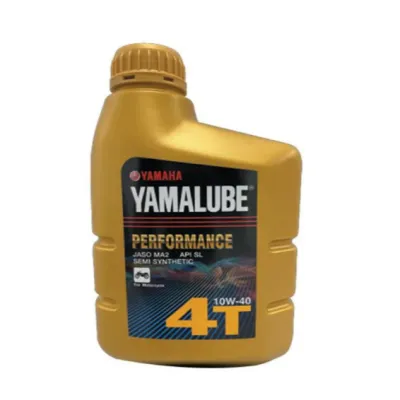
Prices are valid at publication and may change. Please refer to the product page for the latest price.
The second number, such as the “40” in 10W-40, indicates the oil’s viscosity at normal operating temperature (100°C). This represents the oil’s resistance to flow and its ability to maintain a protective film under intense heat. A higher second number means the oil remains thicker and more cohesive at high temperatures, preventing metal-on-metal contact under heavy loads.
However, a higher viscosity rating is not universally better. Engine manufacturers design internal clearances, oil passages, and oil pumps to work with a specific range of oil thickness. Using an oil that is too thick can restrict flow, increase internal drag, and starve critical components. Conversely, using an oil that is too thin can result in a ruptured oil film, leading to rapid wear of bearings, pistons, and cylinder walls.
Beyond Viscosity: Matching JASO Standards to Your Clutch Type
While viscosity determines how the oil flows, the Japanese Automotive Standards Organization (JASO) standard determines how the oil interacts with your motorcycle’s transmission. Unlike passenger cars, many motorcycles utilize a wet clutch system where the engine oil, gearbox, and clutch plates all share the same oil sump, meaning the lubricant must satisfy conflicting mechanical needs.

The JASO standards are divided into two primary categories for four-stroke motorcycles: JASO MA (including MA1 and MA2) and JASO MB. The JASO MA and MA2 classifications are engineered specifically for wet-clutch systems. These oils contain precise friction modifiers that ensure the clutch plates grip together firmly when engaged, preventing slippage under acceleration. JASO MA2 represents the highest friction performance standard, making it the preferred choice for manual motorcycles.
In contrast, the JASO MB standard is formulated for dry-clutch systems, which are most commonly found in automatic scooters and continuously variable transmission (CVT) motorcycles. Because the clutch in these vehicles operates in a separate dry housing, the engine oil does not contact the clutch plates. Consequently, JASO MB oils are formulated with friction reducers designed to minimize internal drag and maximize fuel efficiency.
Using a JASO MB oil in a wet-clutch motorcycle can lead to severe clutch slippage and eventual transmission failure. Conversely, using a JASO MA or MA2 oil in a scooter designed for JASO MB will not cause mechanical damage, but it will result in higher internal friction and reduced fuel economy. Always verify the JASO rating on the back label of the Yamalube bottle before making a purchase.
Step-by-Step: Finding the Exact Yamalube Grade for Your Motorcycle
Verifying Manufacturer Recommendations
The most reliable source of truth for selecting your engine oil is always your motorcycle’s owner’s manual. Manufacturers test engines under various loads to determine the exact oil specifications required to maintain warranty coverage and ensure long-term reliability. The manual outlines the recommended viscosity range, the required JASO standard, and the minimum American Petroleum Institute (API) service category, such as API SL, SM, or SN.
If you lack the physical owner’s manual, you can often find the primary recommended viscosity stamped directly onto the engine casing or printed near the oil filler cap. This physical stamp serves as a quick reference guide for routine maintenance. Avoid relying on generalized advice from online forums or social media groups, as these recommendations often ignore the tight tolerances of modern engines.
Factoring in Singapore's Climate and Engine Mileage
While the manufacturer’s manual is the primary authority, local environmental conditions can influence your choice within the approved viscosity range. Singapore’s tropical climate features consistently high ambient temperatures, high humidity, and dense, stop-and-go urban traffic. This environment subjects motorcycle engines to prolonged idling and slow-speed riding, which limits natural airflow across air-cooled engines and places a heavy thermal load on liquid-cooled systems.
Under these hot operating conditions, the high-temperature viscosity rating of your oil becomes critical. If your owner’s manual permits a range of viscosities—such as 10W-30 for cooler climates and 10W-40 or 20W-50 for hotter regions—it is advisable to opt for the higher viscosity grade approved by the manufacturer to ensure the oil film does not thin out excessively. For instance, a 10W-40 oil provides a more robust protective barrier than a 10W-30 oil when navigating slow-moving traffic on major expressways.
Engine mileage is another factor that can influence your viscosity selection within the manufacturer’s guidelines. As a motorcycle accumulates high mileage, the constant friction between internal components increases the clearances between bearings, pistons, and cylinder walls. To compensate for this wear and maintain adequate oil pressure, some riders transition to a slightly thicker oil grade (such as moving from 10W-40 to 20W-50), provided that the thicker grade is listed as an acceptable alternative in the owner’s manual. However, any significant deviation should be cross-referenced with an authorized service center or a qualified professional mechanic.
Overview of Common Yamalube Viscosity Options
Yamalube offers a diverse portfolio of viscosity grades formulated to meet the specific engineering requirements of different motorcycle types. Understanding the typical applications of these common grades can help you identify the right bottle on the shelf:
- 10W-40: This is the most versatile and widely specified viscosity grade in the Yamalube lineup, highly recommended for modern liquid-cooled and air-cooled manual motorcycles. It is available in mineral, semi-synthetic, and fully synthetic formulations to suit different performance needs.
- 20W-50: This thicker grade is commonly specified for older air-cooled engines, classic motorcycles, high-mileage machines, and heavy-duty single-cylinder or V-twin engines. The higher viscosity helps seal larger internal clearances and maintains oil pressure under extreme operating heat.
- 10W-30: This lower-viscosity grade is specified for modern, fuel-injected scooters and lightweight commuter motorcycles. It is designed to reduce internal fluid drag, thereby enhancing fuel efficiency, while still providing adequate wear protection for engines engineered with tight tolerances.
Remember that the presence of a specific grade on the shelf does not guarantee compatibility with your motorcycle. Always cross-reference the API service category and the JASO rating on the bottle with your vehicle’s requirements. If you are unsure about compatibility, check the product data sheet or consult a professional mechanic before performing an oil change.
Frequently Asked Questions (FAQ)
Can I mix two different Yamalube viscosity grades in an emergency?
In an emergency situation where your oil level is dangerously low, mixing two different Yamalube viscosity grades of the same base type (such as mixing a semi-synthetic 10W-40 with a semi-synthetic 20W-50) is acceptable to prevent running the engine dry. Running an engine without sufficient oil will cause catastrophic mechanical failure within minutes, so adding any clean motorcycle oil is always preferable to operating with an empty sump.
However, mixing different viscosity grades alters the overall viscosity and disrupts the carefully balanced additive package of each oil. This temporary mixture will not perform optimally under high thermal loads. Therefore, you should treat this as a temporary measure to safely reach a workshop, where you should perform a complete oil and filter change using the single, correct viscosity grade recommended by your manufacturer.
Will using a thicker oil than recommended damage my motorcycle engine?
Yes, using an oil that is significantly thicker than what your manufacturer recommends can cause serious engine damage and performance issues. Modern motorcycle engines are engineered with extremely precise, tight clearances between moving parts. If the oil is too thick, the oil pump must work harder to circulate it, which increases internal strain, reduces fuel economy, and can lead to a drop in overall oil pressure.
Furthermore, an excessively thick oil cannot flow quickly enough through narrow oil passages to lubricate critical top-end components, such as the valve train and camshafts, during cold starts. This delay in lubrication causes increased metal-on-metal friction and premature wear. Always stick to the viscosity range specified in your owner’s manual to ensure proper oil flow, cooling, and engine protection.
Community discussion
Share your experience or ask a question. Comments are reviewed before publication.