
Liqui Moly 10W-40 engine oil is best suited for motorcycles whose manufacturers explicitly specify a 10W-40 viscosity grade in their owner’s manuals. This versatile viscosity is highly common across a wide range of modern four-stroke motorcycles, including high-revving sportbikes, daily city commuters, and medium-to-high displacement cruisers. However, determining whether a specific Liqui Moly 10W-40 product is right for your motorcycle requires looking beyond the viscosity numbers on the bottle to verify critical manufacturer specifications, wet clutch compatibility, and regional climate conditions.
While viscosity is a primary factor in selecting engine oil, it must always be matched with the correct industry certifications. Motorcycle engines operate under significantly different mechanical stresses than passenger cars, meaning that a generic automotive oil will not suffice. By understanding how 10W-40 behaves under various operating conditions and learning how to read your motorcycle’s technical documentation, you can make an informed decision that protects your engine and ensures smooth performance.
Understanding 10W-40 Viscosity in Motorcycle Engines
The alphanumeric code “10W-40” describes how the oil flows at both low and high temperatures. The “10W” portion indicates the oil’s cold-flow properties, with the “W” standing for winter. A lower number before the W means the oil remains more fluid at cold startups, allowing it to circulate rapidly through the engine block to protect vital components from initial wear. The “40” represents the oil’s kinematic viscosity at standard engine operating temperature, which is measured at 100°C. This number indicates the oil’s ability to maintain a robust, protective film when the engine is fully warmed up and running under load.
Products mentioned in this guide
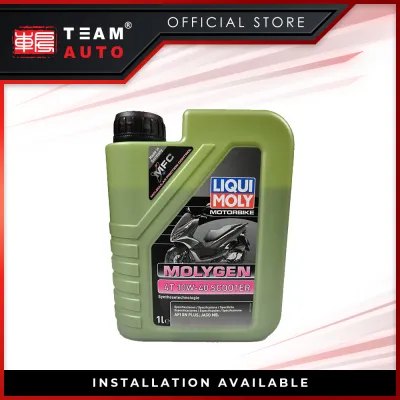
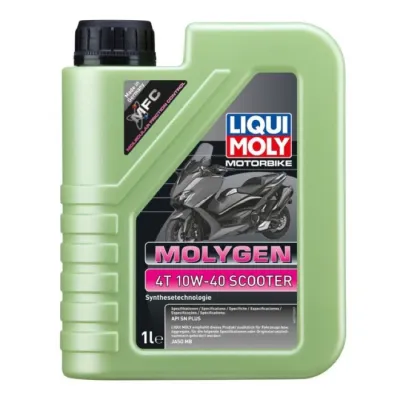
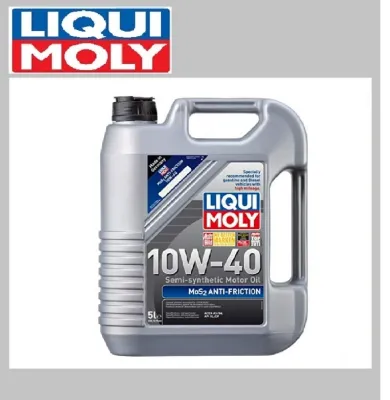
Prices are valid at publication and may change. Please refer to the product page for the latest price.
Motorcycle engines require specialized lubricants because they typically run at much higher rotational speeds and operating temperatures than automotive engines. Furthermore, many motorcycles utilize a shared sump design, meaning a single oil reservoir must simultaneously lubricate the engine cylinders, the transmission gears, and the wet clutch assembly. This environment subjects the oil to intense mechanical shearing forces from the gearbox teeth, which can rapidly break down inferior oil molecules and cause the viscosity to thin out prematurely.
A 10W-40 viscosity grade is designed to offer a balanced performance profile across a broad range of ambient temperatures. It remains sufficiently fluid in cold climates to prevent dry starts, yet retains enough body in hot weather to prevent metal-on-metal contact. In tropical environments like Singapore, where ambient temperatures remain consistently warm year-round, a 10W-40 oil provides a reliable thermal barrier that resists thinning, making it a highly popular choice for daily riders who require consistent protection.
Matching Motorcycle Categories to 10W-40 Characteristics
Different motorcycle categories subject engine oil to distinct thermal and mechanical stresses. While 10W-40 is one of the most widely specified viscosity grades globally, matching your riding style and motorcycle category to this profile is only a preliminary step. You must always verify the final compatibility against your specific owner’s manual.

Sport, Track, and High-Displacement Motorcycles
High-performance sportbikes and high-displacement machines operate under extreme thermal stress and high RPMs. These liquid-cooled engines require an oil with exceptional shear stability to prevent the molecular chains of the lubricant from breaking down under intense mechanical pressure. When the oil film shears, critical engine components can experience rapid wear, leading to a loss of compression and potential engine damage over time.
Many manufacturers of sport and track-focused motorcycles specify 10W-40 because it balances rapid oil circulation at startup with a strong, load-bearing oil film at high operating temperatures. This film protects vital components like camshafts, pistons, and bearings from metal-on-metal contact during aggressive acceleration. If you plan to take your motorcycle to track days or engage in spirited riding, check your manual to ensure 10W-40 is approved for high-stress conditions.
Cruisers, Touring, and Daily Commuters
Cruisers and touring motorcycles often carry heavy loads, including passengers and luggage, over long distances. This continuous load puts sustained pressure on the engine bearings, requiring an oil with reliable film strength to prevent wear. A stable 10W-40 oil helps cushion these heavy-load components, ensuring long-term durability during extended highway journeys.
Daily commuters face a different challenge: stop-and-go traffic. In urban environments, engines experience frequent idling and low-speed riding, which limits natural airflow. For air-cooled or partially faired commuter bikes, this lack of airflow can cause engine temperatures to spike rapidly, making a stable 10W-40 oil crucial for preventing thermal breakdown. Using a 10W-40 oil in these scenarios provides a balanced protective barrier across a wide operating envelope, ensuring smooth gear shifts and reliable clutch engagement during constant stop-start riding.
How to Verify Compatibility Using Your Owner's Manual
To confirm if Liqui Moly 10W-40 is suitable for your motorcycle, your first step should always be consulting the owner’s manual or official service documentation. Manufacturers include a dedicated lubrication section that outlines the exact oil specifications required to maintain engine health and preserve your warranty. This documentation is the ultimate authority on what fluid should enter your engine.
Locate the viscosity-temperature chart in your manual. This chart typically displays a list of approved viscosity grades mapped against the ambient temperature ranges of your riding environment. Locate the typical temperature range of your region on the chart and verify if 10W-40 is positioned as an approved option within that temperature bracket. If you ride in a consistently warm climate, a slightly thicker hot viscosity like 10W-40 might be preferred over 10W-30 to provide extra protection against heat-induced thinning.
In some cases, the manual may list multiple viscosity options based on seasonal changes. If the manufacturer strictly mandates a single viscosity grade like 10W-30 for fuel efficiency, you should not substitute it with 10W-40 unless explicitly permitted. If you no longer have the physical manual, look for official digital copies on the manufacturer’s website or contact an authorized dealership. Never rely on general online forum advice or generic compatibility charts, as engine tolerances and oil passage designs vary significantly between different model years and engine configurations.
Checking Essential Certifications and Wet Clutch Safety
Viscosity is only one part of the compatibility equation; you must also ensure the specific Liqui Moly 10W-40 variant matches your motorcycle’s clutch and emissions systems. Look closely at the product label for the Japanese Automotive Standards Organization (JASO) certification, which is critical for motorcycles with wet clutches. This certification ensures the oil contains the correct frictional properties to prevent clutch slippage.
Most motorcycles share engine oil with the clutch assembly. For these systems, you must use an oil certified as JASO MA or JASO MA2. These standards guarantee that the oil has the correct frictional properties to prevent clutch slippage under load. JASO MA2 offers higher friction performance, making it highly suitable for high-torque and high-performance engines. Avoid using standard automotive 10W-40 oils in a motorcycle with a wet clutch, as car oils often contain friction modifiers designed to maximize fuel economy, which can cause motorcycle clutches to slip, leading to accelerated wear and poor power transfer.
Additionally, check the American Petroleum Institute (API) service classification on the bottle, represented by letters such as API SN, SM, or SL. Compare this rating with the minimum requirement specified in your owner’s manual. The oil you choose must meet or exceed the manufacturer’s specified API standard to ensure proper wear protection and compatibility with modern emissions control systems like catalytic converters. Always select a Liqui Moly product explicitly labeled for motorcycle use to ensure all these critical parameters are met.
Frequently Asked Questions (FAQ)
Can I mix Liqui Moly 10W-40 with another brand of the same viscosity?
While mixing different brands of the same viscosity and specification is generally acceptable in an emergency or for minor top-ups, it is not recommended as a long-term practice. Different brands use unique additive packages that may not interact optimally when mixed. For complete oil changes, perform a full drain and refill with a single product to ensure consistent performance and protection.
Is 10W-40 suitable for both air-cooled and liquid-cooled motorcycles?
Yes, 10W-40 can be used in both air-cooled and liquid-cooled engines, provided the manufacturer approves this viscosity grade. Air-cooled engines experience wider temperature fluctuations and higher peak temperatures, making the thermal stability of a high-quality 10W-40 oil highly beneficial, whereas liquid-cooled engines benefit from its consistent flow and protection.
How often should I change 10W-40 oil in a high-revving sportbike?
You should always follow the oil change intervals specified in your motorcycle’s owner’s manual. If you subject your sportbike to severe operating conditions—such as track days, frequent short trips where the engine doesn’t reach full operating temperature, or riding in extremely dusty or hot environments—you should shorten the interval accordingly to maintain optimal engine protection.
Community discussion
Share your experience or ask a question. Comments are reviewed before publication.