
Selecting a replacement or upgrade 60v battery for your electric motorcycle is a decision that directly dictates your vehicle’s range, acceleration, safety, and overall lifespan. A 60-volt electrical system is common among mid-range electric scooters and motorcycles, balancing efficient power delivery with manageable system weight. However, finding the ideal battery requires looking far beyond the voltage label. You must evaluate the chemical composition, capacity, discharge capabilities, physical dimensions, and safety certifications to ensure a seamless integration.
In Singapore, this decision is further shaped by unique environmental and regulatory factors. The combination of year-round tropical heat, high humidity, and strict Land Transport Authority (LTA) standards means that safety and compliance are just as critical as raw performance. Choosing an incompatible or uncertified battery not only risks damaging your motorcycle’s electrical components but can also lead to severe safety hazards or legal penalties. This guide provides a comprehensive framework to help you evaluate and select the right 60V battery for your riding needs.
Recommended 60V Battery Chemistries Based on Riding Needs
The chemical composition of your battery cells determines how much energy they can store, how heavy the pack will be, how many times you can charge it, and how it behaves under thermal stress. The three primary chemistries available for 60V electric two-wheelers are Lithium Nickel Manganese Cobalt Oxide (NMC), Lithium Iron Phosphate (LFP), and Sealed Lead-Acid (SLA/AGM).
Products mentioned in this guide
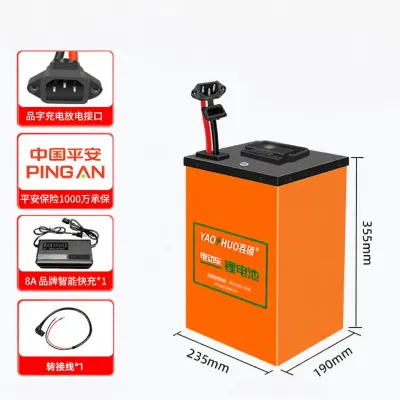
Prices are valid at publication and may change. Please refer to the product page for the latest price.
Lithium Nickel Manganese Cobalt (NMC)
NMC batteries are highly popular for electric motorcycles due to their high energy density. This chemistry packs a significant amount of energy into a relatively small and lightweight package, allowing for longer riding ranges without adding excessive bulk to your motorcycle’s frame. If your riding habits demand agile handling, rapid acceleration, and maximum range per charge, NMC is often the preferred choice. However, NMC cells have a lower thermal runaway threshold compared to LFP, meaning they require a highly sophisticated Battery Management System (BMS) to monitor temperatures, especially in warm climates.
Lithium Iron Phosphate (LFP)
LFP batteries are renowned for their exceptional safety, thermal stability, and long service life. They are highly resistant to thermal runaway and can withstand significantly higher temperatures before degrading, making them incredibly safe for tropical environments. Furthermore, LFP packs typically support 2,000 to 3,000 charge-discharge cycles before dropping to 80% of their original capacity, outlasting NMC by a wide margin. The trade-off is energy density; LFP batteries are heavier and physically larger than NMC packs of the equivalent capacity. If you prioritize longevity, safety, and daily cost-efficiency over saving every gram of weight, LFP is an excellent match.
Sealed Lead-Acid (SLA) / AGM
Lead-acid technology represents the traditional, low-cost option. While the upfront purchase price is significantly lower than lithium alternatives, lead-acid batteries are extremely heavy, have low energy density, and suffer from a short lifespan—often lasting only 300 to 500 cycles. They also experience severe voltage sag under heavy acceleration. In modern electric motorcycles, lead-acid batteries are generally only recommended if your vehicle’s frame and suspension were specifically engineered for their weight, and if your budget strictly prevents upgrading to lithium.
To help you compare these options, the table below outlines the typical performance characteristics of each chemistry:
| Feature | Lithium-Ion (NMC) | Lithium Iron Phosphate (LFP) | Sealed Lead-Acid (SLA/AGM) |
|---|---|---|---|
| Energy Density | High (approx. 150–220 Wh/kg) | Medium (approx. 100–140 Wh/kg) | Low (approx. 30–40 Wh/kg) |
| Typical Cycle Life | 800 – 1,500 cycles | 2,000 – 3,000+ cycles | 300 – 500 cycles |
| Weight | Very Lightweight | Moderate | Extremely Heavy |
| Thermal Stability | Moderate (requires active BMS) | Excellent (highly stable) | Good (low thermal risk) |
| Upfront Cost | High | Moderate to High | Low |
| Ideal Use Case | Performance-focused daily commuting, long-range riding | Long-term durability, high-safety urban transit | Budget-restricted, low-speed local trips |
Key Performance Specs: Capacity and Discharge Rates
Once you have selected a chemistry, you must evaluate the battery’s electrical specifications to ensure it can deliver the required range and power. The two primary metrics to focus on are capacity (measured in Amp-Hours) and discharge rates (measured in Amperes or C-rating).

Understanding Capacity (Amp-Hours and Watt-Hours)
Amp-Hours (Ah) measure the electrical charge a battery can deliver over one hour. To find the total energy storage capacity of a battery, multiply the nominal voltage by the Ah rating to calculate Watt-Hours (Wh). For example, a 60V 20Ah battery provides 60V x 20Ah = 1,200Wh (or 1.2 kWh) of energy. A higher Ah rating directly translates to a longer riding range.
To estimate your real-world range, you must consider your vehicle’s energy consumption, which typically ranges between 30 Wh and 50 Wh per kilometer depending on speed, rider weight, and wind resistance. A 1,200 Wh battery operating at an average efficiency of 40 Wh/km will yield approximately 30 kilometers of range. If your daily commute involves traversing long stretches of the Pan Island Expressway (PIE) or East Coast Parkway (ECP), you should aim for a higher capacity pack (such as 30Ah to 40Ah) to ensure a comfortable safety margin.
Discharge Rates and Controller Matching
Your motorcycle’s motor controller draws current from the battery to power the motor. The battery must be rated to handle both the continuous and peak current demands of this controller:
- Continuous Discharge Rate: The maximum current (in Amps) the battery can safely deliver over an extended period. If your controller draws 40A continuously, but your battery is only rated for 30A continuous discharge, the battery will overheat, trigger its safety shut-off, or experience rapid permanent degradation.
- Peak Discharge Rate: The maximum current the battery can deliver for short bursts (typically 3 to 10 seconds) during hard acceleration or hill climbing.
A battery’s discharge capability is often expressed as a “C-rating,” which describes how quickly the battery can be discharged relative to its capacity. A 20Ah battery with a 2C continuous discharge rating can deliver 40A continuous (20Ah x 2 = 40A). Always verify your motorcycle controller’s specifications and select a battery with a continuous and peak discharge rating that meets or exceeds those requirements. Mismatching these specs leads to “voltage sag,” where the battery voltage drops sharply under load, causing your motorcycle to lose power or stutter during acceleration.
Non-Negotiable Safety Features and Build Quality
Lithium batteries store a massive amount of energy in a compact space. Without proper safety mechanisms, physical damage or electrical faults can lead to catastrophic failures, including thermal runaway.
The Battery Management System (BMS)
A premium Battery Management System is the single most critical safety component of any lithium battery pack. The BMS acts as an internal computer that constantly monitors the health of individual cells. Ensure the battery you select features a BMS that provides:
- Cell Balancing: Ensures that all individual cells within the pack charge and discharge evenly, preventing weak cells from being overstressed.
- Overcharge and Over-Discharge Protection: Automatically cuts off current flow when the battery reaches its maximum safe voltage during charging or drops below its minimum safe threshold during use.
- Over-Current Protection: Instantly disconnects the circuit if the motor controller attempts to draw more current than the battery can safely provide.
- Thermal Monitoring: Uses temperature sensors distributed throughout the pack to shut down operation if internal temperatures exceed safe limits, preventing thermal runaway.
Ingress Protection (IP) Ratings
Motorcycle batteries are exposed to harsh outdoor environments. In Singapore, sudden tropical downpours can flood roads and drench your vehicle. Your battery must have a high Ingress Protection (IP) rating to prevent water from penetrating the casing and causing short circuits. Look for a minimum rating of IP65 (dust-tight and protected against water jets), though IP67 (dust-tight and protected against temporary immersion in water) is highly recommended for maximum peace of mind during heavy rains and routine vehicle washing.
Physical Build Quality
Inspect the physical construction of the battery pack before purchasing. The outer casing should be constructed from robust, impact-resistant materials such as high-grade stainless steel, aluminum, or thick flame-retardant ABS-PC plastics. Avoid packs wrapped only in blue PVC shrink wrap, as these offer zero protection against physical impacts, vibration, or road debris. Inside the casing, cells should be secured in rigid plastic spacers or holders rather than glued directly together, ensuring adequate structural support and thermal dissipation. Wiring should consist of heavy-gauge, high-temperature silicone-insulated cables with secure, professional-grade soldering or crimping.
Ensuring Physical Fitment and Electrical Compatibility
Even the most advanced battery is useless if it does not physically fit into your motorcycle’s battery tray or integrate with its electrical system. Before purchasing, you must perform a thorough compatibility check.
Physical Dimensions and Mounting
Measure your motorcycle’s battery compartment with precision, noting the length, width, and height. Remember to account for the space required for routing thick power cables, the placement of the main connector, and any clearance needed for the BMS module or physical handles. The battery must fit snugly without being forced. If the new battery is smaller than the original (common when upgrading from lead-acid to lithium), you must install secure, non-conductive padding or custom mounting brackets to prevent the battery from sliding or bouncing while riding, which can damage the internal connections.
Electrical Connections and Polarity
Verify that the battery’s output terminals match your motorcycle’s wiring harness. Common heavy-duty connectors include Anderson plugs (such as SB50 or SB120), Chogori connectors, or heavy-gauge ring terminals. The wire gauge of your motorcycle’s harness must be thick enough to handle the current without overheating; typically, 8 AWG or 10 AWG copper wire is required for high-current 60V systems.
Warning: Before making any connections, use a digital multimeter to verify the polarity of both the battery output and the motorcycle’s controller input. Connecting a battery with reversed polarity will instantly destroy your motor controller and can cause an electrical fire.
Charger Compatibility
You must match your charger to the specific chemistry and specifications of your new battery. A charger designed for lead-acid batteries cannot be used on a lithium pack, as it lacks the precise Constant Current / Constant Voltage (CC/CV) charging profile required for lithium cells. Similarly, LFP and NMC batteries require different maximum charge voltages. Using an incorrect charger can overcharge the cells, leading to permanent damage or fire. Always purchase a charger that is explicitly certified by the manufacturer for your specific battery model and chemistry.
Buying and Maintenance Considerations for Singapore Riders
Operating an electric motorcycle in Singapore presents distinct environmental and regulatory challenges that require careful consideration.
Managing Tropical Heat and Humidity
Singapore’s high ambient temperatures, often hovering around 30°C to 34°C, combined with relative humidity levels exceeding 80%, create a demanding environment for batteries. Prolonged exposure to high heat accelerates chemical degradation, reducing the overall lifespan of the cells. To mitigate this, avoid charging your battery immediately after a long ride when the internal cells are still warm; allow the pack to cool down for at least 30 minutes. Whenever possible, park your motorcycle in shaded areas, multi-storey car parks, or underground basements to shield it from direct sunlight.
Warranty, Support, and Sourcing
Given the high cost and safety implications of a 60V battery, purchasing from reputable, authorized local dealers is highly recommended. Avoid buying uncertified battery packs from general online marketplaces or overseas parallel importers. While these imports may seem financially appealing, they often lack genuine safety certifications, use low-quality or recycled cells, and offer no reliable warranty. A reputable local distributor should offer a comprehensive warranty (ideally 12 to 24 months) and provide access to a physical service center with qualified technicians who can handle repairs, cell balancing, and safety inspections.
Regulatory Compliance and Insurance
In Singapore, all motor vehicle modifications are strictly governed by the Land Transport Authority (LTA). Before upgrading your battery—especially if you are changing the battery chemistry from lead-acid to lithium, or significantly increasing the capacity—you must verify that the modification complies with LTA guidelines. Unapproved electrical modifications can render your motorcycle non-road-legal, subject you to heavy fines, and result in the immediate voiding of your motor insurance policy. Always consult with authorized workshops and obtain the necessary approvals to ensure your vehicle remains fully compliant and insured.
Frequently Asked Questions (FAQ)
Can I upgrade from a lead-acid to a lithium 60V battery?
Yes, but it is not a simple drop-in replacement. You must verify that your motorcycle’s motor controller can handle the different voltage discharge curve of a lithium battery. Because lithium batteries are significantly lighter and smaller than lead-acid packs of the same capacity, you will need to install custom mounting brackets or high-density foam padding to secure the new pack within the battery tray. Additionally, you must completely replace your old lead-acid charger with a dedicated lithium charger that matches your new battery’s specific chemistry (NMC or LFP) and voltage limits. Because this process involves high-voltage electrical modifications, it is highly recommended to have the upgrade performed by a qualified professional technician.
How long does a 60V electric motorcycle battery typically last?
The lifespan of a 60V battery depends heavily on its chemistry and how well it is maintained. Under typical riding conditions, a high-quality NMC battery will last between 800 and 1,500 charge cycles (approximately 3 to 5 years of daily use) before its capacity drops to 80% of its original state. An LFP battery offers a much longer lifespan, typically enduring 2,000 to 3,000+ cycles (approximately 7 to 10 years) under proper care. To maximize your battery’s lifespan, avoid regularly discharging it completely to 0% or keeping it charged at 100% for extended periods; keeping the state of charge between 20% and 80% is ideal. Additionally, storing and charging the battery in cool, shaded environments will prevent heat-induced degradation.
Community discussion
Share your experience or ask a question. Comments are reviewed before publication.