
Choosing the right sunshade for your vehicle is a practical decision that directly impacts your daily driving comfort. When parking under the intense sun, the interior of your car can quickly become uncomfortably hot, causing wear on your dashboard and steering wheel. While both umbrella-style and traditional foldable sunshades aim to mitigate this issue, they approach the problem with entirely different designs. Neither option is universally superior; instead, the best choice depends on whether you prioritize maximum coverage or effortless daily storage.
If your primary goal is to achieve complete, edge-to-edge coverage with a snug fit that leaves no gaps for sunlight to penetrate, a traditional foldable sunshade is generally the more effective choice. On the other hand, if you have limited storage space in your cabin and want a shade that you can deploy and pack away in seconds, a car sunshade umbrella offers unmatched convenience. Understanding how these two designs compare across coverage, usability, and safety will help you select the ideal accessory for your windshield.
How Umbrella and Foldable Sunshades Actually Work
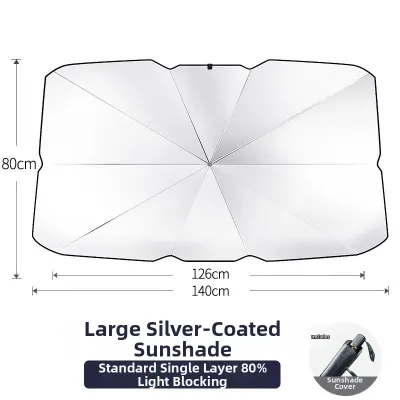
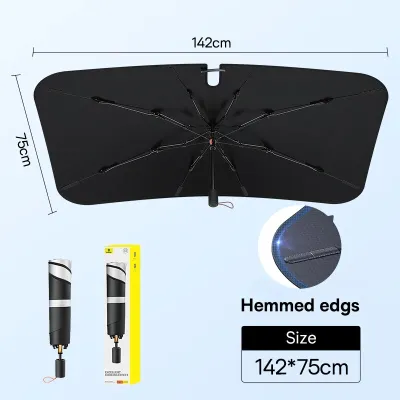
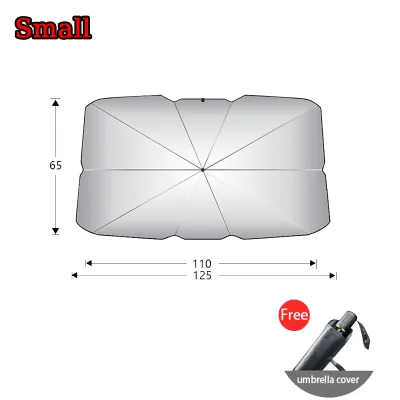
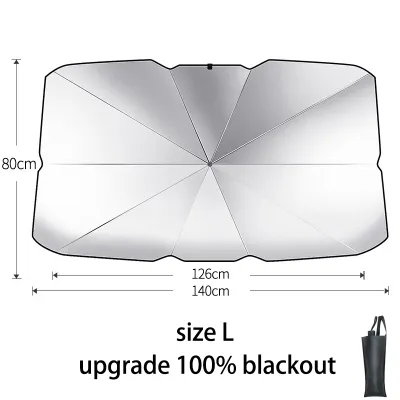
To make an informed decision, it is helpful to understand the structural mechanics that define each sunshade type. The umbrella-style sunshade is a relatively recent innovation in automotive accessories. It operates on the same mechanical principles as a standard rain umbrella, featuring a central shaft, a runner, and a series of metal or fiberglass tension ribs. When you push the runner up the shaft, the ribs extend outward, stretching a reflective fabric canopy into a rectangular shape designed to match the dimensions of a windshield.
Products mentioned in this guide
![[✅SG Ready Stock] Car Sun Umbrella Sun Shields Dash Covers Automobile Interior Accessories Paraso Windshield UV Sunshade Umbrella](https://img.lazcdn.com/g/p/59e698b9187e970f068ac60760f13d65.jpg_400x400q80.jpg_.webp)
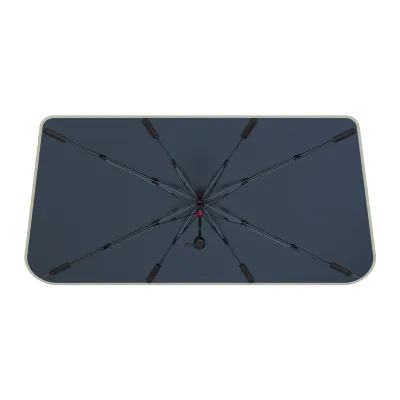

Prices are valid at publication and may change. Please refer to the product page for the latest price.
In contrast, traditional foldable sunshades rely on simpler, time-tested designs. These typically fall into two categories: accordion-style shades and pop-up ring shades. Accordion shades consist of a thick, stiff material—often cardboard or bubble-wrap insulated with reflective foil—that folds along pre-creased lines. Pop-up shades utilize flexible steel wire loops sewn into a lightweight reflective fabric that twist down into a small circle.
These structural differences directly dictate how you handle, store, and position each shade inside your vehicle. The rigid frame of the umbrella type provides structural tension from the center outward, while the foldable type relies on the physical boundaries of your windshield frame and sun visors to remain upright.
Coverage and Heat Protection: Which Blocks More Sun?
When evaluating heat protection, the primary factor is how effectively the shade blocks direct sunlight from entering the cabin. A sunshade acts as a physical barrier, and any gaps around the edges will allow solar radiation to heat up your dashboard, steering wheel, and front seats.

Traditional foldable sunshades generally excel at providing comprehensive, edge-to-edge coverage. Because they are made of semi-rigid materials or flexible wire frames, they can be pushed deep into the corners of the windshield and tucked securely behind the A-pillars. Many manufacturers offer these shades in multiple sizes or even custom-molded shapes tailored to specific vehicle makes and models. This precise fit minimizes light leakage, ensuring that almost the entire surface area of the glass is shielded from the sun.
Umbrella-style sunshades, by comparison, often struggle to achieve a perfect fit in the corners. The rigid metal ribs that support the canopy cannot bend to accommodate the complex curves of a modern windshield. Consequently, you may notice small triangular gaps of exposed glass at the corners of your windshield. Additionally, the central pole requires space to extend, which can sometimes prevent the fabric from sitting completely flush against the glass.
However, actual heat reflection is not determined by shape alone; the materials used in construction play a critical role. Many high-quality sunshades, regardless of style, feature multi-layer construction, including reflective metallic coatings, heat-absorbing middle layers, and dark backing fabrics to prevent light penetration. When shopping, look for products that specify their material composition, such as silver-coated titanium cloth for umbrella types or multi-layer polyethylene bubble foil for foldable types. Checking these specifications will give you a clearer indication of their thermal performance than the design type alone.
Daily Convenience: Storage and Installation Effort
A sunshade is only useful if you actually use it, making daily convenience a major factor in your decision. If a shade is too difficult to install or too bulky to store, it is likely to end up forgotten in your trunk.
The umbrella sunshade is the clear winner when it comes to compact storage. When collapsed, it folds down into a slim, cylindrical shape, much like a personal rain umbrella. It typically comes with a protective leather or fabric sleeve, allowing you to slide it easily into a door pocket, the glove compartment, or the center console. This keeps your cabin looking tidy and ensures the shade is always within arm’s reach of the driver’s seat.
Traditional foldable shades present more of a storage challenge. Accordion-style shades do not compress; they fold into a long, flat rectangle that can be awkward to store when a passenger is in the car. Drivers often have to toss them onto the back seat or slide them between the front seats and the center console. Pop-up wire shades fold into a smaller circle, but mastering the twisting motion required to collapse them can be frustrating.
When it comes to installation effort, the comparison is more balanced. Deploying an umbrella shade is straightforward: you open it inside the cabin, press it against the windshield, and lower your sun visors to hold it in place. However, maneuvering the central pole around your dashboard, infotainment screen, and rearview mirror requires care to avoid accidental bumps. Foldable shades require you to unfurl or pop open a larger piece of material inside the cabin, which can be clumsy in tight spaces, but they do not have a protruding central handle to manage.
Fitment and Safety: Protecting Your Windshield and Dash
Beyond blocking heat, you must consider how a sunshade interacts with your vehicle’s interior components. Modern car cabins are packed with sensitive electronics, touchscreens, and driver-assistance sensors that require protection from physical damage.
Sizing is critical for both safety and effectiveness. Traditional foldable shades are widely available in custom-fit configurations designed for specific vehicle models. These custom options feature precise cutouts for the rearview mirror housing, which often contains advanced driver-assistance system (ADAS) cameras. An ill-fitting shade that presses too hard against this housing could potentially misalign these sensitive sensors. Umbrella shades are almost exclusively sold in generic sizes. You must carefully measure your windshield’s height and width and compare them to the manufacturer’s sizing chart to avoid buying a shade that is too large to open fully or too small to stay in place.
Physical wear and tear is another important consideration, particularly with umbrella-style shades. The metal or fiberglass ribs of an umbrella shade terminate in tips that press against the edges of your windshield frame. If these tips are not properly padded with soft silicone or rubber caps, they can scratch your dashboard leather or scrape the plastic trim along your A-pillars. Furthermore, the central metal pole can rub against your infotainment screen or dashboard buttons during installation. To prevent this, look for umbrella models that feature bendable or flexible shafts and well-padded rib tips.
Traditional foldable shades are generally safer for your interior surfaces because they lack rigid, pointed components. They are made of soft, lightweight materials that pose no risk of scratching your leather dashboard or cracking your glass. However, you should still ensure that any metal wire frames are fully enclosed in fabric piping to prevent the metal from wearing through.
How to Choose the Right Sunshade for Your Car
To determine which sunshade type is the right investment for your vehicle, evaluate your daily driving habits, cabin space, and windshield geometry.
You should choose an umbrella sunshade if:
- Your vehicle has limited cabin storage, and you want a shade that fits neatly into a door pocket or glovebox.
- You prioritize quick, familiar deployment and do not want to struggle with folding large sheets of material.
- Your windshield has a standard, relatively flat shape without complex curves or oversized sensor housings around the rearview mirror.
- You are willing to take extra care during installation to avoid bumping your dashboard screen with the central pole.
You should choose a traditional foldable sunshade if:
- Your primary goal is maximum heat rejection, requiring complete edge-to-edge coverage with no light gaps at the corners.
- You can find a custom-fit model designed specifically for your vehicle's exact windshield dimensions.
- You have ample space in your back seat, footwell, or trunk to store a larger, folded accessory.
- You want a soft, risk-free design that contains no rigid metal poles or sharp rib tips that could scratch your interior.
Regardless of which style you prefer, always measure your windshield’s interior dimensions before making a purchase. Do not rely solely on generic vehicle category recommendations, as windshield angles and rearview mirror designs vary significantly between manufacturers.
Frequently Asked Questions (FAQ)
Can I leave the sunshade on the dashboard while driving?
No, you must never leave a sunshade on the dashboard or attached to the windshield while the vehicle is in motion. Doing so severely obstructs your forward visibility, creating an immediate and extreme safety hazard. Additionally, a loose sunshade resting on the dashboard can slide around during turns, potentially blocking your view of the side mirrors or interfering with your steering wheel. In the event of a collision, a sunshade placed on the passenger side of the dashboard can also interfere with the proper deployment of the passenger-side airbag. Always collapse, secure, and store your sunshade in a designated storage area before starting your engine.
Do umbrella sunshades scratch the windshield or dashboard?
Umbrella sunshades can potentially scratch your dashboard or windshield if they are designed poorly or handled carelessly. Because they feature a rigid internal frame, the tips of the metal ribs and the central support pole can rub against delicate interior surfaces. To prevent scratches, inspect any umbrella sunshade before purchase to ensure it has protective rubber or silicone caps over the rib ends. Some high-quality models also feature a flexible, bendable shaft that can be angled away from your infotainment screen. When installing or removing the shade, move slowly and avoid forcing the mechanism against your dashboard trim.
Community discussion
Share your experience or ask a question. Comments are reviewed before publication.