
If you own a modern Toyota vehicle equipped with a Continuously Variable Transmission (CVT), maintaining the transmission’s health is critical to preserving your car’s drivability and efficiency. When looking up the correct service parts, you will frequently encounter the specification toyota atf cvt fe. This designation refers to a highly specialized, low-viscosity fluid engineered specifically for modern Toyota CVTs to optimize fuel economy while protecting sensitive internal components.
Using the correct transmission fluid is not merely a recommendation; it is a fundamental operational requirement. Because CVTs operate on different mechanical principles than traditional stepped automatic transmissions, they demand unique fluid characteristics. Understanding what this specific fluid rating means will help you make informed maintenance decisions and protect your vehicle from costly transmission failures.
Decoding the Spec: What "Toyota ATF CVT FE" Actually Means
To understand why this fluid is unique, it helps to break down the acronyms printed on the bottle. The first part, “ATF,” stands for Automatic Transmission Fluid. While a CVT operates differently from a traditional geared automatic, Toyota categorizes its CVT fluids under the broader ATF umbrella for standard cataloging.
Products mentioned in this guide
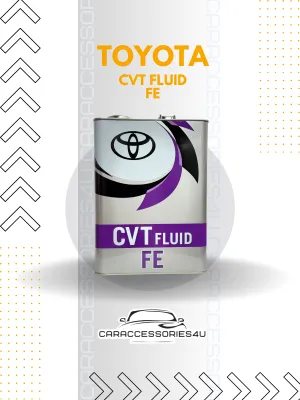
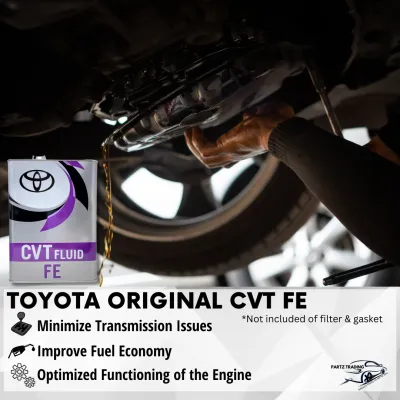
Prices are valid at publication and may change. Please refer to the product page for the latest price.
The “CVT” portion of the name identifies the specific transmission technology the fluid is designed to serve. Unlike traditional transmissions that use physical gears, a CVT uses a system of pulleys and a high-strength metal belt or chain to provide continuous, seamless gear ratio adjustments.
The final and most crucial part of the specification is “FE,” which stands for Fuel Economy. This designation indicates that the fluid is a low-viscosity formulation. By thinning the fluid slightly, Toyota engineers reduced the internal fluid drag—often called parasitic loss—inside the transmission. Lower drag means the engine does not have to work as hard to spin the internal components, directly translating to better fuel efficiency.
Despite its lower viscosity, this fluid is chemically balanced to maintain its essential protective qualities. It is engineered to preserve film strength under high temperatures and maintain the precise hydraulic pressure required to actuate the CVT’s variable pulleys safely.
Why the "FE" Designation Matters for CVT Performance and Life
A CVT relies on an entirely different set of physical forces than a standard automatic transmission. Instead of interlocking gear teeth, a CVT transfers power through the intense friction generated between a metal belt or chain and two smooth, variable-width pulleys.

Because of this design, the transmission fluid must perform a delicate balancing act. The specific friction modifiers in the toyota atf cvt fe formulation are engineered to provide the exact amount of grip required. This friction ensures the metal belt does not slip against the pulleys under heavy acceleration while simultaneously preventing excessive drag that would waste fuel.
If you use a fluid with the incorrect viscosity or friction profile, the consequences can be immediate and severe. Without the precise friction characteristics of the FE fluid, the metal belt can slip, leading to severe transmission shudder, delayed acceleration, and localized overheating. Over time, this slippage will score and damage the polished surfaces of the pulleys, leading to catastrophic transmission failure.
Modern CVTs are highly sensitive to fluid chemistry. Even minor deviations in the additive package can accelerate the wear of internal seals and bearings, making the exact FE specification critical for the long-term reliability of your vehicle.
Toyota ATF CVT FE vs. Other Toyota Transmission Fluids
It is a common mistake among car owners to assume that all transmission fluids are relatively similar. In reality, Toyota ATF CVT FE is distinct from both older CVT formulations and traditional automatic transmission fluids.
For example, Toyota previously used a fluid specification known as Toyota CVT Fluid TC. While both are designed for CVTs, the TC fluid has a higher viscosity and a different additive package compared to the newer FE formulation. They are not universally interchangeable, and using TC in a system designed for FE can reduce fuel efficiency and affect shifting behavior.
Similarly, Toyota ATF WS (World Standard) is engineered strictly for traditional planetary-geared automatic transmissions. It does not contain the specific friction modifiers required to prevent belt slippage in a CVT. Accidentally filling a CVT with ATF WS, or vice versa, can cause rapid, irreversible mechanical damage.
You should never assume backward compatibility or rely on generic “multi-vehicle” CVT fluids unless the product documentation explicitly states it meets the Toyota FE standard. The safest and most reliable way to confirm compatibility is to match the exact specification printed in your vehicle’s owner’s manual.
How to Verify the Right Fluid and Maintain Your CVT
To ensure your transmission receives the correct fluid, always start by checking your vehicle’s official documentation. You can typically find the required fluid specification in the specifications section of your owner’s manual, stamped on the transmission dipstick (if equipped), or printed on the transmission fill plug.
Performing regular inspections is a key part of preventative maintenance. A qualified technician can check the fluid’s condition; healthy fluid typically has a distinct color and a mild chemical smell, while degraded fluid will appear darkly discolored and carry a distinct burnt odor.
When it comes to servicing, you must strictly follow the replacement intervals and procedures outlined in Toyota’s official service schedule. Depending on the vehicle model, this may involve a straightforward drain-and-fill procedure rather than a pressurized flush, which some manufacturers discourage due to the risk of dislodging internal debris.
If you drive in Singapore, your vehicle is subject to unique environmental and operational stresses. The combination of a highly humid, tropical climate and frequent stop-and-go city traffic qualifies as “severe driving conditions” under most manufacturer guidelines. These conditions accelerate fluid degradation, meaning you may need more frequent fluid inspections and replacements than drivers in milder climates.
Before undertaking any transmission service, consult a qualified mechanic or an authorized service center. They can verify your vehicle’s specific model year, transmission code, and safety boundaries to ensure the service is performed correctly and safely.
Frequently Asked Questions (FAQ)
Can I mix Toyota ATF CVT FE with other CVT fluids?
Mixing different CVT fluid specifications or brands is strongly discouraged. Blending fluids alters the carefully engineered friction modifiers and viscosity levels, which can lead to unpredictable transmission behavior, belt slippage, shuddering, or long-term mechanical wear.
Is Toyota ATF CVT FE suitable for all Toyota CVT models?
No, it is not a universal fluid for every Toyota CVT ever manufactured. While it is the standard factory fill for most modern Toyota CVTs, older models may still require the higher-viscosity Toyota CVT Fluid TC. Always verify your specific model year and transmission code in your owner’s manual before purchasing or adding fluid.
Community discussion
Share your experience or ask a question. Comments are reviewed before publication.