
Determining whether Royal Purple coolant is suitable for Singapore’s year-round tropical climate requires looking beyond brand reputation to evaluate specific chemical formulations, boiling points, and vehicle manufacturer requirements. While aftermarket coolants can offer excellent thermal performance, their suitability depends entirely on whether the specific product matches your engine’s original equipment manufacturer (OEM) specifications. In Singapore’s demanding driving environment, choosing a coolant that aligns with your vehicle’s design is the only way to ensure reliable heat dissipation and long-term engine health.
Understanding Singapore's Cooling System Demands
Singapore’s equatorial climate presents a relentless challenge to automotive cooling systems. With ambient temperatures consistently hovering between 30°C and 34°C, accompanied by relative humidity levels that frequently exceed 80 percent, the temperature differential between the engine bay and the surrounding air is significantly compressed. This narrow differential makes it much harder for a standard radiator to shed heat efficiently. Because the ambient air is already warm, the cooling system must work substantially harder to transfer thermal energy away from critical engine components.
This environmental stress is severely compounded by Singapore’s dense urban geography and characteristic stop-and-go traffic. Whether crawling along the Pan Island Expressway (PIE) during peak hours or idling at traffic lights in the Central Business District (CBD), vehicles spend prolonged periods with minimal forward motion. In these scenarios, the natural ram-air cooling generated by driving at highway speeds is virtually non-existent. The cooling system becomes entirely dependent on the radiator fans to pull air through the core, and on the coolant itself to rapidly absorb and transport heat away from the cylinder head and engine block.
Products mentioned in this guide
Prices are valid at publication and may change. Please refer to the product page for the latest price.
At a fundamental level, engine coolant serves as the primary medium for thermal energy transfer. It must possess a high specific heat capacity to absorb massive amounts of heat without undergoing a phase change from liquid to gas. If a coolant reaches its boiling point inside the engine block, it forms localized steam pockets. Because gas is an extremely poor conductor of heat compared to liquid, these steam pockets insulate the metal surfaces, leading to rapid localized overheating, cylinder head warping, and catastrophic gasket failure. Therefore, the fluid’s boiling point under pressure is your engine’s primary line of defense.
While high-performance aftermarket fluids like Royal Purple are engineered to optimize heat transfer and raise boiling thresholds, they are not a universal cure-all. Every aftermarket fluid must be systematically evaluated against the actual thermal and mechanical demands of tropical driving. A coolant that performs exceptionally well in temperate climates with seasonal variations may require different maintenance intervals or specific dilution ratios to deliver the same level of protection under Singapore’s continuous, high-temperature operating conditions.
Evaluating Royal Purple Coolant Specifications for High Heat
To determine if a Royal Purple coolant product is appropriate for your vehicle in a tropical climate, you must objectively analyze its technical specifications. Relying on generalized marketing claims of “improved cooling performance” is insufficient; instead, you must inspect the product’s technical data sheets (TDS) and packaging labels to verify its physical and chemical properties.

Checking Boiling Point and Pressure Ratings
A coolant’s actual boiling point is not a fixed, static number. It is a dynamic value determined by the chemical composition of the fluid (typically a mixture of ethylene glycol and water) and the operating pressure of the vehicle’s sealed cooling system. Radiator caps are engineered to maintain a specific system pressure, usually ranging from 0.9 bar to 1.3 bar (approximately 13 to 19 psi). Pressurizing the system raises the boiling point of the coolant, allowing the engine to operate safely at temperatures well above 100°C without the fluid boiling.
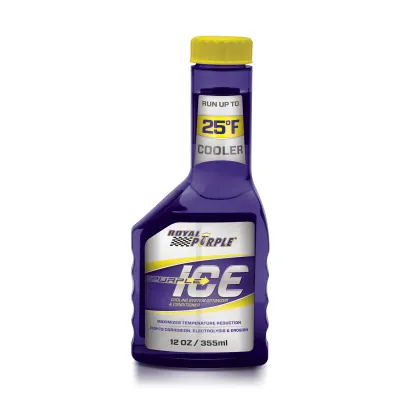
When evaluating Royal Purple products, such as their pre-mixed coolants or specialized additives like Purple Ice, you must check the labeled boiling point specifications under both standard atmospheric pressure and typical pressurized conditions. For example, a standard 50/50 ethylene glycol and water mixture typically boils at around 108°C at sea level, but under a 15-psi radiator cap, that boiling point rises to approximately 129°C. You must verify that the Royal Purple product you are considering meets or exceeds these thermal thresholds to ensure a sufficient safety margin when your engine is under heavy load in midday traffic.
Boiling Point Verification Steps:
- Locate the Technical Data Sheet: Access the official manufacturer documentation for the specific Royal Purple coolant product.
- Identify the Dilution Ratio: Note whether the boiling point is specified for a neat (undiluted) fluid, a 50/50 mix, or a different ratio.
- Check the Pressure Rating: Look for the boiling point listed at 15 psi (1.03 bar) to understand its real-world performance inside a pressurized system.
- Compare with OEM Minimums: Ensure this temperature exceeds the maximum operating temperature specified by your vehicle manufacturer by a safe margin (typically at least 15°C to 20°C).
Verifying Chemical Formulation and Compatibility
Coolants are formulated using different chemical inhibitor technologies to protect the cooling system’s diverse metallurgy from corrosion, cavitation, and scale buildup. The three primary formulations are Inorganic Additive Technology (IAT), Organic Acid Technology (OAT), and Hybrid Organic Acid Technology (HOAT). Each formulation uses a distinct chemical pathway to create a protective barrier on metal surfaces. For instance, older vehicles often rely on silicates and phosphates (IAT), while modern European and Asian vehicles typically require specialized OAT or HOAT formulations that are free of silicates, borates, or phosphates.
Using the incorrect chemical formulation can have disastrous consequences, particularly in a high-heat environment like Singapore where chemical reactions are accelerated. If an incompatible coolant is introduced, the corrosion inhibitors can precipitate out of the liquid, forming a thick, abrasive sludge. This sludge can clog the ultra-fine passages of your radiator and heater core, restrict fluid flow, and cause premature wear on the water pump’s mechanical seals. Furthermore, the wrong chemistry can actively corrode aluminum cylinder heads, copper radiator cores, or degrade the specific elastomer compounds used in your vehicle’s hoses and gaskets.
You must never assume that a premium brand name guarantees universal compatibility. You must read the Royal Purple product label carefully to identify its underlying chemistry. The label must explicitly state that it is compatible with the specific metals and elastomers used in your engine. If your vehicle requires a phosphate-free OAT coolant, verify that the Royal Purple product is certified as such. Do not rely on generic “universal” claims unless the product documentation explicitly lists your vehicle’s specific material requirements.
Matching Coolant to Your Vehicle's Manufacturer Requirements
Regardless of any aftermarket performance claims, your vehicle’s Original Equipment Manufacturer (OEM) specifications must always take precedence. Automotive engineers design cooling systems with specific flow rates, operating pressures, metallurgy, and gasket materials in mind. The coolant specified in your owner’s manual is chemically tailored to protect those exact materials and maintain the system’s designed thermal efficiency.
To ensure warranty compliance and system safety, you must consult your vehicle’s owner’s manual or workshop manual to locate the exact OEM coolant specification code. This is typically an alphanumeric standard, such as G12/G13 for Volkswagen Group vehicles, Type 2 for Honda, Super Long Life Coolant (SLLC) for Toyota, or specific MB-Approval numbers for Mercedes-Benz. These standards dictate not only the base chemistry but also the specific additive packages required to prevent cavitation and galvanic corrosion in that particular engine family.
Once you have identified your vehicle’s OEM specification, you must cross-reference it with the Royal Purple product documentation. A reliable aftermarket coolant will explicitly list the OEM standards it meets or exceeds on its technical data sheet. If the Royal Purple product does not explicitly list your vehicle’s required specification, you should avoid using it. Using a non-compliant fluid, even one marketed as high-performance, can lead to localized boiling, accelerated component degradation, and voided vehicle warranties.
In Singapore’s demanding climate, adhering strictly to OEM chemical requirements is the safest and most effective way to maintain cooling efficiency. The continuous thermal cycling of stop-and-go driving accelerates the breakdown of chemical additives. An OEM-approved fluid is guaranteed to have the correct balance of stabilizers and inhibitors to withstand this continuous stress without breaking down prematurely or damaging the internal surfaces of your cooling system.
Maintenance and Monitoring in a Tropical Climate
Operating a vehicle in a year-round tropical environment like Singapore qualifies as “severe driving conditions” under almost all manufacturer guidelines. Consequently, the cooling system requires more frequent monitoring and maintenance to ensure it continues to perform optimally, regardless of the coolant brand you choose to run.
Regular visual inspections are your first line of defense against cooling system failure. You should check the coolant expansion tank or overflow reservoir at least once a month. Ensure the fluid level rests consistently between the “Min” and “Max” (or “Cold” and “Hot”) markings. Because coolant naturally expands as it heats up and contracts as it cools, checking the level when the engine is completely cold provides the most accurate baseline. A sudden drop in fluid level, even without visible puddles under the car, is a strong indicator of a slow leak or internal consumption that requires immediate professional diagnosis.
Cooling System Component Checklists:
- Radiator Hoses: Inspect all rubber hoses for signs of swelling, softening, hardening, or cracking. Pay close attention to the connections near hose clamps, as the constant thermal cycling can cause the rubber to degrade and lose its structural integrity.
- Radiator Cap: Examine the rubber seal on the radiator cap. If the seal is cracked, torn, or compressed, the cap will fail to maintain the correct system pressure, lowering the coolant's boiling point and increasing the risk of overheating.
- Radiator Fins: Inspect the front of the radiator for accumulated road debris, leaves, or bent cooling fins. Blocked or damaged fins restrict airflow, severely reducing the radiator's ability to dissipate heat.
- Fluid Color and Clarity: Observe the color of the coolant in the reservoir. It should be bright and translucent. If the fluid appears cloudy, rusty, or brown, it indicates that the corrosion inhibitors have depleted or that contamination has occurred, necessitating a immediate system flush.
In Singapore’s high-heat environment, chemical additives in the coolant break down more rapidly than they would in temperate climates. To prevent the accumulation of scale and acid buildup, you should adhere to a strict flushing and replacement schedule. While some modern long-life coolants claim service lives of up to five years, a professional flush every two to three years (or according to your vehicle’s severe-service maintenance schedule) is highly recommended to maintain maximum thermal transfer efficiency.
Finally, you must observe critical safety boundaries when performing any cooling system maintenance. Never open a radiator cap or expansion tank cap when the engine is hot or operating. The cooling system is highly pressurized, and the fluid inside is superheated far past its normal boiling point. Opening the cap releases this pressure instantly, causing the coolant to boil violently and spray scalding liquid and steam out of the filler neck. This can cause severe, life-altering burns. Always allow the engine to cool completely—typically for at least several hours—before attempting to open the cap or service any part of the cooling system. If you are unsure of the correct procedure, always consult a qualified automotive professional.
Frequently Asked Questions (FAQ)
Can I mix Royal Purple coolant with my existing factory coolant?
You should not mix Royal Purple coolant with your existing factory coolant unless the product label explicitly states that it is universally compatible with the specific chemistry currently in your vehicle. Mixing different coolant formulations—such as combining an Organic Acid Technology (OAT) fluid with an older Inorganic Additive Technology (IAT) or Hybrid OAT (HOAT) fluid—can trigger a negative chemical reaction. This reaction often causes the protective additives to precipitate out of solution, creating a thick gel or sludge that can block the narrow passages of your radiator and water pump, leading to rapid engine overheating. To safely switch to a Royal Purple coolant, a complete system flush with distilled water is highly recommended to remove all traces of the old fluid.
Does a higher boiling point coolant guarantee no overheating in Singapore traffic?
No, using a coolant with a higher boiling point does not guarantee that your engine will not overheat in Singapore’s heavy traffic. The coolant is only one component of a highly complex, interdependent mechanical system. A high-boiling-point fluid cannot compensate for mechanical failures such as a seized thermostat, a failed radiator fan motor, a worn water pump impeller, a leaking hose, or a radiator core that is internally clogged with scale. While a premium coolant provides a larger thermal safety margin, preventing overheating in stop-and-go tropical traffic requires the entire cooling system to be fully functional, properly pressurized, and meticulously maintained according to OEM guidelines.
Community discussion
Share your experience or ask a question. Comments are reviewed before publication.