
The choice between a retractable and a standard USB-C cable for your car depends entirely on your cabin layout, device mounting position, and tolerance for clutter. There is no universal winner; retractable designs excel at keeping the console tidy, while standard cables offer flexible reach and simpler mechanics. This guide breaks down the practical trade-offs in convenience, durability, and power delivery to help you select the right form factor for your daily drive.
Cable Management and Daily Convenience
Modern car cabins are increasingly compact, with center consoles packed with cup holders, gear selectors, and wireless charging pads. In this environment, cable management becomes a daily priority. Standard USB-C cables, while reliable, are notorious for creating visual and physical clutter. A loose cable can easily drape over climate controls, wrap around the gear shifter, or fall into cup holders, making it a constant nuisance during your drive.
Retractable USB-C cables, such as those designed by Baseus, solve this issue by using an internal spring-loaded spool. This mechanism allows you to pull out only the exact length of cable required to reach your phone mount, keeping the rest neatly wound inside a central housing. When you are finished charging, a quick tug retracts the entire cable back into its housing, leaving your center console completely clear.
Products mentioned in this guide

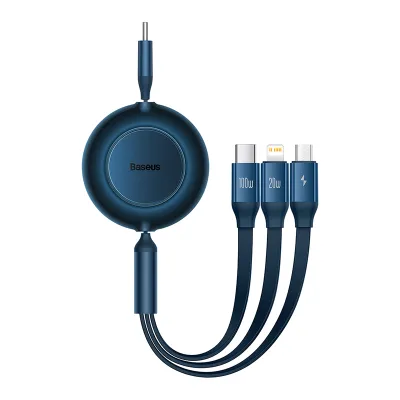
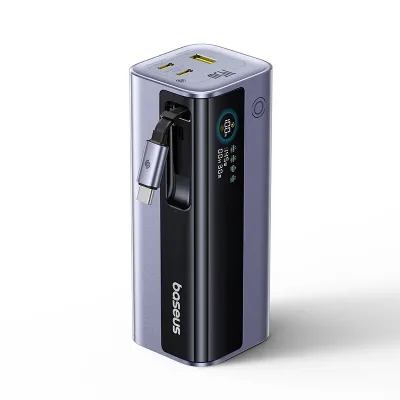
Prices are valid at publication and may change. Please refer to the product page for the latest price.
However, this convenience comes with a trade-off in how you interact with the cable. Most retractable designs require a dual-ended pull mechanism. To extend or retract the cable safely, you must pull both ends simultaneously to keep the internal spool balanced. Pulling from only one side can cause the flat ribbon cable to jam or wind unevenly. Standard cables, by contrast, require no special handling; they are always ready to plug in, even if they require manual coiling to keep the cabin tidy.
Durability and Mechanical Wear Points
The physical lifespan of an in-car cable is heavily influenced by the constant vibrations, temperature swings, and physical pulling inherent to a vehicle environment. Standard and retractable cables fail in entirely different ways due to their structural designs.

Standard cables typically fail at the collar—the junction where the flexible cable meets the rigid connector housing. When a phone is mounted on a dashboard or windshield, the cable often hangs at a sharp angle, putting constant strain on this joint. Over time, repeated bending causes the outer jacket to split, exposing the internal copper wires. To prevent this, high-quality standard cables utilize reinforced strain relief boots and durable outer jackets made of braided nylon or aramid fibers.
Retractable cables introduce mechanical complexity, which creates additional failure points. Instead of a round, heavily shielded wire, retractable cables use a thin, flat ribbon cable that can wind tightly around the internal spool. Every retraction cycle causes this flat cable to slide against itself and the plastic housing, leading to friction wear. Furthermore, the internal steel tension spring can lose its elasticity over time, especially when exposed to high cabin temperatures. If the spring weakens or the internal locking pawl wears down, the cable may fail to retract or refuse to stay locked at your desired length. When shopping for a retractable cable, it is essential to check the build materials of the housing and opt for low-friction TPE ribbon designs that resist binding.
Power Delivery and Charging Compatibility
A common misconception is that retractable cables are inherently slower than standard cables. In reality, the physical form factor does not dictate charging speed. Power delivery is determined by the internal wire gauge, the presence of an e-marker chip for high-wattage connections, and compliance with charging protocols.
Standard cables have ample physical space to accommodate thick copper conductors (often 20 to 24 AWG for power lines) along with robust shielding layers. This allows them to easily support high-wattage Power Delivery (PD) profiles, such as 60W, 100W, or even 240W. If you need to charge a power-hungry tablet or a laptop in your car, a standard high-wattage cable is the most reliable option.
Retractable cables must use thin, flat ribbon wires to fit within their compact spool housings. Because the conductors must remain thin, they naturally have higher electrical resistance over longer distances. While advanced retractable cables are engineered to support fast charging up to 60W or 100W, many budget options are limited to standard 15W or 18W charging. Before purchasing, you must verify the maximum wattage supported by both the cable packaging and your car’s power source. Ensure the cable supports the specific Power Delivery or Quick Charge profile required by your smartphone to avoid creating a charging bottleneck.
Safety and In-Car Environment Factors
The automotive cabin is a harsh environment that demands careful attention to product safety. In tropical climates like Singapore, interior temperatures of a parked car can easily exceed 60°C under direct sunlight. This extreme heat can degrade plastic housings, weaken internal springs in retractable mechanisms, and soften adhesives. Always check the operating temperature range on the product label before leaving any cable permanently in your vehicle.
Physical safety while driving is another critical consideration. A loose standard cable dangling from a dashboard mount can easily slip off the console and slide into the driver’s footwell. If the cable becomes lodged under the brake or accelerator pedal, it poses a severe safety hazard. A retractable cable eliminates this risk by keeping excess length wound up and out of the way.
However, retractable cables present a unique thermal consideration. When high current passes through a coiled wire, heat can build up due to the lack of ventilation within the housing. If you are fast-charging a device at high wattages, it is a safe electrical practice to pull the retractable cable out to its full extension. This allows heat to dissipate from the flat ribbon cable rather than trapping it inside the plastic spool housing, preventing potential thermal degradation.
Decision Framework: Which Cable Fits Your Driving Style?
To make the final choice, map your daily driving habits and cabin layout against the characteristics of each cable type.
Choose a retractable USB-C cable if:
- Your phone mount is positioned close to the USB port, requiring a short, neat connection.
- You prioritize a clutter-free center console and want the cable completely hidden when not in use.
- You are the primary driver and rarely need to pass the charging phone to passengers in the rear seats.
- You are willing to handle the cable with care, pulling from both ends simultaneously to preserve the spring mechanism.
Choose a standard USB-C cable if:
- You need a long cable that can easily reach the rear seats or allow passengers to use the phone comfortably while charging.
- You prefer a simple, fail-proof design with no moving parts or mechanical wear points.
- You frequently use wired smartphone projection systems like Android Auto or Apple CarPlay, which require highly stable, high-bandwidth data connections.
- You need to charge high-power devices like laptops or tablets that require thick-gauge, high-wattage power delivery.
Before purchasing, inspect your car’s port placement and phone mount location. Measuring the actual distance and visualizing the cable path will ensure you select the form factor that best enhances your daily drive.
Frequently Asked Questions (FAQ)
Can I use a retractable USB-C cable for Android Auto or Apple CarPlay?
Wired smartphone projection systems require a high-speed, stable data connection to function reliably. Many compact retractable cables are designed primarily for charging and may only support slow USB 2.0 data transfer speeds (480 Mbps) or omit data lines entirely to keep the ribbon cable thin. If you plan to use wired Android Auto or Apple CarPlay, check the product specifications to ensure the cable is rated for data transfer and matches the requirements of your car’s infotainment system. A high-quality standard USB-C cable is generally the more reliable choice for wired projection due to its superior shielding and stable connection.
Does leaving a standard cable plugged in drain the car battery?
In most modern vehicles, the USB ports and 12V accessory outlets are switched, meaning power is cut off when the ignition is turned off or shortly after the doors are locked. In these vehicles, leaving a cable plugged in with no phone attached will not drain the battery. However, some older vehicles or specific models keep these ports constantly powered. While an idle cable with no device attached draws virtually zero current, it is best to consult your vehicle’s owner’s manual to verify how the accessory power behaves when the engine is off. If your ports remain active, unplugging the cable or adapter when parking for extended periods is a safe habit to prevent any potential parasitic drain.

Community discussion
Share your experience or ask a question. Comments are reviewed before publication.