
To match a portable tyre pump to your vehicle’s tyres, you must ensure the pump’s maximum pressure rating (PSI) exceeds your tyre’s maximum sidewall pressure by at least 20 to 30 PSI. This buffer prevents the pump motor from stalling or overheating as it reaches the target pressure. Additionally, select a pump with a flow rate of at least 25 to 35 Litres per minute (L/min) to avoid excessively long inflation times, and verify that the connector matches your tyre’s standard Schrader valve.
Selecting the wrong specifications can leave you stranded with an overheated motor or an incompatible nozzle. By understanding how these technical metrics translate to real-world performance, you can choose a reliable tool that keeps your vehicle safe and road-ready.
Maximum PSI: Matching Pump Capacity to Tire Sidewall Limits
Every tyre has two distinct pressure metrics that you must understand before buying a portable pump tyre inflator. The first is the recommended cold inflation pressure, which is specified by your vehicle manufacturer and typically found on a placard inside the driver’s door B-pillar or in the owner’s manual. The second is the absolute maximum inflation pressure, which is embossed directly onto the tyre’s sidewall.
Products mentioned in this guide
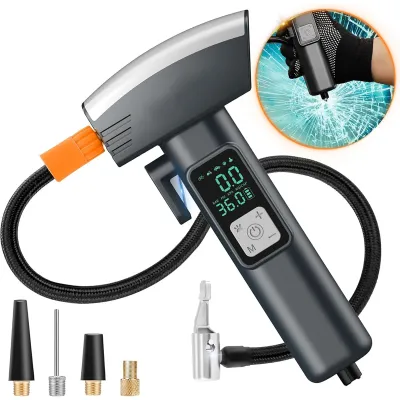
![[SG Stock] Air Pump Car Inflator Compressor Portable Ball Bike Bicycle Rechargeable Basketball Soccer Volleyball Tyre Wheel Tire 12V LED Fast Auto Shut-off Emergency](https://img.lazcdn.com/g/p/cc7d92c566c3860fbbfa1d535cc6f3bb.jpg_400x400q80.jpg_.webp)
![[SG Seller]Portable Car Electric Inflator portable air pump car electric pump wireless air pump car electric pump汽车充气泵](https://img.lazcdn.com/g/p/11d7062f8a657612c19945cd3cdafcdb.jpg_400x400q80.jpg_.webp)
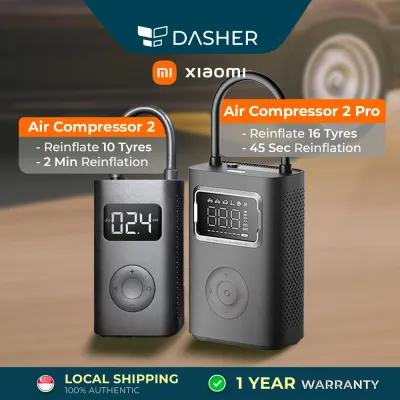
![[LH7W] Bike Air Pump Portable Bicycle Pump Hand Air Pumps with Schrader Valve for Bike Tires Balls Balloons](https://img.lazcdn.com/g/p/a25ed6b70dc7d6221dfcf03b31a98d23.jpg_400x400q80.jpg_.webp)
Prices are valid at publication and may change. Please refer to the product page for the latest price.
Your portable pump’s maximum rated PSI must be significantly higher than both of these numbers. If your tyre requires 35 PSI and your pump is rated for a maximum of only 40 PSI, the pump’s motor will experience extreme strain as it approaches that limit. As backpressure from the tyre increases, the motor slows down, draws more current, and generates intense heat, which can lead to premature tool failure.
For standard passenger cars and compact hatchbacks, a pump rated for 100 to 120 PSI offers an excellent safety margin. If you drive a larger SUV, a light commercial van, or a 4×4 vehicle, your tyres may require higher working pressures, especially when carrying heavy loads. For these larger vehicles, look for a heavy-duty portable pump rated for 150 PSI to ensure the motor can push air against high backpressure without straining.
Flow Rate (L/min): Estimating Inflation Speed for Different Tires
Flow rate, measured in Litres per minute (L/min), dictates how much volume of air the pump can move into the tyre over a given timeframe. While PSI represents the pump’s pushing power, flow rate represents its speed. This distinction is critical because high-volume tyres require a massive amount of physical air to raise their pressure even by a few PSI.

When shopping for a portable pump tyre inflator, look for manufacturer-provided inflation times rather than relying solely on the raw L/min rating. Manufacturers often state how many minutes it takes to inflate a standard tyre size (such as a 195/65R15) from 0 to 30 or 35 PSI. Comparing these real-world times gives you a much better sense of practical performance than a theoretical free-flow L/min rating measured at zero resistance.
Actual inflation speed will always vary based on several environmental and physical factors. A longer air hose introduces more friction, which slightly reduces the flow rate at the nozzle. Furthermore, the stability of the power source plays a major role; a pump running on a weak battery or a fluctuating electrical connection will experience drops in motor speed, lengthening your time spent on the roadside.
Valve Compatibility and Nozzle Adapters
Before purchasing any portable tyre pump, you must ensure that its nozzle can physically connect to your wheel’s valve stem without leaking. The overwhelming majority of passenger cars, SUVs, motorcycles, and utility vehicles use the Schrader valve, which features a threaded outer metal stem and a spring-loaded internal pin. Almost every automotive portable pump comes standard with a Schrader-compatible nozzle.
If you also plan to use your pump for high-performance road bicycles, you will likely encounter the narrower Presta valve. To use an automotive pump on a Presta valve, you must use a brass or plastic threaded adapter, which is often included in the pump’s accessory kit. Always check the product packaging to verify which adapters are supplied.
How the nozzle connects to the valve stem also affects usability and air retention:
- Screw-on Nozzles: These thread directly onto the valve stem. While they provide a highly secure, leak-free seal during inflation, they can be tedious to remove. As you unscrew the brass collar, a small amount of air inevitably escapes, which can lower your final tyre pressure by 1 to 2 PSI.
- Quick-Connect Chucks: These use a thumb-lock lever or a snap-on collar to clamp onto the valve stem instantly. They are highly efficient and minimize air loss during disconnection, making it much easier to maintain precise pressure targets.
Duty Cycle and Power Source: Managing Heat and Runtime
Air compression naturally generates a massive amount of heat due to thermodynamics. Because portable pumps are designed to be compact and lightweight, they have limited surface area and internal cooling mechanisms to dissipate this heat. This physical limitation is governed by the pump’s “duty cycle,” which is the percentage of time a pump can safely run within a given period before requiring a mandatory cool-down phase.
For example, a pump with a 15-minute duty cycle at a specific pressure requires at least 15 to 20 minutes of rest after running continuously for 15 minutes. Ignoring these limits can cause the internal piston seals to melt, ruin the motor windings, or cause the outer casing to become dangerously hot to the touch. Always refer to your product manual to verify these continuous run limits before attempting to inflate multiple large tyres from flat.
Your choice of power source directly impacts both the duty cycle and the pump’s overall performance:
- 12V DC (Cigarette Lighter) Pumps: These draw power directly from your vehicle's electrical system. Because they rely on a constant supply of energy from a running car engine, they can generally sustain longer continuous runtimes and offer more consistent motor performance.
- Rechargeable Battery-Powered Pumps: These cordless, lithium-ion models offer unmatched convenience, especially in tight multi-storey car parks where running a long 12V cable is impractical. However, as the internal battery drains, the voltage drops, which can cause the motor to run slower and hotter, shortening the safe continuous runtime.
Always consult your vehicle’s manual to ensure your 12V power outlet can handle the amperage draw of your chosen pump. Some heavy-duty pumps draw upwards of 15 to 20 amps, which can blow standard 10-amp fuses unless connected directly to the vehicle’s battery terminals using alligator clips.
Frequently Asked Questions (FAQ)
Can I use a standard car portable pump for high-pressure bicycle tires?
Yes, many automotive portable pumps can easily reach the high PSI levels required by narrow road bike tyres (often 80 to 100+ PSI). However, because road bike tyres have a very low physical volume, a high-flow car pump can fill them incredibly fast. You must monitor the pressure gauge closely to prevent over-inflation, which can easily rupture the inner tube.
Does a higher maximum PSI rating mean the pump inflates faster?
No, a higher maximum PSI rating does not correlate with faster inflation times. The maximum PSI only indicates the peak pressure limit the pump can overcome before stalling. The actual speed of inflation is determined entirely by the pump’s flow rate (L/min) and the motor’s ability to maintain high RPM under load.
Community discussion
Share your experience or ask a question. Comments are reviewed before publication.