
Choosing the right engine oil for your vehicle is not a matter of finding a universally ideal product, but rather identifying the formulation that matches your engine’s specific design and emission systems. When comparing Motul 8100 X-clean and Motul 8100 X-cess, the correct choice is determined entirely by your vehicle manufacturer’s original equipment manufacturer (OEM) specifications. These two popular fully synthetic oils belong to the same premium Motul 8100 family, yet they are engineered with fundamentally different chemical profiles to serve distinct mechanical purposes.
The primary distinction between these two product lines lies in their SAPS content, which stands for Sulphated Ash, Phosphorus, and Sulphur. Motul 8100 X-clean is formulated as a mid- or low-SAPS lubricant, meaning it contains reduced levels of these chemical compounds. This design is specifically engineered to protect modern exhaust after-treatment systems, such as Diesel Particulate Filters (DPF) and Gasoline Particulate Filters (GPF), which can easily become clogged or deactivated by high levels of ash and phosphorus.
Conversely, Motul 8100 X-cess is a high-SAPS (or full-SAPS) engine oil. It is formulated with a robust package of traditional detergents and anti-wear additives designed to provide robust protection for engines that do not utilize sensitive particulate filters. These high-SAPS additives are highly effective at neutralizing acids and preventing wear in older engines or specific high-performance gasoline and diesel engines that vent exhaust gases directly without complex filtration systems.
Products mentioned in this guide
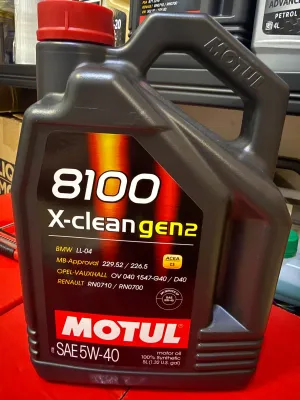
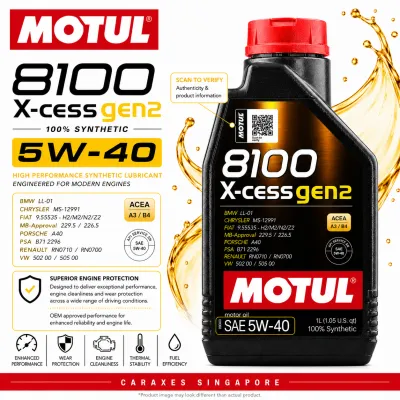
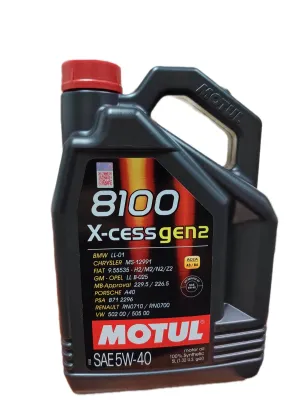
3 Lazada user ratings
Seller responsive, packs fast and ships fast. Product arrived in good condition. Looks genuine with QR sticker and good quality packaging. H…Read full reviewShow less
Seller responsive, packs fast and ships fast. Product arrived in good condition. Looks genuine with QR sticker and good quality packaging. Have not used oil yet
Been on Motul for over a decade, no complaints. Quick to confirm order and pack, delivery took just a day.
Prices are valid at publication and may change. Please refer to the product page for the latest price.
Using a high-SAPS oil like X-cess in an engine designed for a low-SAPS oil like X-clean can lead to rapid accumulation of ash in the particulate filter, eventually resulting in restricted exhaust flow, reduced fuel efficiency, and expensive component failures. On the other hand, using a low-SAPS oil in an older engine that requires high-SAPS protection might result in insufficient additive reserves over long drain intervals. Therefore, understanding the specific requirements of your vehicle’s exhaust and internal components is the essential first step in making the correct selection.
How to Match the Oil to Your Vehicle's OEM Specifications
To determine whether your car requires Motul 8100 X-clean or X-cess, you must consult your vehicle’s owner’s manual to locate the required OEM oil specifications. Manufacturers do not merely recommend a viscosity grade; they establish precise performance standards that address the metallurgy, seal materials, and emission controls of their engines. These standards are typically represented by alphanumeric codes, such as BMW Longlife-04, Mercedes-Benz MB-Approval 229.51, or Volkswagen VW 502 00 and 505 00.
When you examine the owner’s manual, look for both the manufacturer-specific codes and the broader international classifications, such as those from the European Automobile Manufacturers’ Association (ACEA) or the American Petroleum Institute (API). For example, the European Automobile Manufacturers’ Association (ACEA) divides engine oils into different classes. The “A/B” class (such as A3/B4) is intended for passenger car gasoline and light-duty diesel engines without after-treatment systems. These oils are high-SAPS and focus on high shear stability and wear protection over long drain intervals. On the other hand, the “C” class (such as C3) is specifically designed for catalyst-compatible oils. These are low- or mid-SAPS oils designed to be safe for use with DPFs and GPFs. Understanding these broad categories helps you interpret why Motul 8100 X-clean carries ACEA C3 ratings, while Motul 8100 X-cess carries ACEA A3/B4 ratings.
Once you have identified your vehicle’s required specifications, you must cross-reference them directly with the technical certifications printed on the back label of the Motul bottle. Motul 8100 X-clean typically carries approvals such as BMW Longlife-04, MB-Approval 229.51, and Porsche C30, aligning with modern emission-compliant standards. Motul 8100 X-cess, on the other hand, carries approvals like BMW Longlife-01, MB-Approval 229.5, Porsche A40, and VW 502 00 / 505 00, which are classic high-SAPS specifications.
It is critical to understand that these labels are not interchangeable, and a physical check of the container is necessary before any oil change. Even within the same vehicle brand, different model years or engine variants may require completely different oil standards. For example, a Mercedes-Benz gasoline engine from an older generation might require MB-Approval 229.5 (X-cess), while a newer diesel or direct-injection gasoline model from the same brand might strictly demand MB-Approval 229.51 or 229.52 (X-clean).
Ignoring these specific OEM approvals poses significant mechanical risks. Using an oil that lacks the correct manufacturer certification can lead to accelerated wear on internal components, such as the valvetrain or timing chain, due to incompatible additive chemistry. Additionally, using an unapproved formulation can void your vehicle’s manufacturer warranty, leaving you financially responsible for any subsequent engine or emission system repairs.
Comparing Viscosity Grades and Operating Conditions
While the chemical formulation (SAPS level) is the most critical factor in choosing between X-clean and X-cess, you must also select the correct viscosity grade as recommended by your vehicle manufacturer. Viscosity refers to the oil’s resistance to flow, and it is represented by the standard SAE rating, such as 5W-30 or 5W-40. The first number, followed by the “W,” indicates the oil’s flow characteristics at low temperatures, while the second number represents its viscosity at normal engine operating temperatures.

In Singapore’s tropical climate, ambient temperatures remain consistently high throughout the year, typically ranging from 25°C to 33°C. Because freezing temperatures are non-existent locally, the cold-start rating (the “5W” portion) is less critical for preventing cold-weather engine binding than it would be in temperate regions. However, a 5W rating still ensures rapid oil circulation to the upper valvetrain immediately upon starting the engine, which is when a significant portion of engine wear occurs.
The second number in the viscosity rating is highly relevant to operating conditions in Singapore. Stop-and-go traffic, prolonged idling, and high ambient humidity place continuous thermal stress on the engine, causing internal operating temperatures to rise. A higher hot viscosity, such as a 40-weight oil (e.g., 5W-40), provides a thicker protective film over moving parts under high heat, whereas a 30-weight oil (e.g., 5W-30) offers lower resistance and improved fuel economy but a slightly thinner oil film.
In Singapore, where stop-and-go traffic is common on major expressways, engines spend significant time idling or operating at low speeds. This type of driving prevents the engine from receiving sufficient cooling airflow, which increases the thermal load on the motor oil. Under these conditions, the oil’s high-temperature high-shear (HTHS) viscosity becomes a critical factor. Both X-clean and X-cess are formulated to maintain a stable HTHS viscosity, but the specific viscosity grade you choose (such as 5W-30 or 5W-40) must match what your engine’s oil pump and bearing clearances were designed to handle. A viscosity that is too low can lead to metal-to-metal contact under extreme heat, while a viscosity that is too high can cause unnecessary drag, increasing fuel consumption and operating temperatures.
You must treat viscosity selection and formulation selection as two distinct, parallel requirements. For example, if your manual specifies a 5W-30 oil with ACEA C3 specifications, you must look for Motul 8100 X-clean in a 5W-30 grade. You cannot simply select Motul 8100 X-cess 5W-40 and assume it will perform acceptably because it is a premium synthetic oil; doing so would introduce both the wrong viscosity and the wrong chemical formulation to your engine.
Always defer to the specific viscosity chart provided in your owner’s manual, which sometimes offers options based on ambient temperature ranges. If the manual permits multiple viscosity grades for your climate, consider your typical driving habits. Frequent short trips in heavy city traffic may benefit from the specific grade recommended for standard service, while high-load driving or high-mileage engines might require the upper viscosity limit allowed by the manufacturer to maintain adequate oil pressure.
Decision Framework: Which Motul 8100 Should You Choose?
To simplify your selection process, you can apply a structured decision framework based on your vehicle’s mechanical configuration and manufacturer guidelines. This framework ensures that you do not rely on guesswork or generic recommendations, prioritizing engine safety and compliance above all else.
Choose Motul 8100 X-clean if:
- Your vehicle is equipped with a Diesel Particulate Filter (DPF), Selective Catalytic Reduction (SCR) system, or a Gasoline Particulate Filter (GPF).
- Your owner's manual explicitly specifies a mid-SAPS or low-SAPS lubricant, or lists international standards such as ACEA C3.
- Your vehicle requires specific manufacturer approvals designed for emission protection, such as BMW Longlife-04, MB-Approval 229.51/229.52, or Porsche C30.
Choose Motul 8100 X-cess if:
- Your vehicle has a traditional gasoline or diesel engine without any particulate filters or advanced exhaust after-treatment systems.
- Your owner's manual specifies a high-SAPS or full-SAPS lubricant, or lists standards such as ACEA A3/B4 or API SP/SN.
- Your vehicle requires classic high-performance manufacturer approvals, such as BMW Longlife-01, MB-Approval 229.5, Porsche A40, or VW 502 00 / 505 00.
Verify first if:
- You are driving a modern direct-injection turbocharged gasoline vehicle, as these engines have highly specific requirements to prevent Low-Speed Pre-Ignition (LSPI), which may require checking for the latest API SP or ILSAC GF-6 standards on the Motul label.
- Your vehicle is still under factory warranty, as using an oil without the exact OEM-approved code printed on the bottle can invalidate your coverage.
When applying this framework, keep in mind that some manufacturers have transitioned their specifications over time. For instance, older vehicle models requiring older specifications can safely use Motul 8100 X-cess. However, newer models requiring updated specifications must use Motul 8100 X-clean. If you own multiple vehicles, do not assume that a single bottle of Motul 8100 can be used to top up both cars unless both manuals list the exact same OEM specification. Keeping a dedicated bottle of the correct formulation for each vehicle in your garage is the most reliable practice to prevent accidental cross-contamination.
If you consult your owner’s manual and find that the required specifications are unclear, conflicting, or if the recommended codes are missing from the product labels of both X-clean and X-cess, do not proceed with the purchase. In such cases, you should stop and consult a qualified mechanic or contact the vehicle manufacturer’s authorized service center. Professional diagnostic tools and official manufacturer databases can verify the exact fluid requirements for your specific chassis and engine number, preventing costly compatibility errors.
Frequently Asked Questions (FAQ)
Can I mix Motul 8100 X-clean and X-cess?
You should avoid mixing Motul 8100 X-clean and X-cess. Because X-clean is a mid-SAPS oil and X-cess is a high-SAPS oil, mixing them alters the carefully balanced chemical profile of the lubricant. This dilution can lower the effectiveness of the anti-wear additives or raise the ash content beyond the safe threshold for vehicles with particulate filters, potentially voiding OEM compliance. If you need to switch from one formulation to the other, it is highly recommended to perform a complete oil drain and filter replacement rather than topping up one with the other.
What happens if I use X-cess in a car that requires X-clean?
Using Motul 8100 X-cess in an engine that strictly requires X-clean can cause severe damage to your vehicle’s emission control systems. The high levels of sulphated ash, phosphorus, and sulphur in X-cess will accumulate rapidly in components like Diesel Particulate Filters (DPF) or Gasoline Particulate Filters (GPF). Over time, this ash buildup blocks the micro-porous structures of the filters, leading to increased exhaust backpressure, reduced engine performance, elevated fuel consumption, and eventually, costly filter replacement or engine failure.
Where can I verify the authenticity of Motul oils in Singapore?
To ensure you are purchasing genuine Motul products in Singapore, you should buy directly from authorized workshops, official brand distributors, or recognized automotive retailers. Avoid purchasing engine oils from unverified sellers on online marketplaces or third-party ecommerce platforms, as counterfeit lubricants can cause catastrophic engine damage. When inspecting the bottle, check for intact security seals, clear and professionally printed labels, and matching batch codes and production dates stamped on the container, which can be verified with the official local distributor if you suspect any discrepancies.

Community discussion
Share your experience or ask a question. Comments are reviewed before publication.