
Selecting the right motorcycle chain lubricant requires balancing physical thickness with deep penetration. Motul offers several chain lube variants designed for different riding environments, ranging from high-speed road use to dusty off-road trails. Choosing the correct variant depends on understanding how viscosity affects fling-off resistance and how formulation differences protect your specific chain type under local weather conditions.
Understanding Viscosity and Penetration Trade-offs
Chain lubricants must perform two conflicting tasks: they must flow easily to penetrate the tight spaces between pins and rollers, yet remain thick enough to resist being flung off at high speeds. Viscosity represents the fluid’s internal friction or thickness, which directly influences film strength. A higher viscosity lubricant provides a robust protective barrier and resists fling-off, but it can be difficult to apply deeply into the chain’s internal components.
Conversely, penetration relies on low initial viscosity and capillary action to creep past outer seals and lubricate the internal pins. Many aerosol chain lubricants use volatile solvents to temporarily lower viscosity during application. Once sprayed, the solvent evaporates, leaving behind a thicker, high-viscosity protective film.
Products mentioned in this guide
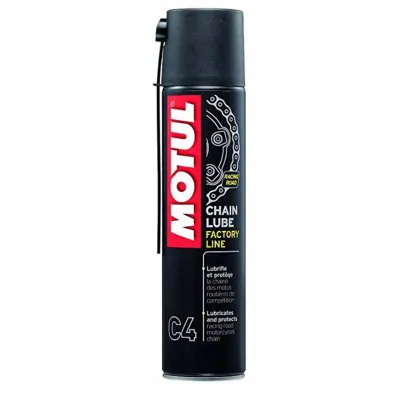
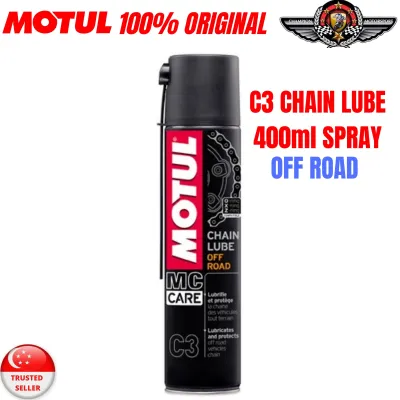
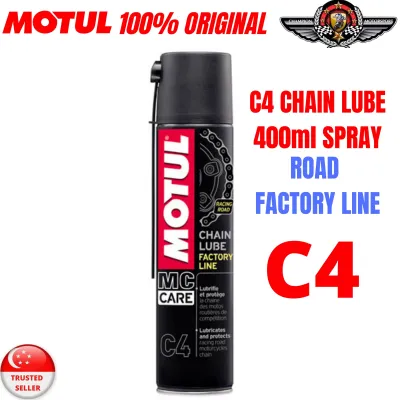
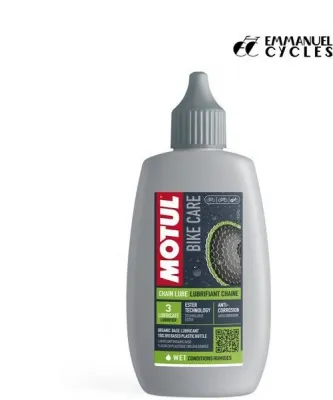
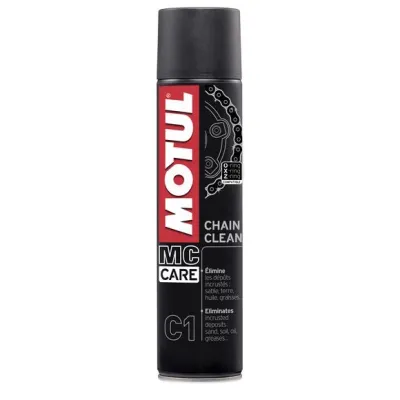
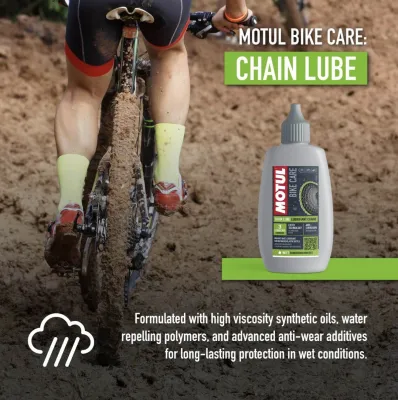
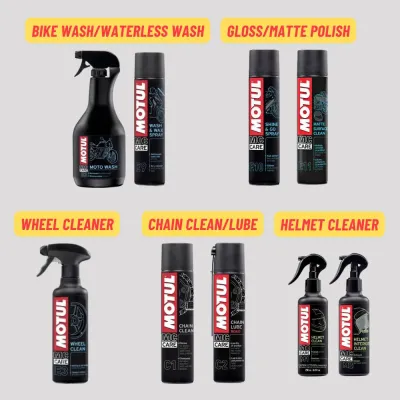
Prices are valid at publication and may change. Please refer to the product page for the latest price.
This physical trade-off means that highly adhesive, high-viscosity formulations often create a tackier surface. While this tackiness keeps the lubricant on the chain during high-speed road riding, it also tends to attract road grit, dust, and debris. When choosing a lubricant, you can gauge its physical behavior by observing the spray pattern, foaming action, and drying time indicated on the product label before applying it to your entire chain.
Reading Motul Product Labels and Formulation Claims
Motul categorizes its chain lubricants into distinct series, such as Road, Off-Road, and Racing, to help riders match the formulation to their specific riding style. These classifications are printed directly on the product labels and correspond to distinct chemical properties. Reading these labels carefully prevents you from using a formula ill-suited to your typical riding environment.

“Dry” formulations are engineered to dry completely, leaving a non-sticky protective barrier. These are designed to repel dust, sand, and dirt, making them suitable for dry off-road environments where abrasive particles could otherwise mix with wet lube to form an abrasive grinding paste. “Wet” or tacky formulations, on the other hand, remain viscous and sticky to provide high water resistance and high-load adhesion, which is essential for wet-weather commuting or long-distance touring.
Rather than relying solely on marketing terms, you should check the manufacturer’s technical data sheet (TDS) or safety data sheet (SDS) for specific additive details. These documents provide objective information regarding the solvent content, temperature limits, and water-washout resistance of each variant. This verification ensures the product matches your operational requirements.
Matching Lube Properties to Your Chain and Riding Conditions
Your motorcycle’s chain construction dictates which lubricant properties are safe to use. Sealed chains, such as O-ring, X-ring, or Z-ring designs, feature rubber seals that lock factory grease inside the internal pins and rollers. For these chains, the primary role of an external lubricant is to keep the rubber seals pliable and protect the outer rollers and sprockets. You must verify solvent and formulation compatibility with your chain manufacturer’s guidelines, as incompatible chemicals can cause the rubber seals to swell, crack, or degrade prematurely.
Unsealed chains lack these rubber barriers, meaning the lubricant must penetrate directly into the internal pins to prevent metal-on-metal wear. These chains require more frequent application of a highly penetrative lubricant. Your riding environment also dictates the ideal balance: wet commuting demands high water wash-off resistance, dry and dusty off-road riding requires a dry-film formula to minimize dust attraction, and high-speed track riding requires high fling-off resistance.
Always consult your motorcycle’s owner’s manual to verify the recommended chain maintenance procedures and compatibility requirements before applying any aftermarket care products. If your chain exhibits signs of severe wear, rust, stiff links, or damaged rubber seals, stop riding and consult a qualified mechanic. No lubricant can restore a structurally compromised chain, and continuing to ride on a damaged chain poses a safety risk.
Application Steps and Post-Ride Maintenance Checks
To ensure your chosen chain lubricant performs as intended, proper preparation is mandatory. You must thoroughly clean and dry the chain before applying any new product. Applying fresh lubricant over old, grit-laden grime traps abrasive particles against the metal surfaces, which accelerates wear on both the chain and sprockets. Use a dedicated chain cleaner safe for your specific seal type, and ensure the chain is completely dry before proceeding.
When applying the lubricant, target the inside run of the chain rollers while slowly rotating the rear wheel by hand. This allows centrifugal force to push the lubricant outward into the rollers as you ride, rather than flinging it off immediately. After application, allow the lubricant to cure or dry for the manufacturer’s recommended time before riding. This curing period allows the carrier solvents to evaporate, leaving behind the protective, high-viscosity film.
Regular post-ride checks will help you determine if your chosen formulation is performing correctly. Look for signs of excessive fling-off on your rear wheel or swingarm, dry metal-on-metal spots on the rollers, or unusual squeaking during operation. These observable conditions indicate that the current formulation may not suit your riding environment or that the application process needs adjustment.
Frequently Asked Questions (FAQ)
Can I use any Motul chain lube on an O-ring or X-ring chain?
While many modern chain lubricants are formulated to be safe for sealed chains, you must always verify the specific product label and your chain manufacturer’s instructions before application. Avoid using unverified solvents, generic degreasers, or lubricants that are not explicitly marked as safe for O-ring or X-ring chains. Incompatible chemicals can degrade, swell, or destroy the rubber seals, leading to premature chain failure.
How often should I reapply chain lube?
Reapplication frequency depends heavily on your specific riding conditions rather than a strict mileage schedule. For example, you should clean and relubricate your chain after riding in heavy rain, washing your motorcycle, or riding in dusty off-road environments. For dry highway commuting, intervals can be longer. Rely on visual and auditory checks—such as a dry appearance, visible rust spots, or squeaking—to determine when your chain requires attention.
Community discussion
Share your experience or ask a question. Comments are reviewed before publication.