
Selecting the correct engine oil viscosity is critical for your motorcycle’s longevity, gear performance, and power delivery. When comparing the three popular viscosity grades of Motul 7100—10W-40, 10W-50, and 20W-50—there is no single, universally superior option. Instead, the correct choice is dictated by your motorcycle manufacturer’s design specifications, the ambient temperature of your riding environment, and the mechanical wear level of your engine.
For the vast majority of modern, liquid-cooled motorcycles operating under standard riding conditions, Motul 7100 10W-40 serves as the default benchmark. This viscosity grade offers a highly balanced profile, providing rapid oil circulation during cold starts while maintaining excellent shear stability at normal running temperatures. It is highly suited for daily commuting and general street riding where the engine is designed for tighter tolerances.
If you ride in a consistently hot, tropical climate—such as Singapore’s year-round high temperatures—or regularly subject your motorcycle to severe operating conditions like congested stop-and-go urban traffic, Motul 7100 10W-50 provides a highly versatile upgrade. This grade retains the easy cold-start characteristics of a 10W oil but delivers a thicker, more resilient protective oil film at elevated engine temperatures. It is an exceptional choice for riders who demand extra protection during high-RPM highway cruising or track days.
Products mentioned in this guide
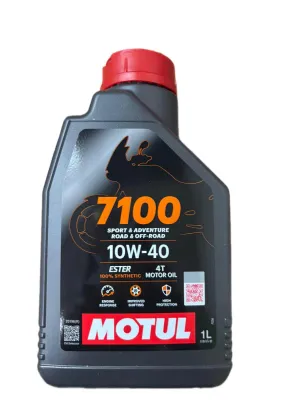
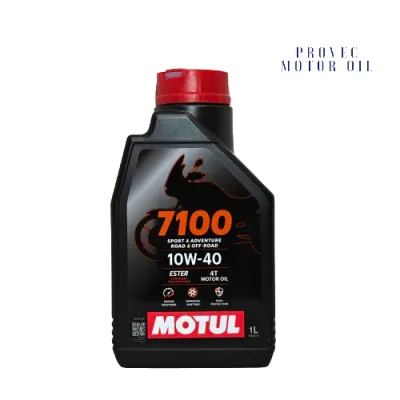
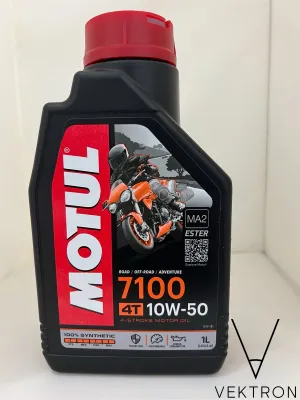
![🇸🇬 MOTUL 7100 4T 10W40 10W50 15W50 100% Synthetic Ester Engine Oil Motorcycle Oil [1L]](https://img.lazcdn.com/g/p/00450279a13a350708397ff343c39c19.png_400x400q80.png_.webp)
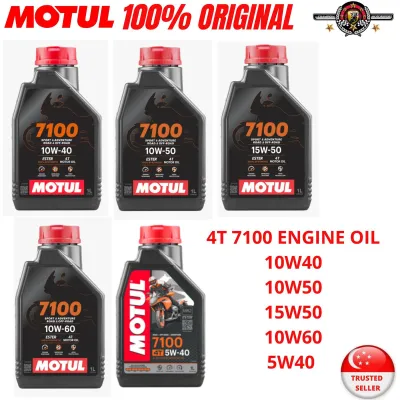
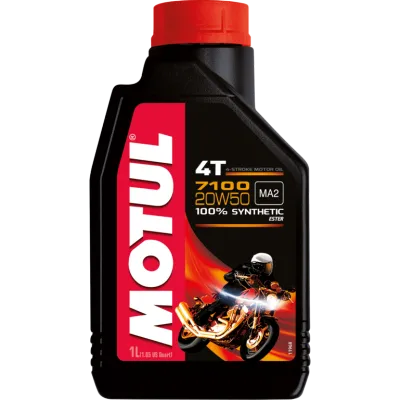
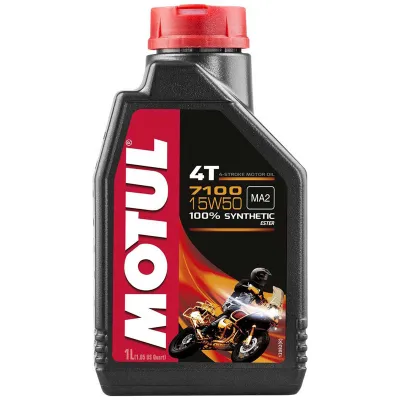
Prices are valid at publication and may change. Please refer to the product page for the latest price.
For older motorcycles, large-displacement air-cooled engines, or high-mileage machines that exhibit signs of internal wear, Motul 7100 20W-50 is the most appropriate selection. The thicker base oil profile of a 20W-50 lubricant is specifically engineered to seal wider clearances between piston rings and cylinder walls, maintain stable oil pressure in hot operating conditions, and minimize oil consumption. It acts as a physical cushion for older mechanical components, reducing engine noise and protecting critical parts from boundary wear.
While these guidelines provide a reliable starting point, your motorcycle’s owner’s manual remains the ultimate authority on oil selection. Deviating from the manufacturer’s recommended viscosity range should only be done with a clear understanding of the mechanical trade-offs involved, as using an incorrect oil thickness can directly impact lubrication efficiency, fuel economy, and wet clutch operation.
Decoding the Numbers: What 10W-40, 10W-50, and 20W-50 Actually Mean
To make a well-informed choice among these three fully synthetic lubricants, it is essential to understand the Society of Automotive Engineers (SAE) J300 engine oil viscosity classification system. This standard defines how engine oils flow at both extremely low and high operating temperatures. Because Motul 7100 is a multigrade oil designed for four-stroke (4T) motorcycle engines, it features a dual-rating system separated by the letter ‘W’, which stands for ‘Winter’. This design allows the oil to remain fluid enough for cold-weather starting while retaining sufficient body to protect the engine when fully warmed up.
The first number in the sequence, followed by the ‘W’ (such as 10W or 20W), represents the oil’s low-temperature flow characteristics, measured through cold-cranking and cold-pumping viscosity tests. A lower number indicates that the oil remains more fluid at low temperatures, requiring less energy from the starter motor to crank the engine and allowing the oil pump to distribute lubrication rapidly to the cylinder head during startup. In this comparison, Motul 7100 10W-40 and 10W-50 share the same low-temperature rating of 10W. This means that upon startup, both oils exhibit identical flow characteristics and offer rapid oil pressure buildup, whereas the 20W-50 grade is significantly thicker and more resistant to flow at cold temperatures.
The second number in the sequence (the 40 or 50) designates the oil’s kinematic viscosity measured at 100°C (212°F), which is the standard operating temperature benchmark for a fully warmed-up engine. This rating dictates the thickness of the oil film protecting internal components under thermal load. A 40-weight oil (like 10W-40) has a lower kinematic viscosity at 100°C, typically ranging between 12.5 and 16.3 centistokes (cSt). A 50-weight oil (like 10W-50 or 20W-50) is thicker at operating temperatures, with a kinematic viscosity ranging between 16.3 and 21.9 cSt, providing a more robust physical barrier between moving metal parts under extreme heat.
By utilizing a 100% synthetic formulation based on high-quality esters, Motul 7100 achieves these wide viscosity spans without relying excessively on unstable polymeric viscosity index improvers (VIIs). The inherent molecular stability of synthetic esters ensures that the physical flow characteristics defined by the SAE J300 standard remain highly stable throughout the entire service interval. This molecular resilience prevents the oil from thinning out permanently due to mechanical shear, which is a common issue in motorcycle engines where the gearbox and engine share the same oil supply.
Head-to-Head Comparison: Performance Across Riding Conditions
Different riding environments and mechanical configurations place distinct physical demands on your motorcycle’s engine oil. Evaluating how Motul 7100 10W-40, 10W-50, and 20W-50 perform across real-world scenarios helps clarify which viscosity grade aligns with your specific daily usage and mechanical requirements.

Cold Starts and Daily Commuting
Engine wear does not occur evenly throughout a ride; the vast majority of internal engine wear happens during a cold start, before the oil pump has fully pressurized the lubrication system. During this critical window, the speed at which the oil flows from the sump to the cylinder head, camshafts, and valve train is paramount. Because Motul 7100 10W-40 and 10W-50 possess a 10W rating, they flow significantly faster upon startup than the thicker 20W-50 variant. This rapid circulation minimizes the brief period of boundary lubrication—where metal parts rub together with minimal oil film—thereby protecting highly sensitive valve train components from premature wear.
For riders who utilize their motorcycles for daily commuting, particularly short trips under 15 to 20 minutes, the engine rarely spends a significant portion of the journey at its optimal, fully warmed-up operating temperature. In these scenarios, using a 10W-40 or 10W-50 oil is highly advantageous. A thinner cold-flow oil reduces internal fluid resistance, allowing the engine to operate more efficiently, run smoother from the moment of ignition, and place less strain on the starter motor and battery.
In contrast, choosing Motul 7100 20W-50 for short daily commutes can lead to several mechanical inefficiencies. Because the 20W-50 oil is highly viscous when cold, it exerts greater drag on the crankshaft and gears, which can manifest as a sluggish engine feel, slightly reduced fuel economy, and increased starter motor wear over time. If your daily rides consist primarily of quick hops to local transport hubs or nearby shops, where the engine oil never reaches its design temperature of 100°C, a 20W-50 oil will remain too thick to lubricate the engine efficiently, potentially leading to localized oil starvation in tight-tolerance oil galleries.
High-Temperature Protection and Heavy Loads
Once an engine reaches its full operating temperature, the primary protective mechanism shifts from rapid flow to oil film thickness and shear stability. High-temperature shear stability refers to the oil’s ability to resist being squeezed out from between high-pressure contact zones, such as the contact points between gear teeth in the transmission or the bearings on the crankshaft. Under these conditions, the higher high-temperature ratings of Motul 7100 10W-50 and 20W-50 provide a clear physical advantage over 10W-40.
In tropical urban environments like Singapore, motorcycles frequently encounter severe thermal stress. Stop-and-go traffic on congested expressways or major arterial roads, combined with high ambient humidity and temperatures exceeding 30°C, prevents efficient heat dissipation—especially in air-cooled or oil-cooled engines. Under these conditions, engine temperatures can quickly spike well above normal operating parameters. Here, the robust 50-weight hot viscosity of Motul 7100 10W-50 and 20W-50 ensures that the oil film does not thin out excessively. This thick protective barrier prevents boundary lubrication conditions, safeguarding the piston skirts, cylinder walls, and transmission gears from scuffing and pitting.
However, it is a common misconception that a thicker hot viscosity is universally superior. If your motorcycle’s engine is designed specifically for a 10W-40 lubricant, its internal oil pump, oil galleries, and bearing clearances are sized precisely to handle that specific flow rate. Forcing a thicker 50-weight oil through an engine designed for a 40-weight can actually increase internal operating temperatures. This occurs because the thicker oil experiences greater fluid friction, which generates additional heat within the oil itself, while simultaneously slowing down the rate of oil flow through the engine, reducing the oil’s ability to carry heat away from the hottest internal components.
For high-performance liquid-cooled sportbikes that operate at very high RPMs, the shear-thinning resistance of the oil is tested to its absolute limit. While 10W-40 is often the default choice for these machines due to its lower drag and higher fuel efficiency, riders who frequently push their bikes to the redline on track days or during spirited weekend rides often benefit from upgrading to 10W-50. The 10W-50 grade provides a safety margin, ensuring that even if localized oil temperatures in the cylinder head exceed 120°C, the oil film remains thick enough to prevent metal-on-metal contact, while still maintaining the excellent cold-flow properties of a 10W oil.
Engine Age, Tolerances, and Oil Consumption
The internal physical dimensions of a motorcycle engine change significantly over its lifespan and vary widely based on its engineering generation. Modern motorcycle engines are manufactured with incredibly tight tolerances, utilizing advanced metallurgy and liquid-cooling systems to maintain highly consistent internal clearances. For these modern machines, Motul 7100 10W-40 is typically the ideal match. Its thinner profile is required to navigate narrow oil passages, lubricate hydraulic timing chain tensioners, and ensure the proper operation of variable valve timing (VVT) systems, which rely on rapid hydraulic pressure changes that a thicker oil would damp or delay.
Conversely, older engines, air-cooled single or twin-cylinder designs, and high-mileage motorcycles present an entirely different set of mechanical requirements. As an engine accumulates mileage, repeated thermal cycles and physical friction gradually wear down the piston rings, cylinder walls, and valve guides, resulting in wider internal clearances. This wear can lead to increased oil consumption, as a thin oil like 10W-40 can easily slip past worn piston rings into the combustion chamber, where it burns off, creating exhaust smoke and carbon deposits. In these worn or wider-tolerance engines, switching to Motul 7100 10W-50 or 20W-50 helps restore the mechanical seal between the piston rings and the cylinder wall, reducing oil consumption and restoring lost engine compression.
Air-cooled engines also experience much wider fluctuations in internal clearances than liquid-cooled designs, as their operating temperatures vary dramatically depending on vehicle speed and ambient air flow. Because of these wider design clearances, manufacturers of air-cooled motorcycles frequently specify a 20W-50 oil. The thicker 20W-50 oil acts as a physical cushion, dampening mechanical noise from the valve train and protecting the engine against the extreme localized heat zones that commonly develop in air-cooled cylinders during prolonged idling or heavy load conditions.
In an engine with worn bearings, a thin oil will escape through the sides of the bearings too easily, causing a drop in overall system oil pressure. This drop in pressure can prevent oil from reaching the top end of the engine, leading to accelerated wear on the camshafts and rocker arms. By utilizing a thicker oil like Motul 7100 20W-50 or 10W-50, the flow resistance within the worn bearings is increased, which helps maintain stable system oil pressure and ensures that all parts of the engine receive adequate lubrication.
Decision Framework: Matching Viscosity to Your Motorcycle
To help you select the exact Motul 7100 viscosity grade for your motorcycle, we have structured a practical decision framework based on engine design, riding conditions, and mechanical symptoms.
Choose 10W-40 if:
- Manufacturer Specification: Your owner's manual explicitly lists 10W-40 as the primary recommended viscosity grade for your typical ambient temperature range.
- Modern Liquid-Cooled Engines: You ride a modern, high-performance sportbike, streetfighter, or scooter equipped with a liquid-cooling system and tight internal clearances.
- Short Commutes and Urban Riding: Your riding consists of frequent short trips where quick oil pressurization and low fluid drag are essential for fuel efficiency and battery health.
- Low Mileage: Your motorcycle is relatively new or has low overall mileage, meaning the internal engine clearances remain within the tight factory specifications.
Choose 10W-50 if:
- High-Heat and Heavy Traffic: You ride in a consistently hot, tropical climate (such as Singapore) and frequently find yourself idling in heavy traffic, which subjects the engine to elevated thermal loads.
- Sustained High-RPM Riding: You regularly take your motorcycle to track days, ride long distances on expressways at high speeds, or carry heavy passenger and luggage loads over long distances.
- Versatile Protection Needs: You want the rapid cold-start protection of a 10W oil but require the added safety margin of a 50-weight oil when the engine is running under extreme heat.
- Approved Alternative: Your motorcycle manufacturer lists 10W-50 as an approved alternative to 10W-40 for riding in high ambient temperatures.
Choose 20W-50 if:
- Older or High-Mileage Engines: Your motorcycle has accumulated high mileage, and you have noticed symptoms of wear, such as low oil pressure warnings or minor oil consumption between service intervals.
- Air-Cooled Designs: You ride an older air-cooled motorcycle, a large-displacement V-twin, or a classic bike designed specifically to run on high-viscosity lubricants.
- Extreme Thermal Conditions: You operate your motorcycle in extreme, sustained heat environments under heavy loads, where the engine requires maximum physical oil film thickness to prevent metal-on-metal contact.
- Ring Sealing and Noise Reduction: You need a thicker oil to help seal worn piston rings, restore engine compression, and dampen loud mechanical clatter from an older valve train.
Verify first if:
- Check for Hydraulic Restrictions: Verify if your motorcycle utilizes hydraulic valve lifters or hydraulic timing chain tensioners, as these components can fail to pump up or operate sluggishly if the oil viscosity is too high.
- Wet Clutch Sensitivity: Ensure your motorcycle's wet clutch system is compatible with the selected viscosity; some clutches can experience dragging or difficult neutral selection when cold if a 20W-50 oil is used instead of the recommended 10W-40.
- Warranty Compliance: If your motorcycle is still under the manufacturer's factory warranty, verify that your chosen viscosity grade is officially approved in the user manual to avoid potential warranty claim denials.
Before You Buy: Verifying Specifications and Safety Limits
Before purchasing your selected grade of Motul 7100 and proceeding with an oil change, you must verify that the oil matches the exact technical specifications required by your motorcycle’s manufacturer. While viscosity (such as 10W-40 or 10W-50) is a critical physical measurement, it is only one part of the lubrication equation. You must also ensure the oil meets or exceeds the required performance standards, specifically the API (American Petroleum Institute) service category and the JASO (Japanese Automotive Standards Organization) standards.
Most modern four-stroke motorcycles with integrated transmissions utilize a wet clutch, meaning the clutch plates are submerged in the same oil that lubricates the engine. For these motorcycles, it is absolutely vital to use an oil that meets the JASO MA2 specification, which Motul 7100 fully synthetic oils do. The JASO MA2 standard guarantees that the oil contains the precise frictional properties required to prevent clutch slippage under high torque loads while ensuring smooth, positive gear engagement. Using a passenger car oil or an oil without the proper JASO MA rating can lead to severe clutch slippage, rapid clutch plate wear, and erratic shifting behavior.
Using an oil viscosity that is significantly thicker than what your manufacturer recommends carries distinct mechanical risks. If you put a 20W-50 oil into a modern engine designed strictly for 10W-40, the thick oil may not flow fast enough through the narrow oil passages feeding the crankshaft journal bearings. This restriction can starve the bearings of critical lubrication during high-RPM operation, leading to localized overheating, bearing spinning, and catastrophic engine failure. Furthermore, the increased fluid friction of an excessively thick oil generates unnecessary heat, forcing your cooling system to work harder and reducing overall engine output.
When performing an oil change, safety and precision are paramount. Always consult your motorcycle’s service manual for the exact oil capacity (both with and without an oil filter change) and the correct torque specifications for the oil drain plug. Never mix different viscosity grades of Motul 7100, and avoid mixing fully synthetic oils with mineral-based lubricants unless it is an absolute emergency to top up a dangerously low oil level. When executing the oil change, always replace the drain plug crush washer with a new one to prevent slow leaks, verify that the replacement oil filter matches the exact OEM specifications, and use a calibrated torque wrench to tighten the drain plug to the manufacturer’s specified torque to avoid stripping the threads in your engine case.
Community discussion
Share your experience or ask a question. Comments are reviewed before publication.