
Determining the correct windshield sun shade size for your Mazda 3 depends primarily on identifying your vehicle’s specific generation, as windshield dimensions, glass angles, and sensor configurations have evolved significantly over the years. While a custom-fit shade designed for your exact model year offers the most seamless, gap-free coverage, choosing a universal shade requires careful physical measurement of your windshield’s width, height, and rearview mirror clearance to ensure complete protection.
Why a Precise Fit Matters for Your Mazda 3's Interior
Using a sun shade that fits your Mazda 3 perfectly is essential for preserving the vehicle’s interior materials and maintaining a comfortable cabin temperature. In tropical climates like Singapore, where vehicles are frequently parked in open-air lots or exposed rooftop carparks, the interior of a car can quickly trap extreme levels of heat. A precise fit is crucial because even minor gaps around the edges of a sun shade allow intense ultraviolet (UV) rays and infrared heat to penetrate the cabin, rendering the shade far less effective.
When UV rays bypass a poorly fitting shade, they directly strike the dashboard, steering wheel, and front seats. Over time, this concentrated exposure leads to localized fading, unsightly cracking of the soft-touch dashboard materials, and rapid degradation of the leather-wrapped steering wheel. Furthermore, a shade that is too large will buckle and bend against the glass, causing the structure to collapse and slip down, leaving the upper half of your windshield completely exposed.
Products mentioned in this guide
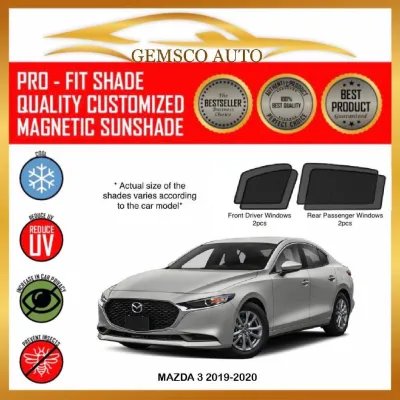

Prices are valid at publication and may change. Please refer to the product page for the latest price.
By blocking heat buildup with a flush-fitting barrier, you significantly reduce the greenhouse effect inside your parked car. This lower baseline temperature minimizes the initial cooling load on your air conditioning system when you return to the vehicle. Consequently, your climate control system can cool the cabin much faster, which reduces fuel consumption and minimizes wear on your air conditioning compressor during those first few minutes of driving.
Identifying Your Mazda 3 Generation for Accurate Sizing
Before purchasing any interior accessory, you must identify the exact generation of your Mazda 3. Windshield dimensions, rake angles, and glass surface areas vary significantly across production eras because Mazda has redesigned the car’s body shape and aerodynamic profile multiple times since its introduction.

The Mazda 3 spans four distinct generations, each featuring unique glass specifications:
- First Generation (BK, 2003–2008): Features a steeper, more traditional windshield angle with a relatively compact glass surface area.
- Second Generation (BL, 2009–2013): Introduced a more swept-back windshield design and a larger overall glass plane.
- Third Generation (BM/BY, 2013–2018): Features a highly aerodynamic, raked windshield with early iterations of sensor housings behind the rearview mirror.
- Fourth Generation (BP, 2019–Present): Features a sleek, modern glass profile with a massive safety sensor pod (i-Activesense) integrated near the top center of the windshield.
To verify your car’s exact model year and generation, check your vehicle registration log card, consult your owner’s manual, or locate the Vehicle Identification Number (VIN) plate on the driver’s side door jamb. When browsing product listings, look for manufacturers that specify exact generational year brackets (such as “Fits Mazda 3 2019–2026”) rather than those using a generic, one-size-fits-all “Mazda 3” label. Additionally, note whether your car is a sedan or a hatchback, as the subtle differences in roofline angles between these body styles can occasionally affect how a rigid sun shade sits against the glass.
Custom-Fit vs. Universal Sun Shades: Which Should You Choose?
Choosing between a custom-fit and a universal sun shade requires balancing your budget against your expectations for coverage, thermal performance, and daily convenience.
Custom-Fit Sun Shades
Custom-fit shades are laser-measured and molded to match the exact contours, rake angle, and sensor cutouts of your specific Mazda 3 generation. They fit flush against the glass, leaving virtually zero gaps along the A-pillars, dashboard, or headliner.
- Benefits: These shades provide maximum thermal protection because they block almost 100% of incoming sunlight. They typically feature a rigid multi-layered core that prevents sagging over time and include precise, fabric-trimmed cutouts to accommodate the bulky rearview mirror and sensor housings found in modern models.
- Limitations: Custom-fit options come at a higher price point, often ranging from S$50 to over S$100. They are also highly vehicle-specific, meaning you cannot transfer them to a different car model if you decide to upgrade your vehicle.
Universal Sun Shades
Universal shades are mass-produced in standard geometric shapes and categorized into broad sizes like small, medium, or large.
- Benefits: They are highly affordable, with prices typically ranging from S$10 to S$25. They are widely available at local automotive supply shops and online marketplaces, and they can easily be reused in other vehicles of similar size.
- Limitations: Because they are not tailored to the Mazda 3's unique windshield taper, they often leave gaps at the corners or buckle in the middle. To stay upright, they rely heavily on being wedged tightly behind your sun visors, and they rarely accommodate modern safety sensor housings without bending awkwardly.
How to Measure Your Windshield for a Universal Shade
If you decide to purchase a universal sun shade, taking accurate physical measurements of your windshield is the only way to ensure a functional fit. Do not rely on generic sizing charts, as they often fail to account for the dramatic taper of modern Mazda windshields.
Step 1: Measure the Width
Using a flexible measuring tape, measure the horizontal width of your windshield glass from the inside of the cabin. Take two measurements: one along the bottom edge where the glass meets the dashboard, and one along the top edge near the headliner. Windshields taper significantly, and knowing both widths prevents you from buying a shade that is too wide at the top to sit flat.
Step 2: Measure the Height
Measure the vertical distance from the top edge of the glass (just below the headliner) down to the point where the windshield meets the dashboard. Keep the measuring tape flat against the glass, following its natural slope rather than measuring straight down vertically.
Step 3: Account for Obstructions
Examine the area around your rearview mirror. If you drive a newer Mazda 3 (particularly third- or fourth-generation models), you will notice a large plastic housing containing cameras and sensors for the i-Activesense safety system. Measure the width and depth of this housing. Your sun shade must either have a built-in collar cutout or be flexible enough to bend around this obstacle without pulling the rest of the shade away from the glass.
Sizing Rule
When comparing your measurements to universal sizing charts, choose a shade that matches your maximum width and height as closely as possible. If your measurements fall between two sizes, it is generally safer to select the slightly larger option—provided the material is flexible. A minor overlap of 1 to 2 inches allows you to wedge the edges securely against the weather stripping and A-pillars, sealing out light leaks. However, if you are buying a highly rigid folding shade, avoid sizing up, as a rigid frame cannot be compressed to fit a space smaller than its dimensions.
Common Sizing Mistakes and How to Avoid Them
Avoiding common purchasing errors will save you the hassle of dealing with returns or living with inadequate heat protection.
- Mistake 1: Buying a shade that is too small. Many drivers assume a "small" or "compact" universal shade is perfect for a compact sedan like the Mazda 3. However, a shade that is too small leaves the lower dashboard and the sides of the windshield completely exposed, allowing heat to build up and leaving vulnerable cabin surfaces unprotected.
- Mistake 2: Ignoring the rearview mirror and sensor area. Failing to account for the bulky sensor housing behind the mirror is a frequent mistake. A rigid shade without a dedicated mirror cutout will press against the housing, causing the shade to bend outward, block your view of the dashboard, or collapse entirely.
- Mistake 3: Choosing an overly rigid, bulky shade. While thick, multi-layered reflective shades offer excellent thermal insulation, they can be incredibly difficult to fold and store. In the relatively cozy cabin of a Mazda 3, a massive, stiff shade that cannot be rolled up compactly will clutter your passenger footwell or take up valuable trunk space.
- Mistake 4: Relying on generic "mid-size" classifications. Sizing terminology varies wildly between accessory brands. A "medium" shade from one manufacturer might be several inches larger or smaller than a "medium" from another. Always verify the actual physical dimensions in centimeters or inches before buying.
Installation and Storage Tips for a Secure Fit
Proper deployment and storage techniques will extend the lifespan of your sun shade and keep your Mazda 3’s cabin tidy.
To install the shade securely, begin by placing the bottom edge flat against the base of the windshield, sliding it as far forward as possible without scratching the dashboard or blocking the defroster vents. Next, push the top of the shade flush against the upper glass, carefully guiding the center cutout around your rearview mirror stem. Finally, pull down both the driver and passenger sun visors to clamp the top edge of the shade firmly against the ceiling. This simple step prevents the shade from sagging or falling forward during the hottest hours of the day.
When it is time to drive, fold or roll the shade according to its design. If you use a spring-wire loop shade, twist it into a compact circle and secure it with its elastic band. For folding accordion-style shades, use the integrated hook-and-loop straps to keep the panels compressed. Store the collapsed shade in the front passenger seatback pocket, the door side pocket, or flat in the trunk to keep your cabin clutter-free and ready for your next journey.
Frequently Asked Questions (FAQ)
Will a sun shade block my Mazda 3’s rain sensors or dashboard cameras?
Modern Mazda 3 models feature sophisticated rain-sensing wipers and i-Activesense safety cameras mounted directly to the windshield behind the rearview mirror. To avoid interfering with these systems or causing dashboard error warnings, you should select a sun shade designed with a deep, integrated cutout or a flexible fabric collar at the top center. This design allows the shade to wrap securely around the mounting bracket without putting physical pressure on the sensor housing or blocking the camera’s forward-facing lenses.
Can I use a windshield shade designed for a different vehicle?
While you can technically use a shade from another vehicle if the dimensions are similar, it is rarely a perfect fit. Even if the overall width and height match, variations in windshield rake, glass curvature, and the exact placement of the rearview mirror can cause the shade to sag or leave large gaps. If you plan to repurpose a shade from another car, physically measure its length and width first, and verify that its mirror cutout aligns with your Mazda 3’s specific windshield configuration.
Community discussion
Share your experience or ask a question. Comments are reviewed before publication.