
Finding the best value LTA-compliant dash cam in Singapore is not about chasing the highest price tag. Instead, true value lies in balancing strict safety regulations with your individual driving needs. A high-value purchase ensures legal compliance, survives the intense tropical heat, and captures clear, usable footage when it matters most, without forcing you to pay for redundant technology.
To make an informed decision, you must look beyond flashy marketing claims and focus on practical verification. Evaluating how a dash cam mounts, how it handles extreme cabin temperatures, and how its features align with your actual driving patterns will help you find a reliable system that protects both your vehicle and your wallet.
How to Verify LTA Compliance Before You Buy
While the Land Transport Authority (LTA) does not pre-approve specific dash cam brands, it enforces strict guidelines regarding vehicle accessories to ensure road safety. Any aftermarket device installed in your vehicle must not compromise driver visibility or vehicle safety systems.
Products mentioned in this guide
![[NEW] 70mai A810S Dash Cam 4K Resolution + HDR | 4G Connectivity | Built-in GPS & ADAS | Dual SONY HDR | Supercapacitor](https://img.lazcdn.com/g/p/12b3e825bd363ef619248cedda0ec9fd.jpg_400x400q80.jpg_.webp)
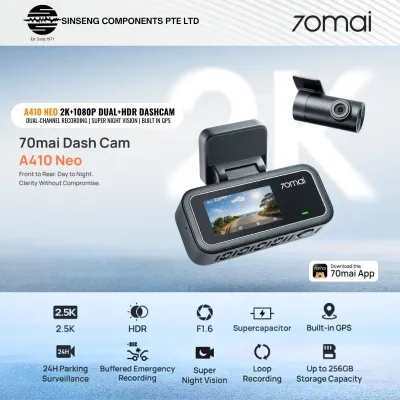
![[2026 NEW] 70mai A410 Neo Dash Cam 2K Front + 1080P Rear | HDR Night Vision | Built-in GPS | Buffered Emergency Recording](https://img.lazcdn.com/g/p/fdee85e2c471600ed4251814d7f73a43.png_400x400q80.png_.webp)
![[Exclusive Deal]Trapo i-Sight Dashcam S-650 | Free Rear Camera | Free Hardwire Kit | Free Installation worth to $50!](https://img.lazcdn.com/g/p/d78d716b9f9ba4b0115acf1956bf69f1.jpg_400x400q80.jpg_.webp)
Prices are valid at publication and may change. Please refer to the product page for the latest price.
The primary compliance consideration is the mounting position. The unit must be installed in a location that does not obstruct the driver’s direct line of sight. Typically, mounting the front camera directly behind or adjacent to the rearview mirror satisfies this requirement. Additionally, you must ensure the camera and its cabling do not interfere with the deployment zones of your vehicle’s airbags, particularly the side curtain airbags if routing cables along the A-pillars.
Another critical safety aspect is the device’s power source. Singapore’s tropical climate presents a unique challenge for car electronics. When parked in open-air carparks, cabin temperatures can easily exceed 60 degrees Celsius. Dash cams powered by internal lithium-ion batteries pose a safety risk under these conditions, as extreme heat can cause batteries to swell or leak. To ensure compliance with general safety standards, look for models powered by supercapacitors, which are designed to withstand high operating temperatures safely.
Before purchasing, verify that the product or its power adapter carries recognized safety certifications. While international markings like CE, FCC, and RoHS indicate compliance with global manufacturing standards, any hardwiring kits connected directly to your car’s electrical system should be checked for local safety marks or manufacturer declarations of compatibility with your specific vehicle model.
Matching Dash Cam Features to Your Driving Needs
To maximize value, you should distinguish between essential baseline features and premium add-ons that may not justify their extra cost. A high-value dash cam must, at a minimum, offer reliable loop recording, automatic G-sensor incident locking, and clear low-light video capture. These core functions ensure that critical footage is preserved during an accident without requiring manual intervention.

Advanced features like Advanced Driver Assistance Systems (ADAS) and cloud connectivity often drive up the purchase price significantly. ADAS features, such as lane departure warnings, are frequently built into modern vehicles already. When integrated into a dash cam, these alerts can sometimes be overly sensitive or redundant, leading many drivers to disable them. Cloud connectivity allows you to view live footage remotely, but it requires a continuous mobile data connection via a separate SIM card, adding ongoing operational costs.
Parking surveillance is another feature where costs can escalate quickly. If you frequently park in high-traffic public areas, parking mode is highly valuable for capturing hit-and-run incidents. However, running a dash cam while the engine is off requires a constant power source. Hardwiring the camera directly to your car’s fuse box is a common solution, but it can drain your car’s starter battery if the camera lacks a reliable low-voltage cutoff feature.
For drivers who want to protect their vehicle’s battery health, dedicated external dash cam battery packs are available. While these packs offer the safest way to run parking mode for extended periods, they represent a significant additional investment. Assessing whether your typical parking locations warrant this extra expense is key to determining the true value of a parking surveillance setup.
Technical Specifications to Compare Across Brands
When comparing different models side-by-side, technical specifications on paper can sometimes be misleading. For instance, a camera advertised with 4K resolution does not automatically guarantee better image quality than a 1080p or 2K model. The physical size and quality of the image sensor are far more critical for capturing legible details, such as license plates, especially in low-light environments like multi-storey carparks.
Look for brands that specify the use of high-sensitivity image sensors designed for night visibility. A wider dynamic range (WDR) or high dynamic range (HDR) feature is also essential, as it helps the camera balance extreme lighting contrasts, such as when exiting a dark tunnel into bright Singapore sunlight, or when headlights shine directly into the lens at night.
The field of view (FOV) is another specification to evaluate carefully. While a wider angle captures more of the surrounding lanes, an excessively wide FOV (greater than 150 degrees) can create a “fish-eye” distortion. This distortion makes objects appear further away than they actually are and can blur crucial details at the edges of the frame. A field of view between 130 and 140 degrees generally offers the best balance between side-to-side coverage and image clarity.
Storage compatibility is a final technical hurdle that affects long-term reliability. Because dash cams write and overwrite data continuously, they subject memory cards to intense wear. Ensure the model you choose supports high-capacity microSD cards (at least 128GB) to prevent frequent overwriting cycles. More importantly, always pair your device with a specialized “high-endurance” microSD card designed specifically for continuous write environments, as standard memory cards are highly prone to premature failure under these conditions.
Decision Framework: Choosing the Right Dash Cam Profile
To finalize your choice, match your driving habits and vehicle setup to one of the following common profiles to find the most cost-effective solution.
If your daily routine consists of standard daytime commuting and you primarily park in sheltered, secure carparks at home and work, a basic single-channel (front-facing) supercapacitor model offers the best value. This setup provides essential protection against front-end incidents during your commute, requires minimal installation effort, and avoids the added complexity and cost of rear wiring or parking mode accessories.
If you frequently park in unmonitored public areas, parallel street lots, or high-density commercial carparks, a dual-channel (front and rear) system with a hardwired parking mode is highly recommended. This configuration ensures comprehensive coverage from both ends of the vehicle, capturing evidence of rear-end collisions or parking mishaps that a front-only camera would miss entirely.
Regardless of the profile you choose, consider the installation process and warranty implications. Modern vehicle electrical architectures are highly complex. Improper DIY installation or tapping into the wrong fuses can void your vehicle’s factory warranty or interfere with sensitive onboard electronics. For new vehicles, it is often wisest to purchase your dash cam from an authorized local distributor that offers professional installation services, ensuring the work is carried out safely and backed by a local warranty.
Frequently Asked Questions (FAQ)
Do I need to register my dash cam with the LTA?
No, you do not need to register your dash cam with the Land Transport Authority (LTA), nor is there any requirement to display a physical sticker or obtain formal approval for private passenger vehicles. However, you must ensure that the physical installation of the camera strictly adheres to safety guidelines, meaning it must not obstruct your view of the road or interfere with any safety systems like airbags.
Can I use a dash cam with a built-in battery in Singapore?
While it is not illegal to use a dash cam with a built-in lithium-ion battery, it is highly discouraged due to Singapore’s hot tropical climate. High cabin temperatures, especially when parked outdoors, can cause lithium-ion batteries to swell, degrade rapidly, or fail entirely. Choosing a model powered by a supercapacitor is a much safer and more durable alternative for local driving conditions.
Is a rear-facing dash cam necessary for the best value?
A rear-facing camera is not strictly necessary, but it significantly enhances the overall value and protection of your setup. While a front-facing camera captures the majority of direct road incidents, a rear camera provides crucial evidence in tailgating disputes, rear-end collisions, and parking lot hit-and-run accidents, making the extra investment highly worthwhile for complete peace of mind.
Community discussion
Share your experience or ask a question. Comments are reviewed before publication.