
Finding the right replacement battery for your motorcycle is essential to ensure reliable starting power and protect your bike’s electrical system. The YTX20L-BS is a highly popular battery size used in many large-displacement motorcycles, cruisers, and touring bikes, but it is not a universal fit. To determine if this specific battery is correct for your motorcycle, you must verify its physical dimensions, terminal layout, cold cranking amps (CCA), and capacity against your vehicle’s original specifications.
Decoding the YTX20L-BS Label: What the Letters and Numbers Mean
Every character in a powersport battery part number represents a specific physical or electrical characteristic. Understanding this alphanumeric code helps you avoid purchasing an incompatible unit that could damage your motorcycle’s electrical system.
The prefix “YTX” indicates a high-performance, maintenance-free Absorbed Glass Mat (AGM) design. AGM batteries utilize thin fiberglass mats sandwiched between lead plates to absorb the liquid electrolyte, making them highly spill-proof and vibration-resistant compared to traditional flooded lead-acid batteries.
Products mentioned in this guide
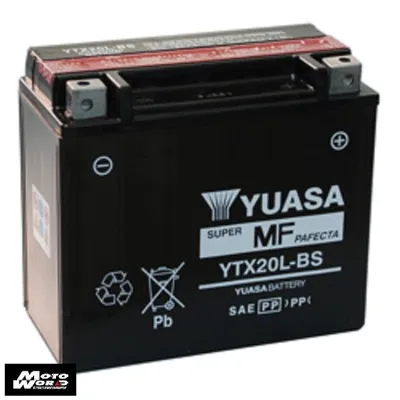
Prices are valid at publication and may change. Please refer to the product page for the latest price.
The number “20” refers to the approximate capacity class of the battery. While it does not represent a direct measurement of Amp-hours, it indicates the general size and power output category within the manufacturer’s lineup.
The letter “L” is one of the most critical markers on the label, designating that the positive terminal is positioned on the left side when you face the front of the battery. Choosing a battery without this letter means the terminals will be reversed, which can lead to severe installation issues.
Finally, the “BS” suffix typically stands for “Bottle Supplied,” indicating a battery that is shipped dry with a separate acid pack. However, because manufacturing standards vary, you must verify the exact activation state on the product packaging, as some brands sell pre-activated, factory-sealed versions under the same base part number.
Step-by-Step Fitment Check: Verifying Compatibility for Your Bike
Before purchasing a replacement battery, you must confirm that your specific motorcycle model is designed to accept the YTX20L-BS. Relying solely on generic online fitment databases can lead to errors, as manufacturers often change battery specifications between model years or regional variants.

Start by locating and inspecting the label on your motorcycle’s original equipment battery. Write down the exact part number, physical dimensions, and electrical ratings printed on the casing.
Next, consult your motorcycle’s owner’s manual or the manufacturer’s official parts catalog to verify the recommended battery group size. This documentation provides the authoritative standard for your vehicle’s electrical requirements.
Avoid purchasing a battery based only on a search engine recommendation or an online marketplace compatibility tool. Physical verification of your current battery tray and the reach of your battery cables is the only way to guarantee a safe and successful installation.
Checking Physical Dimensions and Terminal Polarity
A battery that does not fit securely in the designated tray poses a significant safety hazard. Excess movement can damage the battery casing, loosen terminal connections, or cause electrical shorts against the motorcycle’s frame.
Use a precise measuring tool to record the length, width, and height of your existing battery or the empty battery tray. Compare these measurements directly with the specifications of the YTX20L-BS battery you plan to purchase.
Pay close attention to the “L” polarity marker. If your motorcycle’s wiring harness is designed for a left-side positive terminal, attempting to install a battery with a right-side positive terminal will cause the cables to cross or stretch excessively.
If the terminals do not align naturally with your motorcycle’s wiring harness without tension, stop the installation immediately. Forcing a connection or stretching cables can damage the wiring harness or lead to a catastrophic electrical short.
Matching Cold Cranking Amps (CCA) and Capacity (Ah)
Your motorcycle’s starter motor requires a specific amount of electrical current to turn over the engine, especially in cold weather or after long periods of storage. This starting power is measured in Cold Cranking Amps (CCA).
Locate the CCA and Amp-hour (Ah) ratings on your original battery’s label and compare them to the YTX20L-BS unit. The replacement battery must meet or slightly exceed the manufacturer’s minimum requirements to ensure reliable starting.
While installing a battery with a higher CCA rating is generally safe and can improve starting reliability, you must never install a battery with a lower rating than specified. A battery with insufficient CCA will struggle to start the engine, leading to rapid voltage drops and premature battery failure.
Additionally, ensure the Amp-hour capacity matches your bike’s electrical demands. A lower capacity battery may drain quickly if your motorcycle is equipped with aftermarket accessories like heated grips, GPS units, or auxiliary lighting.
Safe Installation Limits and Electrical Boundaries
Working on a motorcycle’s electrical system requires strict adherence to safety protocols to prevent personal injury and damage to sensitive electronic components. Always refer to your vehicle’s original service manual before beginning any electrical work.
When removing the old battery, always disconnect the negative (ground) cable first. This prevents accidental short circuits if your wrench touches the metal frame of the motorcycle while loosening the terminal. When installing the new battery, reverse this order by connecting the positive cable first and the negative cable last.
If you find that terminal adapters, cable splicing, or physical force are required to make the new battery fit into the tray, stop the installation immediately. These workarounds indicate that the battery is the wrong size or polarity, and continuing poses a severe fire hazard.
If your newly installed, correctly specified battery drains rapidly or fails to hold a charge, do not continue to jump-start or force-charge it. Have your motorcycle’s charging system, including the stator and regulator-rectifier, tested by a qualified technician to identify any underlying electrical faults.
For complex electrical systems or if you are unsure of your ability to perform the installation safely, seek professional assistance from a qualified motorcycle mechanic.
Frequently Asked Questions (FAQ)
Can I use a YTX20-BS instead of a YTX20L-BS?
No, you should not substitute a YTX20-BS for a YTX20L-BS. The primary difference between these two models is the terminal layout; the YTX20-BS has the positive terminal on the right, while the YTX20L-BS has it on the left.
Using a battery with the incorrect terminal layout usually means your motorcycle’s cables will not reach the posts. Attempting to cross the cables or force them to fit can reverse the polarity of your electrical system, causing severe damage to the main fuse, wiring harness, and electronic control unit (ECU).
Do I need to charge a new YTX20L-BS battery before installing it?
Yes, you should check the manufacturer’s instructions on the packaging, as the initial preparation steps depend on how the battery is supplied. Some YTX20L-BS batteries are factory-activated and sealed, meaning they are ready for immediate installation, though a top-off charge is still recommended.
If the battery is shipped dry with a separate acid pack, you must carefully fill the cells according to the instructions, allow the electrolyte to fully absorb, and then charge the battery using a smart charger designed specifically for AGM motorcycle batteries. Avoid using high-amp automotive battery chargers, as they can overheat and permanently damage the smaller cells of a powersport battery.
Community discussion
Share your experience or ask a question. Comments are reviewed before publication.