
Drying your car after a thorough wash might seem like the simplest step in your detailing routine, but it is actually the moment your vehicle’s paintwork is most vulnerable to damage. Using the wrong tool can instantly undo hours of careful washing, leaving behind a web of fine scratches and unsightly swirl marks. To keep your clear coat pristine, investing in a high-quality drying towel is essential. The right choice depends on your vehicle’s size, your local climate, and your preferred drying technique.
Why the Right Drying Towel is Critical for Scratch-Free Paint
When you wash a car, tiny particles of road grit, dust, and environmental fallout can remain on the surface, even after a thorough rinse. If you drag a flat, non-absorbent material across the paint, these microscopic particles become trapped between the cloth and the clear coat. The friction acts like ultra-fine sandpaper, carving micro-scratches into the paint. Over time, these scratches accumulate and reflect light in random directions, creating the dull, circular patterns known as swirl marks. Professional paint correction to remove these defects in Singapore can easily cost anywhere from S$150 to upwards of S$500, making prevention a far more economical strategy.
Traditional household alternatives fail because of their structural limitations. Old cotton t-shirts, bath towels, and traditional leather chamois lack the depth to safely absorb debris. Cotton fibers are relatively thick and round; they push dirt across the paint rather than lifting it. Leather chamois, while highly absorbent, flat-presses any remaining dirt directly against the clear coat, acting as a squeegee for abrasive grit.
Products mentioned in this guide
Prices are valid at publication and may change. Please refer to the product page for the latest price.
A dedicated microfiber drying towel operates on a completely different microscopic level. Microfiber is typically made from a blend of polyester and polyamide, with the fibers split to create a vast network of tiny, wedge-shaped channels. These channels rely on capillary action to draw water deep into the core of the towel, away from the paint surface. Simultaneously, the split fibers trap any residual dirt particles within the recesses of the weave, isolating them from the clear coat. This dual-action performance transforms the drying process from a high-risk chore into a safe, preventative maintenance step.
Key Specifications to Check Before Buying a Drying Towel
Navigating the car care aisle or browsing online marketplaces can be overwhelming due to the sheer variety of microfiber towels available. To make an informed decision, you must understand the technical specifications that dictate how a towel performs. The primary metrics to evaluate are weave pattern, physical dimensions, fabric weight, and edge construction. Each of these attributes directly influences how much water the towel can hold, how safely it glides over your paint, and how long it will last before degrading.

The weave pattern is the most critical factor, as it determines how the fibers are arranged and how they interact with water. The three dominant weaves in the automotive detailing industry are twist-loop, waffle, and plush. Below is a comparison of these weaves to help you understand their strengths and ideal applications:
| Weave Type | Absorption Capacity | Drying Speed | Ideal Paint Condition | Best For |
|---|---|---|---|---|
| Twist-Loop | Extremely High | Moderate | All conditions (including soft clear coats) | Large panels, SUVs, single-pass drying |
| Waffle Weave | Moderate | Very Fast | Well-maintained, waxed, or coated paint | Glass, mirrors, light water management |
| Plush | High | Slow | Delicate, soft, or show-car paint | Detail-oriented drying, high-lubrication sweeps |
Fabric weight is measured in Grams per Square Meter (GSM). This number indicates the density of the microfiber; a higher GSM generally correlates with a thicker, heavier towel that can absorb more water. However, a higher GSM is not always superior, as extremely dense towels can become heavy and difficult to handle when fully saturated.
Finally, look closely at the edge construction. The edges of a towel are often the stiffest parts and pose the highest risk of scratching delicate clear coats. Premium towels feature soft edge styles, such as silk-banded, suede-wrapped, or laser-cut edgeless designs, to eliminate this risk entirely.
Understanding Weave Types: Twist-Loop, Waffle, and Plush
Twist-loop towels represent the modern standard for heavy-duty water absorption. In this design, the microfiber loops are elongated and twisted together into tight, vertical strands. This structural arrangement allows the towel to absorb massive quantities of water without the fibers collapsing flat against the paint. Because the twisted strands have a high surface area, they can pull water off the vehicle with minimal downward pressure, making them exceptionally safe for single-pass drying on large panels.
Waffle weave towels utilize a traditional pattern characterized by a grid of raised squares, resembling a kitchen waffle. This texture reduces the overall surface contact with the paint, which minimizes drag and allows the towel to glide effortlessly. While waffle weaves hold less water overall than twist-loop towels, they excel at fast, streak-free drying. They are particularly effective on glass, side mirrors, and vehicles with existing ceramic coatings or wax sealants that already repel water.
Plush towels feature long, open-ended, untwisted fibers that provide an incredibly soft, cushion-like feel. This design is highly forgiving on extremely soft clear coats, as the long pile allows any missed dirt particles to sink deep into the fabric. However, plush towels tend to drag when saturated, creating a sticky resistance against the paint. They require a patient drying technique, often involving a high-lubrication drying aid, and are best suited for detailers who prioritize maximum paint safety over sheer speed.
Evaluating Size, Thickness (GSM), and Edge Designs
When selecting a towel, physical dimensions must match your physical strength and vehicle size. Large towels, typically measuring 50×80 cm or 60×90 cm, are ideal for covering expansive flat areas like hoods, roofs, and trunks in a single motion. However, using a massive towel on vertical door panels or lower bumpers can be clumsy, often resulting in the towel dragging on the ground and picking up damaging dirt. Smaller towels, around 40×40 cm, offer superior control for drying wheels, door jambs, side mirrors, and intricate front grilles.
Thickness, indicated by GSM, should be chosen based on practical handling. Towels with a GSM of 300 to 500 are lightweight, highly maneuverable, and dry quickly after washing. Towels with a GSM of 800 to 1200+ are incredibly plush and absorbent, but they can weigh over two kilograms when saturated. For most car owners, a medium-weight towel of 500 to 800 GSM offers the best balance of water capacity and ease of use.
Edge design is your final line of defense against paint marring. Avoid towels with hard, heat-sealed polyester edges or rough nylon stitching, as these can easily scratch soft clear coats. Instead, look for edgeless towels where the fabric is laser-cut or ultrasonically cut, leaving no hard borders. Alternatively, premium towels with silk or suede edge banding provide a soft, safe barrier that glides harmlessly over the paint.
How to Match the Towel to Your Vehicle and Drying Technique
Choosing the right towel is not just about technical specifications; it is about matching those specs to your specific vehicle and the environment in which you work. A setup that works perfectly for a compact hatchback parked in a shaded garage may prove highly inefficient for a large family vehicle parked under the intense tropical sun.
Scaling Up for Large SUVs vs. Compact Cars
The physical surface area of your vehicle dictates the total water volume your towel must manage. Large SUVs, multi-purpose vehicles (MPVs), and vans present massive body panels that will quickly overwhelm a single standard-sized towel. If you attempt to dry a large vehicle with an undersized towel, you will find yourself constantly stopping to wring out the saturated fabric, which leaves behind streaks and water spots. For these larger vehicles, a high-GSM, large-format twist-loop towel is highly recommended to complete the bulk of the drying in a single pass.
To maximize efficiency, experienced detailers employ a multi-towel system. Use one large, heavy-duty twist-loop towel (such as a 60×90 cm, 800 GSM profile) as your primary tool to sweep water off the roof, hood, and glass. Then, switch to a smaller, more nimble towel (such as a 40×40 cm, 500 GSM plush or waffle weave) to dry the vertical doors, side mirrors, door jambs, and wheels. This approach prevents your primary towel from becoming oversaturated and ensures you do not accidentally drag a large, heavy towel across a dirty lower panel or the ground.
Managing Fast Evaporation in Tropical Climates
In tropical regions like Singapore, high ambient temperatures and intense humidity present a unique challenge: rapid water evaporation. When sun-heated car panels dry naturally before you can physically reach them with a towel, the evaporating water leaves behind dissolved mineral deposits. These stubborn white rings, known as water spots or calcium spots, can etch into the clear coat over time and are incredibly difficult to remove without machine polishing.
To combat rapid evaporation, you must adapt your drying environment and technique. Always wash and dry your vehicle in a shaded area, such as a covered driveway, a wash bay, or the lower levels of an HDB multi-storey carpark, and avoid working under direct sunlight. Additionally, work during the cooler parts of the day, such as early morning or late evening, when panel temperatures are lower.
Pairing your drying towel with a dedicated drying aid or quick detailer spray is another highly effective strategy. Spraying a light mist of a drying aid onto the wet panel before wiping adds an extra layer of lubrication, reducing friction between the towel and the paint. The drying aid also encapsulates mineral content in the water, slows down the evaporation rate, and leaves behind a thin layer of gloss and protection, ensuring a completely streak-free finish.
Recommended Drying Towel Profiles for Different Needs
Because inventory and pricing on online marketplaces fluctuate constantly, it is best to shop for specific towel profiles rather than relying on individual brand names. Selecting a profile based on your vehicle’s needs, your storage capacity, and your detailing style ensures you get the right tool for the job. Below are three highly effective drying towel profiles tailored to different user priorities.
Maximum Absorption for Large Vehicles
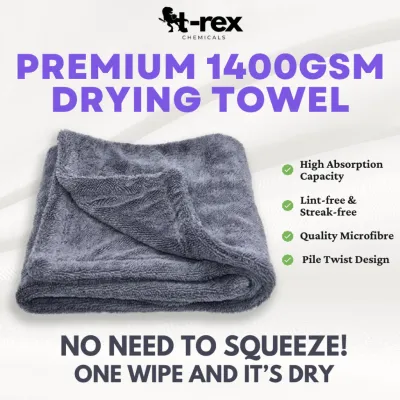
- Profile Specifications: Large format (approximately 60×90 cm), high fabric weight (800+ GSM), and a double-sided twist-loop weave.
- Best For: Large SUVs, family MPVs, and car owners who prefer the "lay and pat" drying method, where the towel is laid flat across the panel and gently patted to absorb water without any dragging motion.
- Pre-Purchase Check: Before purchasing an oversized, high-GSM towel, verify that your home washing machine has a spin-cycle capacity capable of handling heavy, water-logged microfiber. These towels become exceptionally heavy when wet and can unbalance smaller washing machines.
Ultra-Soft Options for Delicate Paint
- Profile Specifications: Medium format (approximately 40×40 cm or 50×50 cm), moderate to high fabric weight (500 to 800 GSM), and a plush, edgeless, or laser-cut design.
- Best For: Vehicles with soft clear coats (common on many Japanese makes), dark-colored cars (especially solid black) that easily show micro-marring, and show cars where paint perfection is paramount.
- Limitation: Plush fibers do not release water as easily as twist-loops, meaning these towels can drag and push water around once they reach saturation. To dry an entire vehicle safely, you will likely need to purchase a pack of three or four towels to swap out as they become wet.
Lightweight and Fast-Drying for Quick Washes
- Profile Specifications: Standard format (approximately 40×40 cm), low-to-medium fabric weight (300 to 500 GSM), and a waffle weave or low-pile twist-loop structure.
- Best For: Quick weekend maintenance washes, drying glass and side mirrors, and apartment dwellers who have limited storage space or must air-dry their laundry on a small balcony.
- Pre-Purchase Check: Always check the product description to ensure the waffle weave is specifically rated for automotive paintwork. Some coarser waffle weave cloths sold in home improvement stores are designed strictly for household glass or interior cleaning and can scratch delicate automotive clear coats.
How to Wash and Maintain Your Microfiber Drying Towels
A premium drying towel is a long-term investment, but its performance will rapidly deteriorate if it is not washed and maintained correctly. Microfiber is highly sensitive to heat and chemical contamination; improper washing can clog the capillary channels, melt the delicate fiber tips, and render the towel useless. By following a strict maintenance protocol, you can preserve your towel’s softness and maximum absorbency for years.
Always wash your microfiber towels separately from other household laundry, especially cotton bath towels and clothing. Cotton sheds lint, and the microscopic wedge-shaped channels of your microfiber towels will eagerly trap these cotton fibers, permanently reducing their water-absorption capacity and turning your towel into a lint-depositing nuisance.
When washing, use a dedicated microfiber wash solution or a mild, clear liquid laundry detergent. Strictly avoid using powdered detergents, as undissolved granules can get trapped inside the weave and scratch your paint during the next dry. Furthermore, never use fabric softeners or bleach. Fabric softeners work by depositing a thin, water-repellent chemical coating over fibers to make them feel soft, which completely clogs the capillary action of microfiber. Bleach will chemically degrade the polyamide fibers, causing them to become brittle and shed.
For drying, the safest method is to hang the towels to air-dry in a clean, shaded, and dust-free indoor environment. If you prefer to use a clothes dryer, select a low-heat or no-heat air-fluff cycle. High heat must be avoided at all costs, as polyester has a low melting point; excessive heat will melt the microscopic tips of the fibers, turning a soft towel into a stiff, scratchy hazard. Once dry, store your towels in a clean, sealed plastic container or a zip-lock bag to prevent them from collecting airborne dust, garage grit, or pet hair before their next use.
Frequently Asked Questions (FAQ)
Can I use a regular cotton bath towel to dry my car?
No, you should never use a regular cotton bath towel to dry your car’s paintwork. Cotton fibers are relatively thick, round, and lack the microscopic split structure of microfiber. Instead of lifting and trapping residual dirt particles, cotton towels press and drag those particles across the clear coat, creating fine scratches and swirl marks. Additionally, cotton towels are far less absorbent than microfiber, meaning you will end up pushing water around and leaving behind unsightly streaks and water spots.
Should I use a separate towel for the wheels and lower bumpers?
Yes, maintaining strict separation between towels used on different parts of the vehicle is essential for paint safety. The wheels, brake calipers, exhaust tips, and lower rocker panels accumulate highly abrasive contaminants, such as metallic brake dust, road tar, and heavy grit. If you use your primary paint-drying towel on these areas, these sharp particles will become deeply embedded in the fibers. Reusing that contaminated towel on your hood or doors later will inevitably cause severe scratching. Always use dedicated, older, or lower-cost microfiber towels for wheels and lower panels, and wash them in a separate load from your premium paint-drying towels.
Community discussion
Share your experience or ask a question. Comments are reviewed before publication.