
Choosing the right foam sprayer for your car is the foundation of a safe, swirl-free home detailing routine. The ideal choice depends on your available water pressure, the size of your vehicle, and how often you wash it. By matching your equipment to your specific washing environment, you can safely lift abrasive road grime before ever touching the paint with a wash mitt.
Determine Your Water Source: Foam Cannon vs. Foam Gun
To choose the correct tool, you must first evaluate your primary water source. The market is divided into two distinct categories: high-pressure foam cannons and low-pressure foam guns. While they serve a similar purpose, their mechanical operations and water requirements are entirely different.
Foam cannons are designed exclusively for use with pressure washers. They utilize the high-velocity water stream from the machine to create a vacuum via the Venturi effect. This vacuum draws the concentrated soap mixture upward from the bottle, blending it with air and water before forcing it through a fine internal mesh filter. This process aerates the mixture, producing a thick, shaving-cream-like foam that clings to the vehicle’s surface. To operate effectively, most foam cannons require a minimum pressure of 1,000 PSI and a flow rate of at least 1.4 GPM.
Products mentioned in this guide
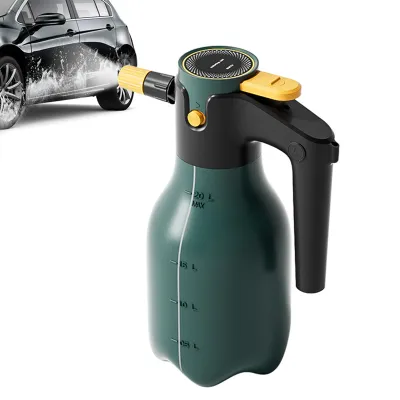
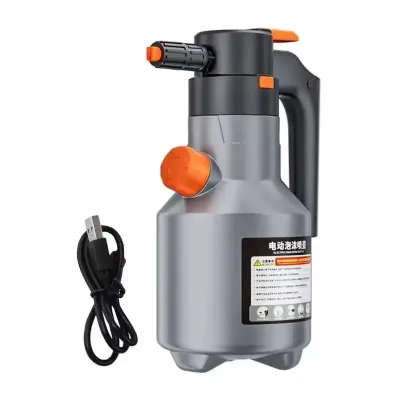
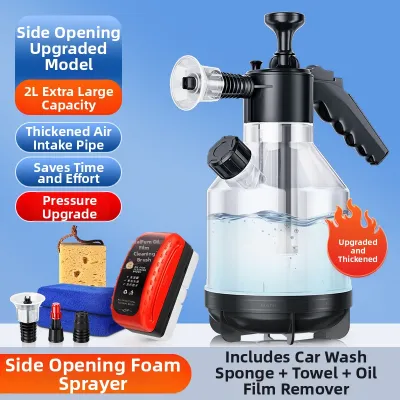
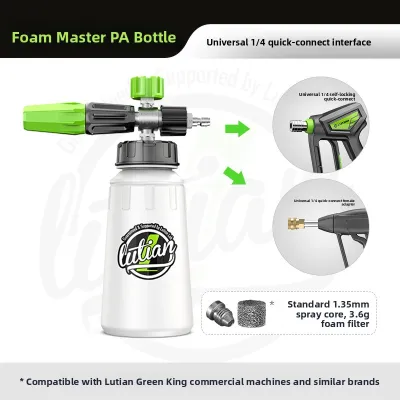
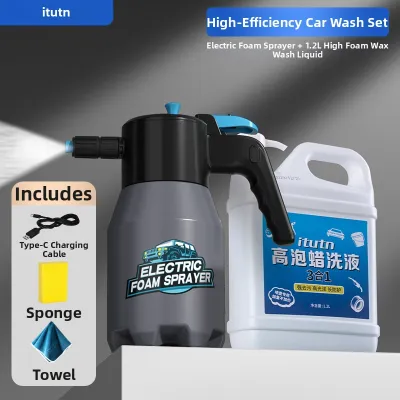
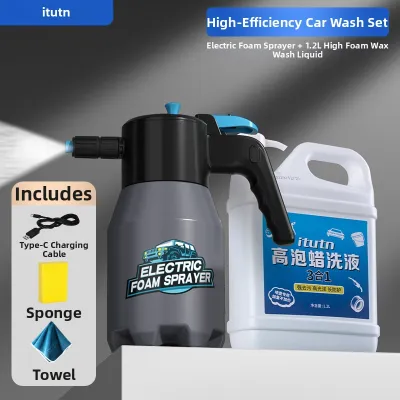
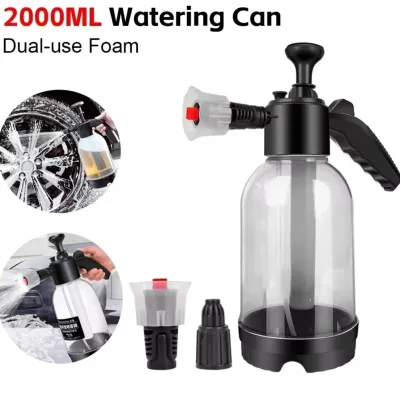
![[SG] 2L Car Wash Foam Spray Gun 🌟 Car Wash Foam Sprayer Car Wash Shampoo Car Wash Sponge Car Wash Cloth Watering Plants](https://img.lazcdn.com/g/p/3446208842b3d5445af222e94ce3bcc3.jpg_400x400q80.jpg_.webp)
Prices are valid at publication and may change. Please refer to the product page for the latest price.
In contrast, foam guns are engineered to connect directly to a standard household garden hose. They operate on municipal water pressure, which typically ranges between 40 and 60 PSI. Because they lack the extreme pressure of a dedicated machine, foam guns cannot aerate the soap to the same degree. Instead of a thick blanket of snow foam, they produce a wetter, runnier soapy lather. While this lather does not cling to the paint for long, it provides excellent lubrication for a direct contact wash.
Before purchasing, perform a quick audit of your outdoor setup. If you plan to use a foam cannon, locate the specifications label on your pressure washer to verify its PSI and flow rate. For garden hose setups, check that your outdoor tap has adequate flow and that your hose is free of kinks. You should also inspect your hose fittings; standard garden hoses typically use threaded brass or plastic click-on connectors, whereas pressure washer wands usually require specific quick-connect plugs or threaded adapters.
Match Capacity and Output to Vehicle Size and Washing Frequency
Once you have identified your water source, you must match the sprayer’s bottle capacity and foam output to your vehicle’s physical dimensions. Most foam sprayers on the market feature a standard 1-liter bottle. This capacity is generally sufficient to cover a standard sedan or a compact hatchback in a single, thorough pass without needing a refill.

For larger vehicles, such as full-size sports utility vehicles (SUVs), multi-purpose vehicles (MPVs), or commercial vans, a standard 1-liter bottle may run dry before you finish coating the entire exterior. In these scenarios, look for sprayers that offer larger bottle options or purchase a secondary bottle to keep pre-mixed soap on hand. Alternatively, choosing a highly efficient foam cannon that allows precise control over the water-to-soap ratio can help stretch a single liter of mixture across a larger surface area.
The condition of your vehicle and your local climate also dictate your foam thickness requirements. In tropical environments like Singapore, high ambient temperatures cause soapy water to dry rapidly on hot automotive paint, which can leave unsightly water spots and soap residue. If you are dealing with heavily soiled vehicles, you need a thick, slow-draining foam that can dwell on the paint for several minutes to encapsulate abrasive road grime. For daily drivers that only carry light dust, a thinner, faster-flowing foam is often preferable, as it lubricates the surface quickly and rinses away easily before the tropical heat can dry it.
Washing frequency is another critical factor when evaluating material durability. If you wash your vehicle once a week or manage multiple family cars, your equipment will experience significant wear. High-frequency users should prioritize bottles made from high-density polyethylene (HDPE), which offers superior resistance to chemical degradation from concentrated car shampoos. Occasional weekend washers may find standard polyethylene bottles sufficient, but investing in robust materials prevents premature cracking and leaks over time.
Evaluate Build Quality, Adjustability, and Fitting Compatibility
A reliable foam sprayer must withstand high water pressure and exposure to harsh cleaning chemicals. When evaluating build quality, start by inspecting the manifold, which is the central block where water, air, and soap mix. High-quality sprayers feature solid brass or stainless steel manifolds. These metals resist corrosion, withstand accidental drops, and are highly resistant to thread stripping when attaching fittings. Plastic manifolds are lighter and less expensive, but they are prone to cracking under pressure or splitting if cross-threaded.
Adjustability is another essential feature for fine-tuning your wash. Look for a foam sprayer equipped with an adjustable top knob to regulate the soap dilution rate. Turning this knob restricts or increases the flow of soap from the bottle, allowing you to customize the foam thickness based on how dirty the car is. Additionally, the front nozzle should feature adjustable spray blades. By twisting the nozzle head, you can transition from a narrow, concentrated stream for hard-to-reach wheel arches to a wide, sweeping fan pattern that covers large body panels quickly.
Fitting compatibility is a common hurdle for home detailers. Most modern foam cannons come pre-installed with a 1/4-inch quick-connect plug, which is the standard fitting for aftermarket pressure washer wands. However, many entry-level or proprietary pressure washers use unique connection systems, such as bayonet fittings or M22 threaded connections. Before buying, consult your pressure washer’s manual to identify its specific connection type. You may need to purchase a dedicated adapter to bridge the gap between your pressure washer wand and the foam cannon’s inlet.
Finally, perform a physical check of the bottle design. A wide-mouth bottle is highly recommended, as it makes pouring concentrated soap and water much easier without spilling. Transparent or semi-transparent bottles with molded measurement markings allow you to mix precise dilution ratios without guessing. A wide, stable base is also beneficial, preventing the top-heavy brass manifold from tipping the bottle over when placed on flat ground.
Condition-Based Selection Paths for Home Car Washers
To simplify your decision, consider which of the following three common home washing scenarios best describes your setup.
Path A is tailored for apartment dwellers or those with access only to a standard garden hose. In many residential estates or multi-story car parks in Singapore, high-pressure washers are either impractical or prohibited due to noise and water runoff regulations. If you fall into this category, a low-pressure foam gun is your most practical option. It connects directly to your garden hose and provides sufficient lubrication to safely wash away light dust and road film. Alternatively, if you do not have a hose connection at all, a manual pump-up foaming sprayer is an excellent substitute. These handheld devices use manual air pressure to generate a surprisingly thick foam, making them perfect for localized cleaning or waterless wash routines.
Path B is ideal for the weekend detailing enthusiast who owns an entry-level electric pressure washer. These machines typically operate between 1,000 and 1,500 PSI with a flow rate of 1.2 to 1.6 GPM. For this setup, choose a mid-range foam cannon equipped with a 1.1mm internal orifice nozzle. Standard foam cannons often come with a 1.25mm orifice, which requires higher water flow to create thick foam. Swapping to a smaller 1.1mm orifice restricts the water flow slightly, increasing the velocity and allowing lower-powered electric pressure washers to produce rich, thick snow foam.
Path C is designed for the high-frequency enthusiast or professional-grade home detailer who utilizes a high-output pressure washer. If your machine delivers over 2,000 PSI and a flow rate exceeding 2.0 GPM, you require a heavy-duty foam cannon with a standard 1.25mm or larger orifice. This setup can handle high volumes of water without causing your pressure washer to bypass or surge. Look for premium models featuring stainless steel quick-connects, heavy-duty brass bodies, and reinforced HDPE bottles with wide bases to withstand rugged, daily use.
Safe Setup, Dilution, and Routine Maintenance
Operating your foam sprayer safely and maintaining it properly will extend its lifespan and protect your vehicle’s finish. When preparing your soap mixture, always fill the bottle with warm water first before adding the concentrated car wash shampoo. If you pour the soap in first and then add water, the force of the water will cause the soap to foam up prematurely inside the bottle. This creates air pockets that disrupt the suction tube, resulting in an uneven, watery spray. Always refer to the soap manufacturer’s label for the recommended dilution ratio, as over-concentrating the mixture can leave a dull film on your paint.
Routine maintenance is crucial to prevent clogs and internal corrosion. After every wash session, detach the soap bottle and rinse it thoroughly with clean water. Fill the bottle with clean, warm water, reattach it to the sprayer head, and run the system for at least 30 seconds. This flushes out any residual soap trapped inside the internal steel mesh filter and the delicate O-rings. Over time, dried soap residue will harden inside the mesh filter, restricting water flow and reducing the sprayer’s ability to generate thick foam.
Proper storage will protect the physical integrity of your equipment. Store the foam sprayer and bottle in a cool, shaded area away from direct sunlight. Prolonged exposure to ultraviolet (UV) rays can embrittle the plastic bottle, leading to cracks and leaks under pressure. If you live in a region prone to cold weather, ensure the sprayer is completely drained of water before storage, as freezing water can expand and crack the internal brass manifold or ruin the seals.
Frequently Asked Questions (FAQ)
Can I use a foam cannon with a standard garden hose?
No, a foam cannon cannot function with a standard garden hose because it requires high water pressure to operate. Foam cannons rely on the high velocity of a pressure washer—typically at least 1,000 PSI—to draw soap up and aerate it through an internal mesh filter. If connected to a garden hose, which only provides around 40 to 60 PSI, the water flow will not create the necessary vacuum, resulting in a weak trickle of soapy water. For garden hose setups, you must use a dedicated foam gun designed specifically for low-pressure operation.
Does foam thickness actually improve the car wash result?
Foam thickness plays a functional role in the pre-wash process, but it is not the sole indicator of a clean car. The primary purpose of thick snow foam is to cling to the vehicle’s vertical surfaces, allowing the soap’s surfactants to dwell on the paint. This dwell time helps loosen, encapsulate, and drag down abrasive dirt and road grime before you touch the car with a wash mitt, significantly reducing the risk of swirl marks. However, foam alone is a pre-wash step and rarely removes bonded contaminants completely; a gentle contact wash is still required for a spotless finish.
Why is my foam sprayer only spraying watery soap?
If your foam sprayer is producing watery soap instead of thick foam, the issue is usually caused by a clog, incorrect dilution, or insufficient pressure. First, check the internal steel mesh filter, as dried soap residue often clogs the mesh and prevents proper aeration. You can clean or replace this filter to restore performance. Next, verify your soap-to-water ratio and ensure you are using a dedicated high-foaming car shampoo. Finally, ensure your pressure washer meets the minimum PSI and GPM requirements, and check that the pickup tube inside the bottle is securely attached and free of blockages.
Community discussion
Share your experience or ask a question. Comments are reviewed before publication.