
When you purchase a cute LINE Friends car air freshener to brighten up your daily commute, you expect the pleasant scent to accompany you for several weeks. However, in Singapore’s intense tropical climate, the actual lifespan of these character-themed fresheners often falls short of the estimates printed on the packaging. While a manufacturer might advertise a lifespan of 30 to 45 days under temperate conditions, operating a vehicle in high heat and humidity means the fragrance may fade much sooner. Understanding how tropical environmental factors interact with different freshener materials is key to managing your expectations and getting the most value out of your purchase.
Factors That Reduce Scent Longevity in Tropical Climates
The primary driver behind rapid fragrance depletion is the extreme heat buildup inside a parked vehicle. When your car is parked in an unsheltered open-air car park, such as an HDB rooftop deck, solar radiation passes through the glass windows and heats up the interior. Because the cabin is sealed, this heat becomes trapped, causing internal temperatures to soar far beyond the ambient outdoor temperature. This intense thermal environment forces the volatile organic compounds responsible for the fragrance to vaporize at an accelerated rate, even when the car is stationary.
Direct sunlight exposure through the windshield further compounds this issue. Ultraviolet (UV) radiation actively breaks down the chemical structures of the fragrance oils. When a vent clip or hanging card is positioned in the direct path of sunlight, the UV rays degrade the scent molecules, causing them to lose their aromatic properties or evaporate prematurely. This chemical degradation can also alter the scent profile itself, sometimes transforming a sweet, fruity aroma into a faint, synthetic smell.
Products mentioned in this guide
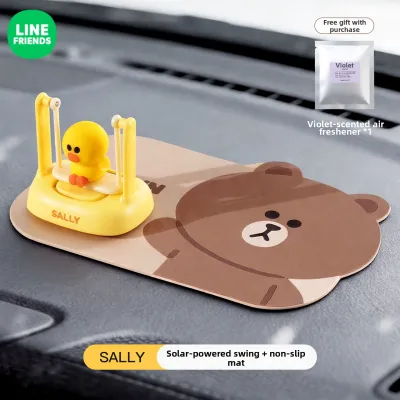
Prices are valid at publication and may change. Please refer to the product page for the latest price.
Additionally, high relative humidity plays a significant role in how freshener materials behave. Many air fresheners rely on porous materials, such as paper, cardboard, or ceramic cores, to hold and slowly release fragrance oils. When the air is saturated with moisture, these materials can absorb water vapor from the surrounding environment. This moisture absorption can displace the fragrance oils or cause the material to release the scent in rapid, uncontrolled bursts rather than a steady, metered diffusion. Over time, high humidity can also compromise the structural integrity of paper-based fresheners, leading to warping.
Identifying Your Freshener Type and Expected Behavior
To estimate how long your LINE Friends freshener will last, you must first identify its specific product format. These accessories generally fall into three categories: liquid-filled vent clips, solid polymer or ceramic cartridges, and hanging paper cards. Vent clips that utilize a solid membrane or a ceramic insert tend to offer the highest heat resilience. Because the fragrance molecules are embedded within a dense physical matrix, they are released more slowly and are less susceptible to sudden temperature spikes compared to open liquid reservoirs or thin paper formats.

Before installing your freshener, check the manufacturer’s label to establish a baseline longevity claim. These packaging claims are typically based on testing conducted in controlled, temperate laboratory environments, usually maintained around 20°C to 22°C. Because these ideal conditions do not reflect the harsh realities of a tropical climate, you should treat the label’s estimate as a maximum potential lifespan. In a vehicle exposed to daily outdoor parking, you can generally expect the actual scent duration to be reduced by approximately 30% to 50%.
Understanding the physical behavior of liquids and gels under thermal stress can help you monitor their depletion. Liquid-based fresheners rely on a wick or a semi-permeable membrane to control evaporation. When cabin temperatures rise, the liquid thins out and passes through the membrane much faster, leading to rapid depletion. Gel-based alternatives face a similar challenge; high heat causes the water or solvent content in the gel to evaporate quickly, leaving behind a shrunken, hardened residue. Solid polymer figures, on the other hand, maintain their shape better and release scent at a more consistent, albeit quieter, rate.
Practical Tips to Extend Fragrance Life in a Hot Car
Maximizing the lifespan of your car air freshener requires strategic placement that balances scent distribution with protection from the elements. While it is tempting to hang a cute character card directly from your rearview mirror, this position exposes the product to maximum sunlight and UV radiation. Instead, consider placing hanging fresheners in shaded areas of the cabin, such as behind the front seats. If you are using a vent clip, mount it on a lower dashboard vent rather than the center vents directly beneath the windshield. Most importantly, ensure that any accessory you install does not obstruct your line of sight or interfere with the deployment zones of your vehicle’s airbags. Consult your vehicle’s owner manual to identify airbag deployment zones before mounting accessories.
Another highly effective strategy is to use a high-quality reflective windshield sunshade whenever you park outdoors. By placing a sunshade across your front windshield, you block a massive portion of the solar radiation that enters the cabin. This simple step can lower the peak dashboard temperature by several degrees, directly reducing the thermal stress on your air freshener and other interior plastics. Over time, this temperature reduction prevents the rapid boiling off of fragrance oils, helping the scent core last significantly longer.
If your LINE Friends vent clip features an adjustable dial or shutter, make active use of it to preserve the scent. These dials allow you to restrict the airflow passing through the fragrance cartridge. When you are driving with the air conditioning set to a low fan speed, or when you park the car for the day, turn the dial to the minimum or closed position. This limits the exposure of the scent core to moving air, preventing unnecessary evaporation when you are not in the vehicle to enjoy it.
Signs It Is Time to Replace Your Car Air Freshener
Recognizing when your air freshener has reached the end of its functional life is important for maintaining a pleasant cabin environment and protecting your vehicle’s interior. The most straightforward indicator is a significant and persistent drop in scent intensity. If you find that you can no longer smell the fragrance even with the vent shutters fully open and the air conditioning running, the active aromatic compounds have likely fully dissipated, leaving behind only the inert carrier materials.
You should also perform regular visual inspections of the freshener unit. For gel-based products, look for severe shrinkage, cracking, or a dry, leathery texture. For liquid-filled cartridges, check the fluid level; once the reservoir is empty, the wick will dry out quickly. Paper cards will often show signs of physical degradation, such as severe fading of the character print, warping of the cardboard, or a brittle texture that indicates the oils have completely evaporated.
Crucially, keep an eye out for melted adhesives or leaking fragrance oils. High cabin temperatures can soften the glues used to assemble character figures, which may cause the decorative LINE Friends toy to detach. Furthermore, if a liquid cartridge cracks or overflows due to thermal expansion, the concentrated fragrance oils can leak onto your dashboard. These oils act as powerful solvents that can permanently bubble, peel, or discolor automotive plastics, vinyl trim, and leather upholstery. If you detect any oily residue, remove the freshener immediately and clean the area using a mild, vehicle-approved interior cleaner to prevent permanent cosmetic damage.
Frequently Asked Questions (FAQ)
Can extreme heat melt the plastic LINE Friends figure on a vent clip?
Official character air fresheners are typically manufactured using durable, automotive-grade plastics such as PVC or ABS, which are engineered to withstand standard interior temperatures without melting. However, prolonged exposure to extreme, direct sunlight in an unsheltered car park can cause these plastics to soften, become sticky to the touch, or develop a slight warp. If you notice the character figure feels tacky or shows signs of distortion, it is best to temporarily remove it from the vent and store it in a cool, shaded glove compartment. Always check the product packaging to verify that the materials are rated for high-temperature automotive environments before installation.
Does parking in a shaded area significantly improve freshener lifespan?
Yes, parking in a shaded area—such as a multi-story car park, a basement garage, or beneath a sheltered driveway—has a dramatic positive impact on the lifespan of your air freshener. By shielding your vehicle from direct solar radiation, you prevent the extreme greenhouse effect that drives cabin temperatures to excessive levels. This lower, more stable ambient temperature slows down the evaporation rate of the fragrance oils, allowing the scent to last much closer to the manufacturer’s original estimated lifespan compared to a vehicle parked continuously under the open sky.
Community discussion
Share your experience or ask a question. Comments are reviewed before publication.