
Selecting the right crash bars for the Honda CB200X requires evaluating structural mounting points, material durability under high humidity, and local workshop support. Since the CB200X shares design elements with other small-displacement Honda platforms but features unique fairings, verifying exact model-year fitment is critical to avoid interference with the bodywork or steering. A well-chosen crash bar system protects expensive plastic fairings, the radiator, and engine cases from costly damage during low-speed tips or parking lot falls.
Because crash bars attach directly to the motorcycle’s frame and engine mounts, choosing and installing them is a safety-critical task. Incorrectly fitted bars can alter the bike’s structural integrity, restrict steering movement, or cause engine damage if mounted improperly. This guide outlines the essential fitment, material, and sourcing criteria to help you make an informed decision for your Honda CB200X.
Key Fitment and Compatibility Checks for the CB200X
Before purchasing any crash bar system, you must verify how the accessory mounts to the motorcycle’s chassis. Crash bars generally fall into two categories: frame-mounted and engine-mounted. Frame-mounted systems are highly recommended because they transfer the energy of an impact directly to the rigid chassis of the motorcycle. Engine-mounted systems, which attach directly to the engine casing or oil pan bolts, carry a higher risk of transferring impact forces directly to the engine block, potentially causing cracked casings or oil leaks during a hard fall.
Products mentioned in this guide
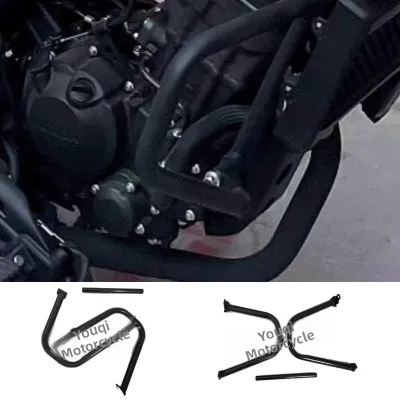
Prices are valid at publication and may change. Please refer to the product page for the latest price.
Clearance is another critical factor when evaluating crash bars for the Honda CB200X. The motorcycle features a distinct adventure-style front fairing and an underbelly cowl. The crash bars must be designed with sufficient clearance to ensure they do not rub against these plastic components. Constant contact combined with engine vibrations will quickly wear through paint and crack plastic fairings. Furthermore, you must verify that the bars do not interfere with the front forks or steering mechanism at full lock. Turn the handlebars completely to the left and right to ensure there is no contact with the bars, cables, or brake lines.
Finally, pay close attention to the mounting hardware and bolt thread sizes. The Honda CB200X uses specific engine hanger bolts that must often be replaced with longer bolts supplied by the crash bar manufacturer to accommodate the thickness of the mounting brackets. These replacement bolts must match the original thread pitch and meet or exceed the original equipment manufacturer (OEM) tensile strength specifications. Using sub-standard bolts or incorrect thread pitches can strip the frame threads or lead to bolt failure under load. Always check if the kit requires proprietary mounting brackets or if it utilizes existing factory mounting points without modification.
Material and Design Considerations for Daily and Touring Use
The choice of material directly impacts the durability, weight, and maintenance requirements of your crash bars. In tropical climates characterized by high humidity and frequent rainfall, corrosion resistance is a primary concern. Mild steel and stainless steel are the two most common materials used in aftermarket crash bars, each offering distinct trade-offs.

Mild steel is highly ductile and possesses excellent impact absorption properties, meaning it will bend slightly under extreme force to absorb energy rather than transferring it to the motorcycle’s frame. However, mild steel is highly susceptible to rust. It requires a high-quality powder-coated or painted finish to protect it from the elements. If the finish is scratched or chipped by road debris, moisture will quickly penetrate the metal, leading to sub-surface rust that compromises the structural integrity of the bars. Stainless steel, on the other hand, offers superior natural corrosion resistance and does not require a protective coating to prevent rust. While stainless steel is generally heavier and more expensive, it remains highly durable and is easier to maintain in wet environments.
Tube diameter and wall thickness determine the overall strength of the crash bars. For a lightweight motorcycle like the Honda CB200X, tubing with an outer diameter of 22mm to 25mm and a wall thickness of approximately 2mm provides an optimal balance between structural rigidity and weight. Avoid excessively thick or heavy bars, as adding unnecessary weight high up on the motorcycle’s frame can negatively affect handling and fuel efficiency.
Additionally, consider the structural layout of the bars. One-piece welded designs offer maximum rigidity because they lack joint connections that can loosen over time. However, they can be more challenging to install and align perfectly. Multi-piece modular designs use connecting sleeves, clamps, or plates to join different sections of the bars. While modular designs are easier to install and allow you to replace individual damaged sections rather than the entire assembly, they introduce potential vibration points and require regular inspection to ensure the connecting hardware remains tight.
Sourcing and Verifying Availability in Singapore
When sourcing crash bars for your Honda CB200X in Singapore, you have several avenues to explore, ranging from authorized accessory dealers to specialized aftermarket motorcycle workshops. Because the CB200X is a popular commuter and entry-level adventure bike, local workshops often carry compatible accessories or can source them quickly from regional distributors.
Visiting specialized motorcycle workshops in established industrial hubs—such as Ubi, Kaki Bukit, Toh Guan, or Bukit Batok—allows you to consult directly with experienced mechanics. These workshops can often recommend specific brands that have a proven track record of fitting the CB200X without alignment issues. If you choose to purchase crash bars from online marketplaces or overseas suppliers, be prepared for potential fitment discrepancies. Minor manufacturing variances can make self-installation difficult, and returning bulky items internationally can be costly and time-consuming.
Lead times for aftermarket parts vary significantly. While some common designs may be kept in stock locally for immediate installation, specialized or premium brands may require special ordering with lead times ranging from a few weeks to over a month. When inquiring about availability, always ask the supplier or workshop if the quoted price in S$ includes professional installation and post-fitment alignment checks. Sourcing the parts and having them installed at the same workshop is often the safest approach, as the mechanics will be responsible for resolving any fitment or hardware compatibility issues that arise during the process.
Installation Safety and Post-Fitment Inspection
Installing crash bars is a modification that directly affects the structural assembly of your motorcycle. Because mounting points often share critical engine hanger bolts, incorrect installation can compromise the safety and stability of the vehicle. It is highly recommended to have the installation performed by a qualified professional at a reputable motorcycle workshop. If you choose to undertake the installation yourself, you must strictly follow the safety boundaries and original vehicle instructions.
Before beginning, consult the Honda CB200X service manual to identify the correct torque specifications for all affected engine and frame bolts. Never guess the tightness of these critical fasteners; always use a calibrated torque wrench to tighten all bolts to the manufacturer’s exact specifications. Under-tightening can cause bolts to back out due to engine vibrations, while over-tightening can strip the threads in the motorcycle’s frame or crush the engine mounting brackets.
Once the crash bars are mounted, conduct a thorough visual and physical clearance inspection before riding. Verify the following points:
- Ensure there is adequate clearance between the crash bars and all plastic fairings, the radiator, and the exhaust header pipe.
- Turn the handlebars fully from lock to lock to confirm that the front forks, brake lines, clutch cables, and wiring harnesses do not pinch, stretch, or make contact with the crash bars.
- Check that the rider's boots and controls (gear shifter and rear brake pedal) have unobstructed clearance and can be operated safely.
After the initial installation, schedule periodic inspections of the crash bar system. Single-cylinder engines like the one in the CB200X produce natural vibrations that can loosen fasteners over time. Inspect all mounting bolts after the first 100 kilometers of riding, and subsequently during regular oil changes or maintenance intervals. Look for early signs of surface rust, especially around weld joints and mounting brackets, and treat any chips or scratches promptly with a rust-inhibiting touch-up paint to preserve the structural integrity of the steel.
Frequently Asked Questions (FAQ)
Do crash bars affect the handling or weight balance of the CB200X?
Adding crash bars to the Honda CB200X introduces a small amount of additional weight, typically between 4kg and 8kg depending on the material and design. Because this weight is mounted relatively low and close to the motorcycle’s center of gravity, the impact on general handling, steering speed, and balance is minimal. Most riders will not notice a significant difference in daily riding dynamics.
However, wider crash bar profiles do alter the physical dimensions of the motorcycle. If you choose a wide-profile design, you must exercise extra caution when lane filtering through tight traffic or parking in narrow motorcycle lots. Ensure you are familiar with the widest points of your motorcycle to avoid accidental contact with other vehicles or obstacles.
Can I install aftermarket crash bars without voiding my motorcycle's warranty?
In Singapore, installing aftermarket bolt-on accessories like crash bars generally does not void the entire motorcycle warranty, provided the installation does not require modifying the main frame, altering the electrical wiring, or changing core engine components. Most authorized distributors will only deny warranty claims if the aftermarket accessory directly caused or contributed to a mechanical or structural failure.
To protect your warranty, avoid welding or drilling into the original frame during installation. Always use non-destructive, bolt-on mounting methods that utilize existing factory holes. If you are concerned about warranty compliance, consult your authorized Honda dealer or distributor to clarify their specific policies regarding aftermarket protective guards before proceeding with the purchase.
Community discussion
Share your experience or ask a question. Comments are reviewed before publication.