
Deciding whether to upgrade your vehicle’s motor oil from the standard manufacturer-recommended option to a premium aftermarket product like Motul 8100 is a common dilemma for car owners. For daily drivers navigating urban roads, the choice often comes down to balancing the higher cost of premium lubricants against the promised benefits of superior engine protection and performance.
Standard original equipment manufacturer (OEM) oils are formulated to meet the baseline specifications required to keep your engine running safely and to maintain your factory warranty. They are reliable, cost-effective, and perfectly adequate for normal driving conditions. However, premium fully synthetic aftermarket oils like the Motul 8100 series are engineered with advanced base oils and specialized additive packages designed to withstand greater thermal stress and resist oxidation.
Whether this upgrade is worth the additional expense depends largely on your specific vehicle requirements, your daily driving habits, and your budget. For a standard commuter car driven under mild conditions, standard OEM oil is entirely sufficient. But if your daily commute involves severe driving patterns, or if your vehicle’s engine demands high-performance lubrication, upgrading to a compatible premium synthetic oil can provide valuable peace of mind and long-term protection.
Products mentioned in this guide
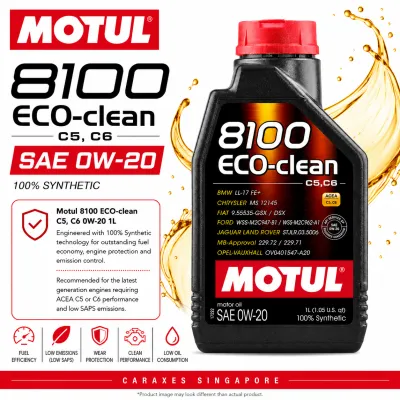
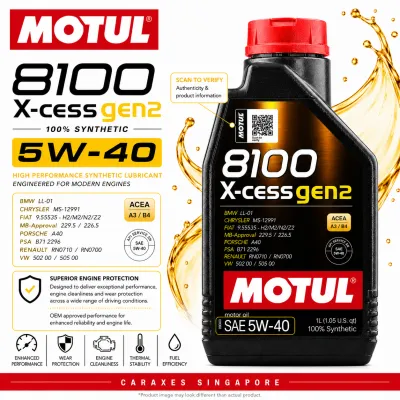
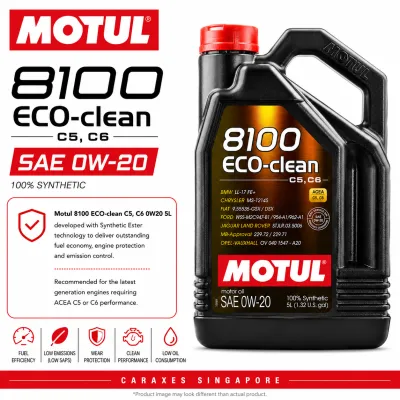
1 Lazada user ratings
Good catch during the promotion. Good buy.
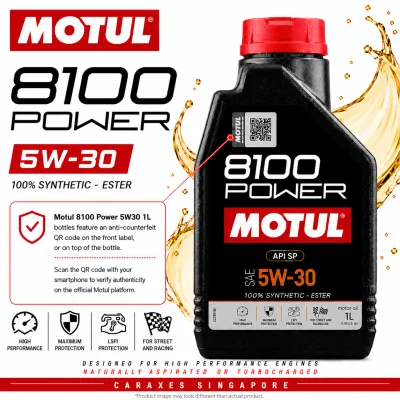
3 Lazada user ratings
Seller responsive, packs fast and ships fast. Product arrived in good condition. Looks genuine with QR sticker and good quality packaging. H…Read full reviewShow less
Seller responsive, packs fast and ships fast. Product arrived in good condition. Looks genuine with QR sticker and good quality packaging. Have not used oil yet
Been on Motul for over a decade, no complaints. Quick to confirm order and pack, delivery took just a day.
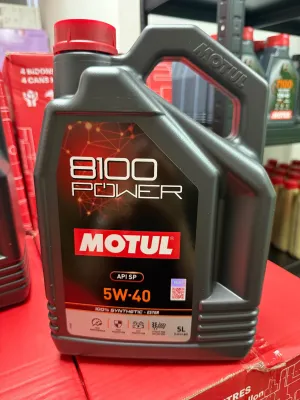
Prices are valid at publication and may change. Please refer to the product page for the latest price.
Understanding OEM Motor Oil and Premium Aftermarket Alternatives
To make an informed decision, it is essential to understand how standard OEM oils and premium aftermarket alternatives differ in their formulation goals. Vehicle manufacturers do not typically refine their own oil; instead, they partner with major lubricant producers to package oils that meet their exact baseline engineering specifications. These OEM fluids are designed to offer balanced, reliable performance across a wide range of standard operating conditions while keeping production and servicing costs manageable.
In contrast, premium aftermarket lines like Motul 8100 are formulated to target the upper limits of performance standards. These oils typically utilize high-quality fully synthetic base stocks, such as Group III or Group IV (polyalphaolefin) synthetics, combined with robust additive packages. These additives include detergents, dispersants, anti-wear agents, and friction modifiers that are selected to maintain viscosity stability under extreme temperatures and minimize the formation of sludge and varnish inside the engine.
However, a premium label does not guarantee better performance unless the oil’s technical specifications align with your engine’s design. Modern engines are highly sensitive to oil viscosity and chemical composition. For instance, an oil formulated for high-performance European sports cars may not provide the correct flow characteristics or emissions system compatibility for a modern Japanese hybrid. An upgrade is only beneficial if the specific variant of Motul 8100 you choose carries the exact certifications and viscosity ratings required by your vehicle’s manufacturer.
Assessing Your Daily Driving Conditions in Singapore
Your daily driving environment plays a critical role in determining whether standard OEM oil is sufficient or if a premium upgrade is justified. In Singapore, the driving landscape is characterized by unique challenges that place significant stress on engine lubricants. Understanding these local factors can help you evaluate if your current oil is being pushed to its limits.

Frequent stop-and-go traffic, prolonged idling at traffic lights, and short trips are standard for many local drivers. These driving patterns are classified as “severe operating conditions” by most vehicle manufacturers. During short trips, the engine often fails to reach its optimal operating temperature for a sustained period. This prevents accumulated moisture and unburnt fuel from evaporating out of the oil, which can lead to fuel dilution and accelerated oil degradation.
Additionally, the tropical climate of Singapore means ambient temperatures remain consistently high throughout the year. When combined with slow-moving traffic, the engine bay experiences elevated thermal loads with minimal cooling airflow. High temperatures accelerate the oxidation process of motor oil, causing it to thicken, lose its lubricating properties, and potentially form harmful deposits on critical engine components.
You can monitor several observable signs to determine if your current oil is degrading prematurely under these conditions. Pulling the dipstick to check the oil’s color and consistency can provide clues; oil that becomes exceptionally dark, thick, or gritty long before the scheduled service interval may be struggling with thermal stress. A gradual decrease in fuel efficiency or a slightly rougher engine idle as you approach your next oil change can also indicate that the lubricant’s friction-reducing properties are diminishing, suggesting that a higher-quality synthetic oil might offer better stability.
How to Verify Motul 8100 Benefits Against Your Owner’s Manual
Before purchasing any aftermarket motor oil, you must verify that the product is fully compatible with your vehicle. Assuming that a premium brand name like Motul automatically guarantees compatibility is a common mistake that can lead to engine damage or voided warranties. A systematic verification process is essential to ensure a safe upgrade.
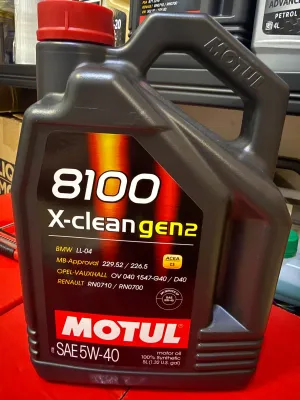
Start by consulting your vehicle’s owner’s manual to locate the precise oil specifications. Look for the required viscosity grade, which is typically represented by numbers such as 0W-20, 5W-30, or 5W-40. Next, identify the required industry standards, such as API (American Petroleum Institute) classifications or ACEA (European Automobile Manufacturers’ Association) sequences. Many modern vehicles also require specific manufacturer approval codes, such as BMW Longlife-01, Mercedes-Benz MB-Approval 229.5, or VW 502 00.
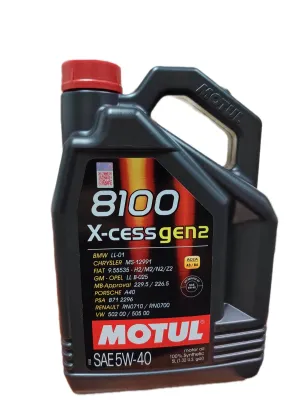
Once you have these specifications, examine the product label of the Motul 8100 variant you are considering. The Motul 8100 family includes several distinct products, such as 8100 X-cess, 8100 X-clean, and 8100 Eco-lite. Each of these variants is formulated with a different chemical balance to meet specific manufacturer standards. For example, a variant labeled “X-clean” is typically designed for mid-SAPS (sulfated ash, phosphorus, and sulfur) compatibility to protect modern exhaust aftertreatment systems, while “Eco-lite” focuses on fuel economy and low-viscosity requirements.
Never rely solely on general marketing terms or broad product tiers. If your owner’s manual specifies a highly technical standard, you must locate that exact code on the back of the Motul bottle. If the specific code is missing, that particular variant is not approved for your engine, regardless of the brand’s reputation. Taking the time to match these specifications ensures that the oil will function harmoniously with your engine’s internal clearances and emissions systems.
Calculating the Financial Impact of an Oil Upgrade
Upgrading to a premium motor oil involves a clear financial trade-off. To determine if the transition makes sense for your household budget, it is helpful to calculate the annual cost difference between standard OEM servicing and a premium aftermarket option.
In Singapore, standard OEM oils or basic synthetic blends provided during routine dealership services typically cost between S$15 and S$25 per liter. Premium fully synthetic aftermarket oils, such as the Motul 8100 series, generally retail between S$25 and S$40 per liter, depending on the specific variant and where you purchase it. For a typical passenger car requiring a 4-liter to 5-liter oil change, this price difference translates to an additional upfront cost of approximately S$40 to S$100 per service.
Some drivers attempt to offset this higher cost by extending their oil drain intervals, assuming that premium synthetic oils last longer. However, this practice is highly risky. You should never exceed the service intervals recommended in your vehicle’s owner’s manual unless both the oil manufacturer and your vehicle manufacturer explicitly authorize extended intervals for your specific driving conditions. Given the severe stop-and-go nature of driving in Singapore, sticking to the standard 10,000 km or 6-month service interval remains the safest approach to prevent engine wear.
To calculate the annual financial impact, consider your average yearly mileage. If you drive approximately 15,000 km per year and service your vehicle twice annually, upgrading to Motul 8100 will increase your maintenance costs by roughly S$80 to S$200 per year. For many owners, this annual premium is a reasonable investment for enhanced engine protection, reduced deposit formation, and potential long-term savings on major engine repairs. For others, the baseline protection of OEM oil remains the more economical choice.
Warranty Considerations and Your Final Upgrade Decision
Maintaining your vehicle’s factory warranty is a primary concern when considering aftermarket fluids. If your car is still covered by a manufacturer’s warranty, you must understand the conditions under which using an aftermarket oil is permitted.
Generally, using an aftermarket motor oil will not void your vehicle’s warranty as long as the oil meets the exact technical specifications and manufacturer approvals outlined in your owner’s manual. To protect your coverage, you must keep detailed records of every oil change. This includes retaining itemized receipts that clearly state the brand, specific product name (such as Motul 8100 X-cess 5W-40), and the date of service. If an engine issue arises, you must be able to prove that the lubricant used complied fully with the manufacturer’s requirements.
If you encounter a situation where your owner’s manual and the aftermarket oil label present conflicting information, or if the Motul 8100 variant does not explicitly list your vehicle’s required approval code, the safest course of action is to stick with the OEM oil. Using an unapproved lubricant, even a premium one, gives the manufacturer a valid reason to deny warranty claims related to engine wear or emissions system failures.
Your final decision should align with your vehicle’s status and your driving habits. Sticking with standard OEM oil is the most practical choice if your car is under a strict dealership service contract, if you drive primarily short distances under light loads, or if you prefer to keep maintenance costs as low as possible. Conversely, upgrading to a compatible Motul 8100 variant is highly justified if your vehicle is out of warranty, if you frequently drive in heavy traffic or hot conditions, if you plan to keep the car for many years, and if you value the added thermal stability and deposit control that a premium fully synthetic formulation provides.
Frequently Asked Questions (FAQ)
Can I mix Motul 8100 with my remaining OEM motor oil?
While modern engine oils are generally designed to be miscible, mixing different brands and formulations is highly discouraged by manufacturers. Each motor oil utilizes a unique, carefully balanced additive package. Mixing Motul 8100 with a different OEM oil can disrupt this chemical balance, potentially diluting the effectiveness of the anti-wear agents, detergents, and friction modifiers. If you are planning to switch to Motul 8100, it is best to perform a complete oil and filter change rather than topping up your existing oil. This ensures you receive the full performance and protection benefits of the premium formulation without contamination.
Will switching to a premium oil void my car's warranty?
Switching to a premium aftermarket oil like Motul 8100 will not void your vehicle’s warranty, provided the specific variant you choose meets or exceeds the exact viscosity and performance standards specified in your owner’s manual. To safeguard your warranty coverage, always verify that the specific OEM approval codes are printed on the oil bottle. Additionally, keep detailed service records, including itemized receipts that specify the exact product name and viscosity grade used during maintenance, to demonstrate compliance with the manufacturer’s service guidelines.

Community discussion
Share your experience or ask a question. Comments are reviewed before publication.