
When choosing between a wired USB-C car charger and a wireless car charger within the Essager 45W range, the wired connection is the clear winner for speed and reliability. A physical USB-C cable delivers direct, uninterrupted power to your device, maximizing the charging rate while minimizing heat generation. In contrast, wireless charging prioritizes convenience, allowing you to mount and unmount your phone quickly, but it suffers from energy loss, heat buildup, and potential connection drops on bumpy roads. Deciding between the two depends on whether you value rapid battery recovery during short drives or a cable-free dashboard setup.
Decoding the 45W Label: Wired vs Wireless Specifications
To understand how these chargers perform, you must first decode the “45W” label printed on the packaging. Many drivers assume a 45W charger will automatically deliver 45W of power directly to their phone, but actual output depends heavily on the connection type and port configuration. You should always inspect the detailed “Output” specifications printed on the charger’s body or packaging to understand its true capabilities.
Car chargers often advertise a combined wattage that represents the total output across multiple ports rather than a single connection. For example, a charger labeled as 45W might split its power, offering 30W on one USB-C port and 15W on a USB-A port when both are in use. If you plug in two devices simultaneously, neither will receive the full 45W.
Products mentioned in this guide
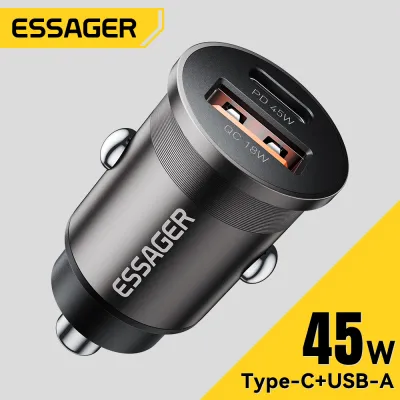
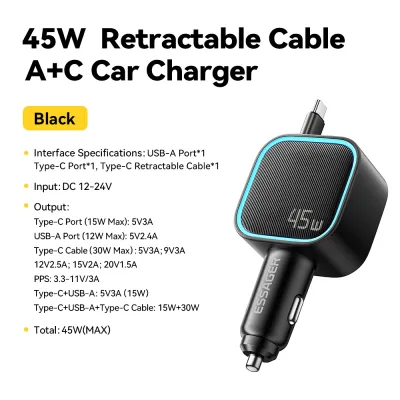
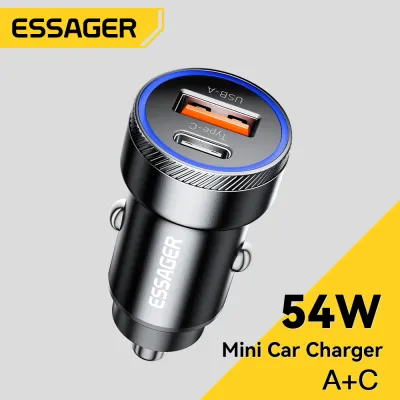
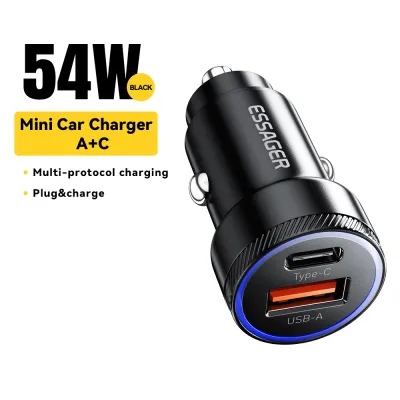
Prices are valid at publication and may change. Please refer to the product page for the latest price.
Wired charging relies on established fast-charging protocols like USB-C Power Delivery (PD) and Programmable Power Supply (PPS). These protocols allow the charger and your phone to communicate dynamically, negotiating the optimal voltage and current. If your phone supports PD or PPS, a wired 45W charger can deliver its maximum single-port output directly to your device, provided you use a compatible high-wattage cable.
Wireless charging operates under different standards, primarily the universal Qi or newer Qi2 protocols. Even if a wireless car charger is advertised with a high input wattage, the actual wireless power transmitted to your phone is usually capped at lower limits, such as 7.5W, 10W, or 15W, depending on your phone’s brand and compatibility. A “45W wireless charger” often refers to the total power the mount draws from the car’s 12V socket to power its internal cooling fans, motorized clamps, and wireless coils combined, rather than the power delivered to a single device.
Real-World Charging Speed and Efficiency in the Car
In the cabin of a moving vehicle, environmental factors play a massive role in how quickly your phone charges. Wired USB-C connections are highly efficient because electricity flows directly through copper wires with minimal resistance. This direct transfer means almost all the drawn power goes straight into your phone’s battery, resulting in rapid charging times and very little wasted energy.

Wireless charging, however, relies on electromagnetic induction, which is inherently less efficient. A significant portion of the electrical energy is lost as heat during the transfer between the charger’s transmitter coil and your phone’s receiver coil. This energy loss means wireless charging will always take longer to charge your phone from empty compared to a wired connection of the same nominal wattage.
This heat generation is a critical drawback in a car environment. As the wireless coils and your phone’s battery heat up, your phone’s internal safety mechanisms will trigger thermal throttling. To protect the battery from permanent heat damage, the phone will automatically reduce its charging intake, sometimes dropping to a slow trickle charge. If your car’s cabin is already warm from sunlight, this slowdown happens even faster.
The performance gap becomes even more noticeable when you run power-intensive applications while driving. Using GPS navigation with high screen brightness and active cellular data consumes a large amount of power. Under these conditions, a wireless charger might only supply enough energy to keep the battery level stable, whereas a wired USB-C connection can easily overcome the power drain and continue to charge the battery rapidly.
To see how your chosen method is performing, you can check your phone’s battery settings or use a reputable diagnostic application during a drive. These tools can show you whether your device is actively fast-charging or if thermal limits have throttled the power intake.
Connection Stability and Reliability on the Road
Road conditions introduce physical challenges that can disrupt your charging experience. A wired USB-C connection offers excellent physical stability. Once the cable is firmly clicked into your phone’s charging port, the connection remains secure regardless of sharp turns, sudden stops, or driving over speed bumps. The physical latching mechanism of USB-C is designed to withstand moderate movement without interrupting the power flow.
Wireless charging mounts are far more sensitive to physical alignment. For efficient power transfer, the charging coil inside your phone must align precisely with the coil inside the mount. If your phone shifts even slightly due to road vibrations, the charging speed can drop dramatically, or the connection may cut out entirely.
Thick or rugged phone cases further complicate this alignment. If your case exceeds the maximum thickness recommended by the charger manufacturer, the electromagnetic field weakens, reducing efficiency or preventing charging altogether. Additionally, metal plates, ring holders, or credit cards stored in your phone case can trigger the charger’s Foreign Object Detection (FOD) safety system, which automatically shuts off power to prevent overheating.
Vehicle vibrations can also cause micro-disconnects on wireless mounts. Every time the phone bounces slightly off the charging pad, the charger must re-establish the connection, leading to repeated charging start-and-stop cycles that can degrade your battery health over time. If you choose a wireless model, it is essential to inspect the mount’s grip strength, ensure it has adjustable feet to align the coils, and verify that the clamping mechanism holds your phone securely on rough roads.
Which Essager Car Charger Fits Your Driving Habits?
Selecting the right charger requires evaluating your daily driving habits and your phone’s specific hardware capabilities. A wired USB-C charger is the ideal choice if you frequently take long road trips, rely heavily on real-time navigation apps, or need to quickly boost your battery during a short commute. It is also the necessary choice if your phone does not support wireless charging or lacks compatibility with high-speed wireless protocols.
A wireless car charger mount is better suited for drivers who prioritize a clean, cable-free dashboard and take frequent, short trips. If your daily routine involves getting in and out of the car repeatedly for errands or deliveries, the convenience of dropping your phone into a motorized or magnetic mount without fumbling with cables is highly beneficial.
Before making a purchase, you must perform a few compatibility checks. First, consult your vehicle’s owner’s manual to verify that your 12V accessory socket (cigarette lighter) can support the input requirements of a high-wattage charger. Some older vehicles have lower fuse ratings that may limit power delivery. Second, examine your phone case to ensure it is thin enough and free of metallic materials that could interfere with wireless charging.
Installation and Safety Checks for Your Vehicle
Operating high-wattage electronics in a vehicle requires careful attention to safety to protect your car’s electrical system and your mobile devices. Always inspect the physical condition of your car’s 12V socket before inserting a new charger. Ensure the socket is free of dust, debris, or corrosion, which can cause poor electrical contact and localized heating.
When shopping for a charger, verify that the product specifications list essential safety protections. These include overcurrent protection, overvoltage protection, short-circuit protection, and temperature control. For wireless chargers, Foreign Object Detection (FOD) is a critical safety feature that prevents the coils from heating up metal items like coins or keys left on the charging pad.
Avoid mounting wireless chargers in positions where they are exposed to direct, intense sunlight through the windshield for extended periods. The combination of solar heat and the heat generated by wireless charging can quickly push your phone into thermal shutdown, damaging the battery or warping the plastic components of the mount.
Finally, establish a routine to check your charging equipment. If you ever notice an unusual burning smell, discoloration of the plastic, or if the charger or cable becomes too hot to touch comfortably, immediately unplug the device from the 12V socket. Discontinue use and consult the manufacturer’s documentation or a qualified automotive technician to diagnose the issue before attempting to use another charger.
Frequently Asked Questions (FAQ)
Can a 45W Wireless Car Charger Fast-Charge Any Phone?
No, a high-wattage rating on a wireless charger does not guarantee fast charging for every device. Your phone must support the specific wireless charging standard and power profile of the charger to achieve maximum speeds. Many phones default to a standard, slower charging rate when paired with third-party wireless chargers to protect their batteries, regardless of how much power the charger is capable of outputting.
Does a High-Wattage Car Charger Drain the Vehicle Battery?
When your phone is disconnected, a plugged-in car charger draws an extremely small amount of standby power, which is generally harmless over short periods. However, some vehicles keep the 12V accessory socket powered even when the engine is turned off and the key is removed. If your car is parked for several days or weeks with the charger plugged into an active socket, this parasitic drain can eventually weaken your car battery, so it is safest to unplug the charger when leaving the vehicle parked long-term.

Community discussion
Share your experience or ask a question. Comments are reviewed before publication.