
When selecting transmission fluid, the letters and numbers on the bottle can seem like a confusing array of chemical shorthand. For drivers looking at Motul Gear 300, two key specifications stand out: API GL-5 and SAE 75W-90. These ratings are not generic quality marks; they are precise engineering standards that dictate how the fluid behaves under extreme heat, high pressure, and cold starts.
For your gearbox, these ratings determine whether the fluid can safely protect the gears under load without causing chemical damage to internal components like yellow-metal synchronizers. Choosing the wrong specification can lead to accelerated wear, poor shift quality, or catastrophic transmission failure.
What the SAE 75W-90 Viscosity Rating Means for Your Shifts
The SAE 75W-90 rating defines the fluid’s viscosity, which is its resistance to flow at specific temperature extremes. This multi-grade rating ensures the oil remains thin enough to flow when cold, yet thick enough to protect mechanical components when hot.
Products mentioned in this guide
![🇸🇬 MOTUL Gear 300 75W90 Fully Synthetic Manual Transmission & Gear Oil [1L]](https://img.lazcdn.com/g/p/fc5aa19c05c07f31d509e96a9338acd0.png_400x400q80.png_.webp)
![MOTUL GEAR 300 75W90 [1L]](https://img.lazcdn.com/g/p/39a6ee75f36db1b253e62075d7292b73.jpg_400x400q80.jpg_.webp)
![🇸🇬 MOTUL Gear 300 LS 75W90 Fully Synthetic LSD Differential Gear Oil [1L]](https://img.lazcdn.com/g/p/60520f4373c6ca19d1eccb1537521ba4.png_400x400q80.png_.webp)
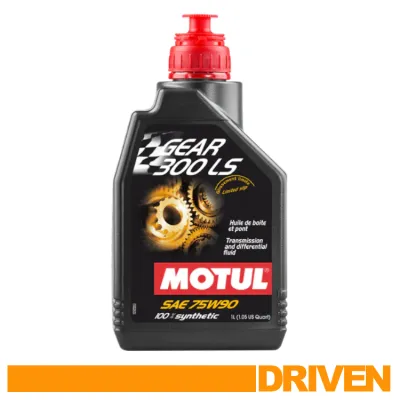
Prices are valid at publication and may change. Please refer to the product page for the latest price.
The “75W” portion represents the winter or cold-temperature rating. A lower number before the “W” indicates better fluid flow at low temperatures. Even in a tropical climate like Singapore, where freezing temperatures are non-existent, cold-start viscosity remains highly relevant. When a vehicle sits overnight, the transmission fluid settles and cools to ambient temperature. Upon startup, the fluid must immediately circulate to coat the gears and synchronizers. A 75W rating ensures rapid lubrication during these initial moments, reducing drag and preventing stiff, notched gear shifts when you first drive off.
The “90” portion denotes the high-temperature kinematic viscosity, measured at 100°C. This is the typical operating temperature range for a gearbox under normal driving conditions. Under heavy mechanical loads, high speeds, or prolonged stop-and-go city driving, the gears generate intense heat and pressure. The “90” rating indicates that the fluid maintains a sufficiently thick protective oil film under these conditions. This film acts as a barrier, preventing direct metal-to-metal contact between the gear teeth, which would otherwise lead to rapid wear, pitting, and eventual gear failure.
Before purchasing, you must compare these specific numbers with the viscosity range recommended in your vehicle’s owner manual. While 75W-90 is a highly versatile grade, some modern manual transmissions or transaxles are engineered for thinner fluids, such as 75W-80, to improve fuel efficiency. Using a higher viscosity than recommended can cause sluggish shifts and increased operating temperatures, while a lower viscosity may fail to provide adequate wear protection.
What the API GL-5 Standard Means for Gear Protection and Compatibility
The API GL-5 standard refers to the performance classification set by the American Petroleum Institute. This rating specifically indicates the level of extreme pressure (EP) protection the fluid provides, which is crucial for gearboxes operating under severe stress.

API GL-5 fluids are primarily formulated for high-load, high-slip conditions. These conditions are most commonly found in hypoid gear sets, which are typically used in differentials and some transaxles. Hypoid gears feature an offset design that creates a sliding action between the gear teeth, generating immense friction and heat. To prevent the gears from welding together under these extreme forces, GL-5 fluids contain a high concentration of chemical additives, usually based on sulfur and phosphorus. These additives react with the metal surfaces under heat to form a sacrificial protective layer.
However, this high concentration of sulfur-based EP additives introduces a critical compatibility concern for manual transmissions. Many manual gearboxes utilize synchronizers made of “yellow metals,” such as brass or bronze, to match gear speeds during shifts. The active sulfur in GL-5 fluids can chemically react with these softer metals, causing them to corrode and peel away over time. This degradation leads to rough shifting, gear grinding, and eventual synchronizer failure.
Consequently, you must verify whether your specific gearbox explicitly requires an API GL-4 fluid or officially approves the use of GL-5. API GL-4 fluids contain roughly half the amount of EP additives found in GL-5, making them safe for yellow-metal synchronizers while still providing adequate protection for helical or spur gears. Some modern gear oils, including certain formulations of Motul Gear 300, are designed to be non-corrosive to copper alloys, but you must always cross-reference this with your vehicle manufacturer’s explicit requirements.
How to Verify if Motul Gear 300 Fits Your Specific Transmission
Verifying compatibility before pouring new fluid into your transmission is essential to prevent costly mechanical failures. Operating a vehicle with the wrong transmission fluid can void warranties and lead to severe drivetrain damage.
Begin by locating your vehicle’s service booklet or owner’s manual. Navigate to the technical specifications or maintenance section, which lists the required fluid capacities, viscosity grades, and performance standards. Note any proprietary manufacturer specifications or OEM approval codes, such as specific factory part numbers or performance specifications unique to your vehicle brand.
Next, cross-reference these requirements with the specifications printed on the Motul Gear 300 product label. The label must explicitly state that it meets or exceeds the exact standards required by your vehicle manufacturer. Do not rely solely on the general SAE 75W-90 or API GL-5 ratings; ensure any specific manufacturer approval codes match perfectly.
Always identify clear stop conditions before starting the service. If your owner’s manual specifies a highly proprietary fluid, a different viscosity grade, or if the requirements are ambiguous, do not proceed with the fluid change. Stop immediately and consult a certified mechanic or an authorized dealership.
Additionally, keep in mind the safety boundaries of transmission maintenance. Working underneath a vehicle requires proper lifting equipment, jack stands, and personal protective gear. Always follow the original-vehicle instructions for safety precautions, drain plug torque values, and disposal procedures for used fluids. If you do not have the necessary tools or experience to perform the service safely, seek qualified professional installation at a reputable service center.
Frequently Asked Questions (FAQ)
Is API GL-5 always an upgrade over GL-4 for manual gearboxes?
No, API GL-5 is not a universal upgrade over GL-4. While GL-5 provides superior extreme-pressure protection for high-load differentials, its high concentration of sulfur-based additives can chemically corrode brass and bronze synchronizers in manual gearboxes. The correct specification depends entirely on the synchronizer materials and the manufacturer’s engineering design. Always use the exact API standard specified in your vehicle’s manual.
Can I top up my gearbox with a different viscosity if 75W-90 is unavailable?
Mixing different viscosity grades or fluid brands is highly discouraged. Combining different fluids alters the overall viscosity profile and can destabilize the chemical additive packages, reducing the fluid’s ability to protect against wear and heat. For optimal mechanical safety and performance, it is best to perform a complete drain and flush with the correct fluid rather than risking a partial top-up with an incompatible grade.
Community discussion
Share your experience or ask a question. Comments are reviewed before publication.