
Selecting the right motorcycle oil is one of the most critical decisions you can make to ensure the longevity and performance of your engine. In the world of high-performance lubricants, the Motul 7100 series stands out as a premier fully synthetic option. However, choosing the correct viscosity grade—such as 10W-30, 10W-40, 10W-50, or 15W-50—can be confusing. These numbers represent the oil’s flow characteristics at extreme temperatures, directly impacting how quickly the lubricant circulates during a cold start and how effectively it protects internal components under high thermal stress.
For riders navigating Singapore’s hot tropical climate and dense, stop-and-go traffic, understanding these grades is essential. The right viscosity ensures that your engine remains shielded from wear, your wet clutch operates smoothly without slipping, and your gearbox shifts cleanly. Matching the oil grade to your specific motorcycle manufacturer guidelines and riding habits prevents premature engine wear and helps maintain peak operating efficiency.
What Motul 7100 Viscosity Numbers Actually Mean
The numbers printed on a bottle of Motul 7100 refer to its Society of Automotive Engineers (SAE) viscosity grade. This classification system describes how the oil flows at both low and high temperatures, which is crucial because oil naturally thins out as it heats up and thickens as it cools down. Modern multi-grade oils are engineered with viscosity index improvers to behave like a thin oil when cold and a thicker oil when hot.
Products mentioned in this guide
![🇸🇬 MOTUL 7100 4T 10W40 10W50 15W50 100% Synthetic Ester Engine Oil Motorcycle Oil [1L]](https://img.lazcdn.com/g/p/00450279a13a350708397ff343c39c19.png_400x400q80.png_.webp)
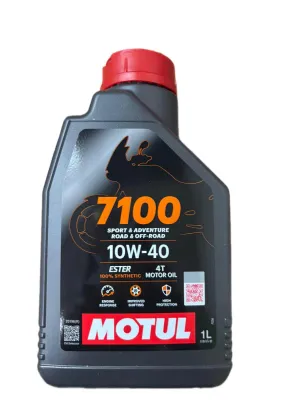
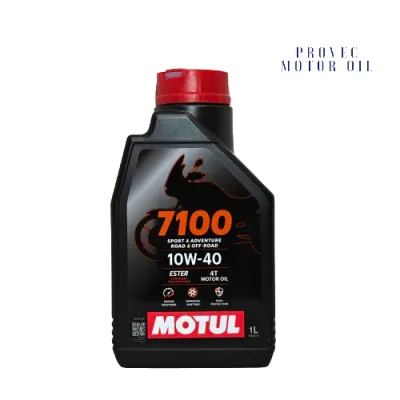
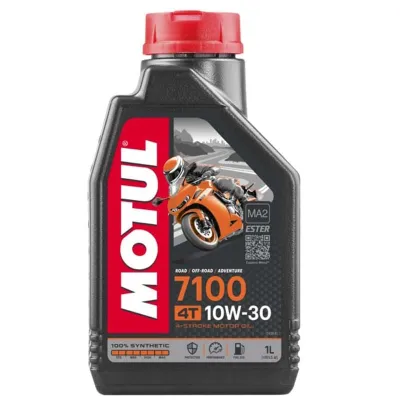
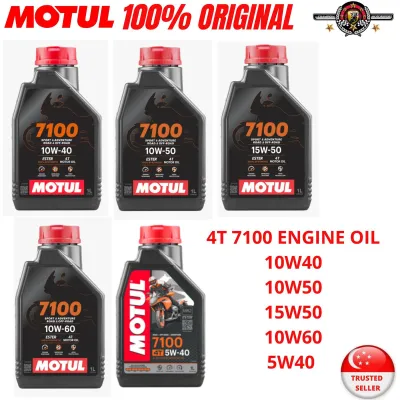
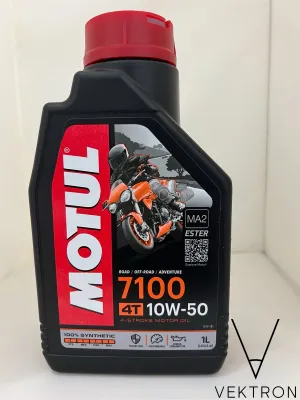
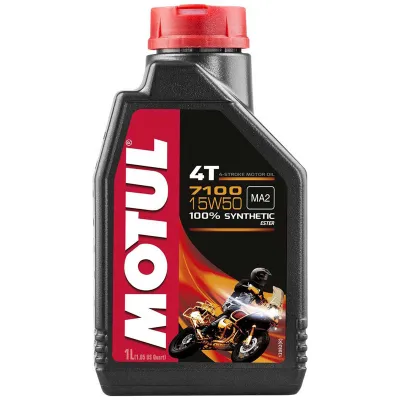
Prices are valid at publication and may change. Please refer to the product page for the latest price.
The first part of the grade, containing the letter “W”, stands for “Winter” rather than weight. This number (such as 10W or 15W) indicates the oil’s low-temperature flow properties and pumpability. A lower number before the “W” means the oil remains more fluid at low temperatures, allowing it to circulate rapidly through the engine immediately after startup to minimize initial metal-on-metal friction.
The second number (such as 30, 40, or 50) represents the oil’s high-temperature viscosity rating, measured under standardized laboratory conditions at 100°C. This number indicates the oil’s resistance to thinning when the engine reaches its normal operating temperature. A higher second number means the oil maintains a thicker, more robust lubricating film under extreme heat and heavy mechanical load.
It is important to clarify that these numbers do not represent absolute physical measurements of thickness. Instead, they are standardized ratings of relative flow rates and shear resistance. They tell you how well the oil will resist thinning out when subjected to the intense heat generated inside your motorcycle’s combustion chambers and transmission gears.
Comparing the Grades: 10W-30, 10W-40, 10W-50, and 15W-50
Motul 7100 is formulated in several viscosity grades to accommodate different engine designs, climates, and riding styles. While they all share the same high-quality synthetic foundation, their distinct flow profiles make them suitable for very different operating environments.

10W-30 and 10W-40: Cold Starts and Everyday Riding
The lower viscosity grades in the Motul 7100 lineup, specifically 10W-30 and 10W-40, are engineered for rapid circulation and reduced internal fluid resistance. These oils flow quickly upon startup, ensuring that critical overhead components, such as the camshaft and valve train, receive immediate lubrication.
- Rapid Lubrication: Minimizes initial engine wear during the crucial first few seconds after starting the motorcycle.
- Reduced Internal Drag: Thinner oil creates less fluid resistance inside the engine, which can improve throttle response and slightly enhance fuel efficiency.
- Target Applications: These grades are the standard recommendation for modern, liquid-cooled motorcycles with tight internal clearances. They are ideal for daily commuting and standard urban riding where engine temperatures are strictly regulated by a radiator and cooling fan.
10W-50 and 15W-50: High Heat and Heavy Loads
The higher viscosity grades, such as 10W-50 and 15W-50, are formulated to provide maximum film strength under severe thermal stress. These oils resist thinning even when the engine is pushed to its absolute limits.
- Robust Film Protection: Maintains a thick, stable cushion of oil between moving parts under extreme heat and heavy mechanical loads.
- Target Applications: These grades are highly suited for air-cooled or air/oil-cooled engines, which naturally run much hotter than liquid-cooled systems. They are also ideal for older motorcycles with wider internal clearances, high-mileage engines, or bikes subjected to sustained high-RPM highway cruising in hot tropical climates.
- The Trade-Off: The primary trade-off is a slight increase in internal fluid drag. This can result in marginally higher fuel consumption and a slightly heavier engine feel during cold starts compared to thinner grades.
How Viscosity Directly Affects Engine Protection and Clutch Feel
Viscosity is the single most important physical property of an engine lubricant because it determines the thickness of the oil film separating moving metal parts. If the oil film is too thin, the protective barrier can collapse under heavy loads, leading to direct metal-to-metal contact, rapid wear, and localized overheating. Conversely, if the oil is too thick, it may not flow quickly enough to carry heat away from critical areas, resulting in elevated operating temperatures.
In most motorcycles, the engine oil must do triple duty: lubricating the engine, protecting the gearbox, and cooling the wet clutch. This shared-sump design requires a delicate balance. The viscosity of the oil directly influences how the clutch plates engage and disengage.
Using an oil with the correct viscosity ensures that the clutch plates can grip effectively without slipping under acceleration, while still releasing cleanly when you pull the clutch lever. An oil that is too thin can lead to clutch slippage and accelerated wear of the friction plates. An oil that is too thick can cause excessive clutch drag, making gear shifts feel clunky, stiff, or making it difficult to find neutral when idling at a stoplight.
Motul 7100 addresses these demanding requirements by utilizing high-quality ester-based synthetic base stocks. This Ester technology features polar molecules that naturally cling to metal surfaces. This molecular adhesion provides a persistent, microscopic protective film across all internal components, ensuring reliable lubrication during cold starts and maintaining exceptional film stability under high shear forces, regardless of the specific viscosity grade you choose.
How to Choose the Right Motul 7100 Grade for Your Motorcycle
Selecting the correct viscosity grade should never be based on guesswork or online trends. To make a safe and informed decision, riders should follow a structured approach.
First, always consult your motorcycle owner’s manual. The manufacturer’s documentation is the primary, non-negotiable authority for oil selection. Manufacturers design engines with specific internal tolerances, oil pump capacities, and operating clearances that dictate the ideal baseline viscosity grade. Always verify that your chosen oil meets or exceeds the performance specifications, such as JASO MA2 for wet clutches and the appropriate API rating, listed in your manual.
Second, consider your local riding environment and usage patterns. While the manufacturer’s manual remains the standard, it often provides a chart showing acceptable viscosity ranges based on ambient temperatures. In hot, tropical regions like Singapore, where ambient temperatures remain consistently high year-round, opting for the higher end of the manufacturer’s recommended viscosity range (such as choosing 10W-40 over 10W-30, if both are permitted) can provide an extra margin of safety against oil thinning during heavy traffic jams.
Avoid the temptation to use an oil that is significantly thicker than what your manufacturer recommends. Using an excessively thick oil in a modern, tight-tolerance engine can lead to oil starvation. The oil pump may struggle to push the heavy fluid through narrow oil passages, leaving critical components dry during startup and causing accelerated wear.
Frequently Asked Questions (FAQ)
Can I mix different Motul 7100 viscosity grades?
It is strongly advised not to mix different viscosity grades of Motul 7100, such as topping up a crankcase filled with 10W-40 using 10W-50. While they are chemically compatible and will not cause a catastrophic reaction, mixing different grades alters the carefully engineered flow characteristics and physical properties of the oil. This unpredictably changes the overall viscosity, which can compromise engine protection, affect wet clutch performance, and prevent the oil from performing as designed by the manufacturer.
Is a higher viscosity grade always better for engine protection?
No, a higher viscosity grade is not inherently better for engine protection. While thicker oil provides a more robust film under extreme heat, it flows much slower at lower temperatures. If an oil is too thick for your specific engine design, it will take longer to reach critical components like the valve train during a cold start, leading to increased wear. Additionally, excessively thick oil increases internal friction and drag, which raises engine operating temperatures, reduces fuel efficiency, and can cause oil starvation in modern engines with highly precise, narrow clearances.
Community discussion
Share your experience or ask a question. Comments are reviewed before publication.