
Evaluating a dash cam for your vehicle in Singapore requires balancing daily driving needs, local weather conditions, and strict regulatory standards. The 70mai A410 has gained attention as a compact recording solution, but local drivers must compare its official specifications against alternative models to determine if it truly fits their requirements. A proper comparison goes beyond marketing claims, focusing instead on verifiable hardware capabilities, installation safety, and compliance with local road safety guidelines.
To make an informed decision, you must analyze how the device performs under Singapore’s specific environmental challenges, such as high cabin temperatures and sudden tropical downpours. This guide provides a systematic framework to evaluate the 70mai A410 alongside other compliant dash cams, helping you verify legal mounting zones, assess power management systems, and choose the right setup for your vehicle.
Understanding LTA Compliance Requirements
The Land Transport Authority (LTA) maintains clear guidelines to ensure that aftermarket accessories do not compromise road safety. When installing any dash cam, including the 70mai A410, the primary legal consideration is visual obstruction. The device must be mounted in a position that does not impede the driver’s direct line of sight or block the view of surrounding traffic. Typically, this means placing the camera high up on the windshield, ideally behind or adjacent to the rearview mirror, within the zone covered by the windshield wipers to ensure clear recording during rain without blocking your forward vision.
Products mentioned in this guide

![[2026 NEW] 70mai A410 Neo Dash Cam 2K Front + 1080P Rear | HDR Night Vision | Built-in GPS | Buffered Emergency Recording](https://img.lazcdn.com/g/p/fdee85e2c471600ed4251814d7f73a43.png_400x400q80.png_.webp)
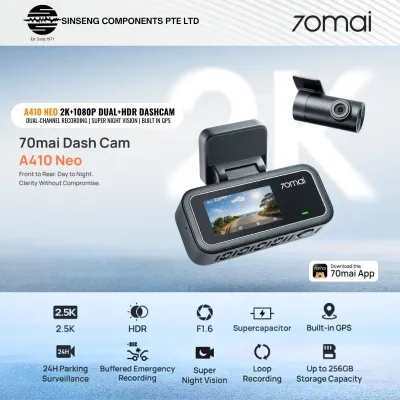
Prices are valid at publication and may change. Please refer to the product page for the latest price.
Another critical safety aspect is the power source and its thermal limits. Singapore’s tropical climate regularly subjects parked vehicles to intense solar heating, with cabin temperatures easily exceeding sixty degrees Celsius in open-air car parks. You must check the product manual to verify whether the dash cam utilizes a lithium-ion battery or a supercapacitor. Supercapacitors are generally preferred for high-temperature environments because they do not store energy chemically, significantly reducing the risk of swelling, leakage, or thermal failure compared to traditional lithium-ion batteries.
Finally, ensure the dash cam and its wiring comply with local electrical safety standards. Any device sold or installed should carry appropriate certification marks indicating it has passed standard safety tests. When comparing models, review the manufacturer’s packaging or official specification sheets to confirm compliance with electromagnetic compatibility standards, which prevents the dash cam from interfering with your vehicle’s onboard electronics, radio signals, or safety sensors.
Core Specifications to Evaluate
When comparing the 70mai A410 to alternative dash cams, start by examining the official video specifications rather than relying on generic quality labels. Check the native resolution of the image sensor, which is typically expressed in pixels (such as 1920×1080 or 2560×1440). A higher native resolution allows for clearer detail retrieval, such as reading license plates at a distance, provided the lens quality and video compression rates are well-optimized. Additionally, compare the diagonal field of view (FOV) listed in the technical specifications; a field of view between 130 and 140 degrees generally offers a good balance between capturing adjacent lanes and minimizing edge distortion.

Low-light performance is another crucial metric, especially for night driving along poorly lit roads or navigating dimly lit multi-story car parks. Look for models that explicitly list High Dynamic Range (HDR) or Wide Dynamic Range (WDR) in their technical specifications. These technologies allow the camera sensor to capture multiple exposures simultaneously, preventing bright headlights from washing out the image while preserving details in dark shadows. Verify the specific sensor model used in the device, as reputable sensor manufacturers provide more consistent low-light performance across varying ambient conditions.
For drivers who require continuous monitoring, parking surveillance capabilities must be carefully evaluated. Most dash cams require a dedicated hardwiring kit to draw power from the vehicle’s battery when the ignition is turned off. Review the user manual for the hardwiring kit to confirm it includes an adjustable low-voltage cutoff setting. This feature is essential for protecting your vehicle’s battery health, as it automatically shuts down the dash cam when the car battery drops below a safe voltage threshold, preventing a dead battery when you attempt to start your car.
Lastly, evaluate any integrated smart features, such as Advanced Driver Assistance Systems (ADAS) or GPS logging. ADAS features, which can include lane departure warnings or forward collision alerts, rely on visual sensors and software algorithms that require precise calibration during installation. Check the manufacturer’s instructions to understand the limitations of these systems, as heavy rain, poor road markings, or windshield glare can temporarily reduce their operational accuracy.
Installation and Vehicle Compatibility
The physical installation of your dash cam plays a major role in both safety and cabin aesthetics. A standard plug-and-play installation using the vehicle’s 12V auxiliary power outlet (cigarette lighter) is straightforward and can be completed without professional assistance. However, this method leaves visible cables running across the dashboard and typically disables parking mode functions once the engine is turned off. For a cleaner look and full access to parking surveillance, a professional hardwire installation is recommended, routing the power cables behind the interior trim panels directly to the fuse box.
If you select a dual-channel (front and rear) system, routing the rear camera cable requires careful planning. The cable must be routed safely along the roofline or floor sills without obstructing the deployment paths of side curtain airbags. Additionally, check the compatibility of the rear camera mount with your vehicle’s rear window. Vehicles equipped with aftermarket solar films, heavy window tints, or integrated defogger heating lines require precise camera placement; mounting the camera directly over a heating element can damage the defogger grid or cause the adhesive to fail over time due to localized heat.
The mounting mechanism itself should be evaluated based on your windshield’s angle and material. Many modern dash cams utilize an electrostatic sticker that adheres to the glass first, allowing the camera’s adhesive mount to stick to the film rather than directly to the windshield. This prevents adhesive residue and protects aftermarket solar films from damage if you need to reposition or remove the camera. Ensure the mount allows for vertical tilt adjustment to accommodate the specific slope of your windshield, whether you drive a compact hatchback, a sedan, or a commercial van.
Decision Framework: Choosing the Right Dash Cam
To make your final decision, apply a structured framework based on your specific vehicle setup, parking habits, and technical requirements.
Choose the 70mai A410 if:
- It successfully meets all LTA visual obstruction guidelines when positioned on your windshield.
- Its official video resolution and low-light specifications align with your daily commuting needs.
- You prefer a compact, budget-friendly device with straightforward manufacturer documentation and standard recording features.
Choose an alternative model if:
- Your vehicle is frequently parked outdoors in direct sunlight, making a supercapacitor-based power supply a priority for long-term thermal durability.
- You require advanced features not supported by the 70mai A410's official specifications, such as built-in GPS tracking, cloud connectivity for remote monitoring, or multi-channel expansion beyond front and rear coverage.
- You prefer a device with physical buttons or a larger display screen for easier menu navigation without relying on a smartphone application.
Verify first if:
- Your vehicle features specialized windshield coatings, acoustic glass, or advanced solar films that could interfere with GPS signals or adhesive mounts.
- Your car utilizes a complex CAN bus electrical system or is a hybrid/electric vehicle, which may require specific hardwiring procedures or professional installation to avoid electrical interference.
- The physical dimensions of the dash cam and its mount fit comfortably behind your rearview mirror without violating local safety regulations.
Frequently Asked Questions (FAQ)
Do I need to register my dash cam with the LTA?
No, private vehicle owners in Singapore are not required to register their dash cams with the Land Transport Authority (LTA). However, you must ensure that the device is installed in compliance with all safety regulations. This means the camera must not block your view of the road, and all wiring must be neatly routed and secured so it does not interfere with the vehicle’s controls, pedals, or airbag deployment zones.
Can a dash cam drain my car battery when parked?
Yes, if a dash cam is hardwired to record continuously while parked, it can drain your car’s battery over time. To prevent this, always use a high-quality hardwiring kit equipped with an automatic low-voltage cutoff function. This safety mechanism monitors your vehicle’s battery voltage and automatically cuts power to the dash cam when the voltage drops below a pre-set level, ensuring your car retains enough power to start reliably.
Community discussion
Share your experience or ask a question. Comments are reviewed before publication.