
Maintaining correct tyre pressure is essential for road safety, fuel efficiency, and tyre longevity. While petrol stations across Singapore offer public air compressors, having a portable electric tyre pump in your boot provides unmatched convenience and peace of mind during unexpected pressure drops or roadside emergencies. However, navigating the technical specifications of these devices can be confusing. To choose the right tool for your vehicle, you must look past marketing buzzwords and focus on the technical parameters that directly impact real-world performance.
Quick Reference: The 4 Specs That Dictate Pump Performance
When evaluating an electric tyre pump, four core specifications determine how effectively the device will perform when you are stranded on the roadside:
- Maximum Continuous Pressure: The actual pressure the pump can sustain safely during operation, measured in PSI or Bar.
- Power Source Type: Whether the unit runs on a 12V DC vehicle outlet or an internal rechargeable lithium-ion battery.
- Airflow Rate: The volume of air delivered per minute, which dictates how quickly your tyre inflates.
- Auto-Shutoff Accuracy: The sensor's ability to stop inflation precisely at your target pressure to prevent over-inflation.
It is a common misconception that a higher numerical rating on the box guarantees a better experience. For standard passenger cars, matching the pump’s capabilities to your vehicle’s specific requirements is far more important than buying the most powerful model on the shelf.
Products mentioned in this guide
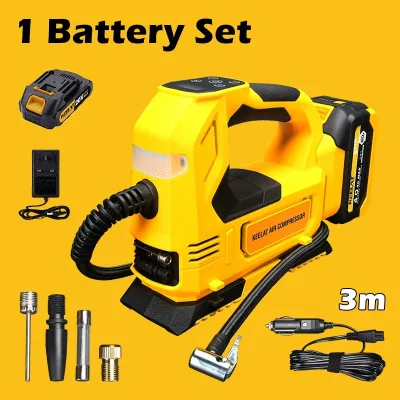
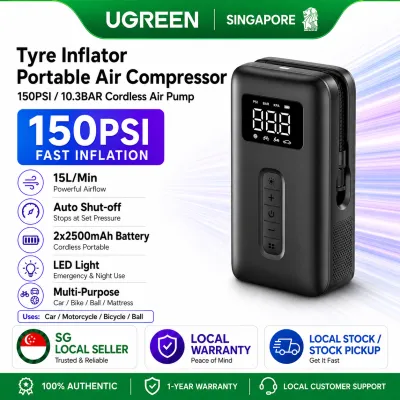
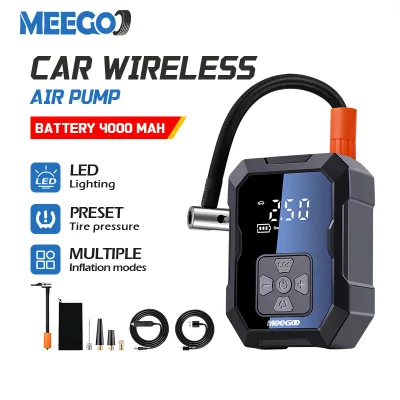
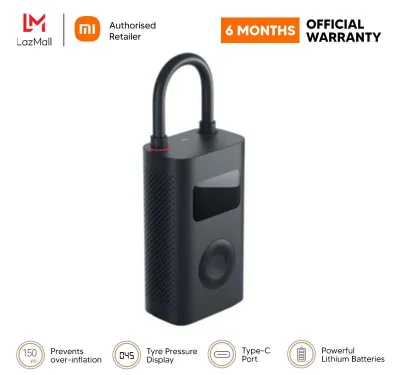
![[SG Stock] Air Pump Car Inflator Compressor Portable Ball Bike Bicycle Rechargeable Basketball Soccer Volleyball Tyre Wheel Tire 12V LED Fast Auto Shut-off Emergency](https://img.lazcdn.com/g/p/cc7d92c566c3860fbbfa1d535cc6f3bb.jpg_400x400q80.jpg_.webp)
![[SG 24H Ship]12000mAh Nitrogen Cordless Car Air Pump 150PSI Portable Tire Inflator for Car Motorcycle Bike](https://img.lazcdn.com/g/p/db8d65465d4e56efe7ecd2e3046fe2d8.jpg_400x400q80.jpg_.webp)
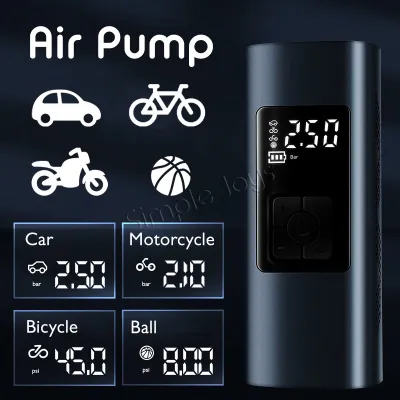
![[SG Seller]Portable Car Electric Inflator portable air pump car electric pump wireless air pump car electric pump汽车充气泵](https://img.lazcdn.com/g/p/11d7062f8a657612c19945cd3cdafcdb.jpg_400x400q80.jpg_.webp)
Prices are valid at publication and may change. Please refer to the product page for the latest price.
Maximum Pressure Ratings: Matching PSI to Your Vehicle
When browsing online marketplaces, you will often see electric tyre pumps boasting maximum pressure ratings of 120 to 150 PSI. While these figures look impressive, they usually represent peak pressure capabilities under zero-flow conditions rather than continuous working pressure. For standard passenger cars, SUVs, and family hatchbacks, typical recommended tyre pressures range between 30 and 35 PSI (approximately 2.1 to 2.4 Bar).

To find your vehicle’s exact requirements, check the tyre information placard located on the driver’s side door jamb or consult your owner’s manual. Selecting a pump with a continuous working pressure rating slightly above your vehicle’s recommended level—such as 50 to 60 PSI—provides a safe operational margin. This ensures the motor does not run at its absolute limit, reducing wear and tear. Extreme high-pressure models designed for heavy commercial trucks are generally unnecessary and may cost more without offering any practical benefit for daily driving.
Power Sources: Choosing Between 12V Plug-In and Cordless Batteries
The choice between a 12V DC plug-in pump and a cordless battery-powered model depends heavily on your typical usage scenarios and storage preferences.
A 12V DC pump plugs directly into your vehicle’s cigarette lighter socket. These units offer reliable, unlimited runtime because they draw power directly from your car’s electrical system. They are ideal for emergency kits since you never have to worry about whether the pump’s battery is charged. However, you are physically tethered to the vehicle by the length of the power cord, which must be long enough to reach all four tyres comfortably.
Cordless lithium-ion pumps offer superior portability and multi-use convenience, making them highly popular for parking in multi-storey car parks where power outlets are unavailable. When choosing a cordless model, verify the battery capacity (measured in milliampere-hours or watt-hours) and the charging interface. USB-C charging compatibility is highly convenient for topping up the battery via your car’s USB ports.
If you opt for a 12V plug-in model, always verify your vehicle’s 12V socket fuse rating in the owner’s manual. High-draw pumps can pull up to 10 or 15 Amps, and plugging them into a lower-rated socket can instantly blow a fuse, leaving you without power when you need it most.
Inflation Speed and Duty Cycle: Avoiding Motor Burnout
Inflation speed is determined by the pump’s airflow rate, typically measured in litres per minute (LPM). A higher LPM rating means the pump can move a larger volume of air, filling your tyre much faster. For instance, a pump with an airflow rate of 25 to 30 LPM can top up a standard passenger tyre in a couple of minutes, whereas a lower-rated model might take significantly longer.
However, speed must be balanced against the pump’s duty cycle. The duty cycle refers to the maximum continuous run time a pump can sustain before it requires a mandatory cool-down period to prevent overheating. Many compact electric pumps have a duty cycle of 10 to 15 minutes, followed by a required 10- to 15-minute rest period.
If you need to inflate multiple tyres or a larger SUV tyre, a short duty cycle can turn a quick task into a lengthy process. Always consult the manufacturer’s label or product documentation for specific operating limits and cool-down instructions to avoid permanent motor damage.
Smart Features: Evaluating Auto-Shutoff Accuracy and Displays
Modern electric tyre pumps often feature digital control panels that allow you to pre-set your desired pressure. Once the pump reaches this target, an auto-shutoff mechanism halts operation. This feature is highly valuable for preventing over-inflation, which can lead to uneven tyre wear and compromised handling. When evaluating pumps, look for models that specify a low margin of error, typically within +/- 1 PSI.
The choice of display also affects usability. Digital screens are generally easier to read than traditional analogue dial gauges, especially under the dim lighting of multi-storey car parks or during nighttime roadside emergencies. Backlit LCD screens ensure you can monitor pressure readings clearly at any hour.
Additionally, practical features like preset memory functions—which save your preferred pressure settings for future use—and integrated LED work lights can significantly reduce stress during emergency roadside situations.
Frequently Asked Questions (FAQ)
Can I use a standard car tyre pump for bicycle or motorcycle tyres?
Yes, most standard car tyre pumps can be used for bicycle or motorcycle tyres, provided you have the correct nozzle adapters. Car tyres use Schrader valves, while many road bicycles use Presta valves. Ensure the pump package includes the necessary valve adapters. Keep in mind that while bicycle tyres require higher PSI ratings, they hold a much lower volume of air, so inflation will occur very rapidly.
Does a higher wattage motor always mean faster inflation?
Not necessarily. While motor wattage indicates raw power consumption, actual inflation speed depends heavily on the pump’s internal cylinder design, sealing efficiency, and overall airflow mechanics. A well-engineered pump with a lower wattage motor can sometimes deliver a higher airflow rate (LPM) than an inefficient high-wattage model. Always prioritize the manufacturer’s stated airflow rate over motor wattage when comparing inflation speeds.
Community discussion
Share your experience or ask a question. Comments are reviewed before publication.