
Choosing the right 60V battery for an electric motorcycle requires balancing physical constraints, electrical limits, and safety features. To make an informed decision, you must verify the battery’s physical dimensions, match its nominal and peak voltages to your motor controller, evaluate the continuous and peak current ratings of the Battery Management System (BMS), and choose a cell chemistry that fits your riding habits. A mismatch in any of these areas can lead to poor vehicle performance, component damage, or severe safety hazards.
Because electric motorcycles rely on high-voltage, high-current systems, safety must be your primary focus. Before purchasing or installing any replacement battery, always consult your motorcycle’s owner manual and verify compatibility with local transport authorities, such as Singapore’s Land Transport Authority (LTA), to ensure the modification remains road-legal. If you are unfamiliar with high-voltage DC wiring, seek assistance from a qualified electric vehicle technician to perform the installation safely.
Quick Answer: Essential Specs for a 60V Electric Motorcycle Battery
When shopping for a replacement or upgraded 60V battery, you will encounter numerous technical specifications. To simplify your search, keep this checklist of non-negotiable specifications on hand to verify compatibility with your motorcycle’s existing setup:
Products mentioned in this guide
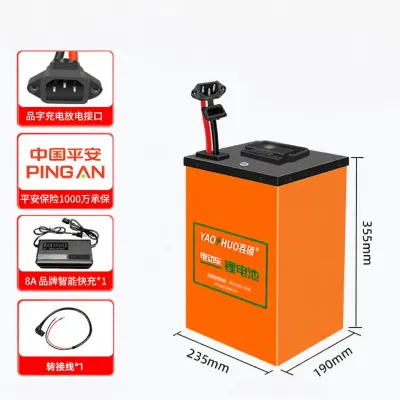
Prices are valid at publication and may change. Please refer to the product page for the latest price.
- Nominal Voltage: Must be rated at 60V (typically achieved via 16S or 17S lithium-ion configurations, or 20S lithium iron phosphate configurations).
- Maximum Charge Voltage: Ensure this matches your charger's output rating (typically 67.2V for 16S, 71.4V for 17S, or 73V for 20S LiFePO4).
- Capacity (Ah): Determines your overall riding range; higher Amp-hours mean more energy storage, provided the pack fits your battery tray.
- BMS Continuous Discharge Current: Must equal or exceed your motor controller's maximum continuous current rating (typically 30A to 60A for standard 60V commuter motorcycles).
- Physical Dimensions: Measure the length, width, and height of your battery compartment, allowing extra space for cushioning and cable runs.
- Terminal and Connector Type: Must match your motorcycle's power harness (common types include Anderson SB50/SB120, XT90, or specialized waterproof aviation plugs).
Aligning these specifications with your original equipment manufacturer (OEM) standards is the most reliable way to maintain vehicle safety, preserve your motor controller’s lifespan, and prevent electrical faults.
Verifying System Compatibility and Physical Fit
One of the most common mistakes when purchasing a “60V” battery is assuming all 60V systems operate at identical voltages. In reality, 60V is simply a nominal label. The actual operating voltage of the battery fluctuates significantly depending on its state of charge and the specific arrangement of the internal battery cells.

A standard lithium-ion battery labeled as 60V is typically configured in either a 16-series (16S) or 17-series (17S) arrangement. A 16S pack has a nominal voltage of 59.2V and charges to a maximum of 67.2V. A 17S pack has a nominal voltage of 62.9V and charges to a maximum of 71.4V. Conversely, a Lithium Iron Phosphate (LiFePO4) battery designed for 60V systems usually features a 20-series (20S) configuration, resulting in a nominal voltage of 64V and a peak charge of 73V.
Your motorcycle’s motor controller is designed with strict upper and lower voltage limits. If you install a battery with a peak voltage that exceeds your controller’s maximum threshold, the controller will trigger an overvoltage protection fault and refuse to operate, or worse, the excess voltage will permanently damage the controller’s internal capacitors. Always locate the controller’s specification label to verify its maximum input voltage before selecting a battery configuration.
Physical fit is equally critical. Electric motorcycle battery compartments are often highly compact, leaving little room for error. When measuring your battery tray, do not rely solely on the dimensions of your old battery. Measure the raw physical space inside the compartment and account for structural obstructions, latching mechanisms, and the routing of thick power cables.
Electrical and Controller Matching
To ensure your new battery operates safely with your motorcycle, you must match its discharge capabilities to your motor controller’s demands. The motor controller acts as the gatekeeper, drawing current from the battery to power the motor.
Check your controller’s label for two key ratings: the continuous current limit and the peak (or burst) current limit. If your controller has a peak current draw of 50A, but your battery is only rated to safely deliver 30A of continuous current, the battery’s voltage will drop dramatically under hard acceleration. This phenomenon, known as voltage sag, can trigger the controller’s low-voltage cutoff, causing your motorcycle to lose power unexpectedly in the middle of traffic.
Additionally, never attempt to mix different battery chemistries, capacities, or voltages in parallel or series configurations. Combining a lithium battery with an older lead-acid battery, or pairing packs with different BMS designs, creates severe electrical imbalances. These imbalances can cause rapid, uncontrolled current transfers between the packs, leading to overheating, melted wiring, or electrical fires.
Physical Dimensions and Terminal Layout
When measuring your battery compartment, always leave a buffer of at least 5mm to 10mm on all sides. This clearance is necessary to accommodate protective foam padding or rubber dampeners. Because motorcycles experience constant road vibrations and shocks—especially when navigating uneven roads or speed bumps—a battery that is tightly wedged against metal brackets without cushioning will eventually suffer structural damage to its outer casing or internal cell welds.
Pay close attention to the placement and orientation of the positive and negative terminals. If the terminal layout on the new battery is reversed compared to your original setup, your existing power cables may not reach the terminals. Stretching or pulling cables to make them fit puts mechanical stress on the connectors, increasing the risk of a loose connection or an electrical short.
Ensure you use high-quality, heavy-duty connectors that are rated for the high currents of a 60V system. Common options include:
- Anderson Powerpole Connectors (e.g., SB50 or SB120): Excellent for high-current applications and frequent disconnection.
- XT90-S Connectors: Feature an integrated anti-spark design that prevents damaging electrical arcs when plugging in the battery.
- M8 Ring Terminals: Commonly used for permanent, bolted connections in fixed battery installations.
Always verify that your motorcycle’s wiring harness uses the correct wire gauge. For a 60V system drawing between 30A and 50A, you should use high-temperature silicone-insulated copper wire rated at 8 AWG or 10 AWG. Using undersized wiring creates electrical resistance, which generates dangerous levels of heat during operation.
Choosing Battery Chemistry and Capacity (Ah)
Your choice of battery chemistry and capacity directly dictates how far your electric motorcycle can travel, how heavy the vehicle will feel, and how many years the battery will last before requiring replacement. Understanding the trade-offs of each chemistry allows you to choose a pack that aligns with your budget and daily commuting needs.
Comparing Lithium Chemistries vs. Lead-Acid
For 60V electric motorcycles, the primary choice is between two lithium-based chemistries and traditional lead-acid technology. Each option presents distinct characteristics:
- Lithium Nickel Manganese Cobalt Oxide (NMC): This is the most common chemistry found in modern electric motorcycles. NMC batteries offer high energy density, meaning they pack a large amount of energy into a lightweight and compact footprint. This makes them ideal for riders who need maximum range and sporty performance. However, NMC cells have a moderate cycle life (typically 800 to 1,500 charge cycles) and require robust thermal management because they are more sensitive to high temperatures.
- Lithium Iron Phosphate (LiFePO4): LiFePO4 batteries are highly regarded for their exceptional safety, thermal stability, and long lifespan. They can easily withstand 2,000 to 3,500 charge cycles before their capacity degrades significantly. They are also highly resistant to thermal runaway, making them a very safe choice for hot climates. The trade-off is energy density; LiFePO4 packs are roughly 20% to 30% heavier and bulkier than NMC packs of the same capacity.
- Sealed Lead-Acid (SLA) / AGM: Lead-acid batteries are the heaviest and least efficient option, offering a very short lifespan of roughly 300 to 500 cycles. They suffer from severe voltage sag under load, which reduces performance as the battery drains. While they have a low initial purchase price, their weight and frequent replacement needs make them less cost-effective over time. Upgrading a motorcycle from lead-acid to lithium requires replacing the charger with a lithium-compatible model and securing the lighter lithium pack in the oversized battery tray using custom brackets or high-density foam inserts.
Estimating Range from Capacity (Ah)
To avoid relying on optimistic manufacturer range claims, you can estimate your real-world riding range using a straightforward electrical calculation. First, determine your battery’s total energy capacity in Watt-hours (Wh) using the following formula:
$$\text{Watt-hours (Wh)} = \text{Nominal Voltage (V)} \times \text{Capacity (Ah)}$$
For example, if you choose a 60V battery with a capacity of 40Ah, the total energy capacity is:
$$60\text{ V} \times 40\text{ Ah} = 2,400\text{ Wh (or 2.4 kWh)}$$
Next, estimate your motorcycle’s average energy consumption. A lightweight electric commuter motorcycle or scooter typically consumes between 30 Wh and 45 Wh per kilometer, depending on riding style, speed, and terrain. To find your estimated range, divide the total Watt-hours by your expected consumption rate:
- Conservative Riding (30 Wh/km): $2,400\text{ Wh} / 30\text{ Wh/km} = 80\text{ km}$ of range.
- Aggressive Riding or High Speeds (45 Wh/km): $2,400\text{ Wh} / 45\text{ Wh/km} = 53.3\text{ km}$ of range.
Keep in mind that real-world factors will always affect these numbers. Carrying a passenger, riding in heavy stop-and-go urban traffic, maintaining low tire pressure, or climbing steep flyovers will increase your energy consumption and reduce your total range.
Evaluating the Battery Management System (BMS)
A Battery Management System (BMS) is the electronic “brain” installed inside every high-quality lithium battery pack. Because a 60V lithium battery consists of dozens of individual cells wired together, a BMS is absolutely mandatory. It ensures that all cells charge and discharge uniformly, preventing individual cells from becoming overstressed, which could lead to premature battery failure or safety hazards.
Matching BMS Current Ratings to the Controller
When selecting a battery, you must ensure the BMS is rated to handle the electrical current demanded by your motorcycle’s motor controller. The BMS has two primary current ratings:
- Continuous Discharge Current: The maximum current the BMS can safely manage indefinitely during normal riding.
- Peak or Burst Discharge Current: The maximum current the BMS can handle for short intervals, typically 3 to 10 seconds, during hard acceleration or when starting from a complete stop.
If your motor controller draws a maximum continuous current of 45A, your battery’s BMS must have a continuous rating of at least 45A (ideally 50A or 60A to provide a safe operating margin). If you install a battery with an undersized BMS rated for only 30A continuous, the BMS’s overcurrent protection will trip whenever you accelerate hard or climb a steep incline. This will instantly cut all power to the motorcycle, leaving you stranded in active traffic, which is an incredibly dangerous situation.
Core Protections and Smart Features
At a minimum, the BMS in your 60V battery must offer the following core safety protections:
- Overcharge Protection: Stops the charging process once any individual cell inside the pack reaches its maximum safe voltage limit.
- Over-Discharge Protection: Disconnects the battery from the load before the cells drain past their minimum safe voltage, preventing permanent chemical degradation.
- Short-Circuit Protection: Instantly cuts off current output in the event of an external short circuit, protecting the wiring and cells from melting.
- Over-Temperature Protection: Suspends charging or discharging if the internal temperature of the battery pack exceeds safe limits (typically around 60°C to 65°C).
For added convenience, consider upgrading to a “Smart BMS” equipped with Bluetooth connectivity. A Smart BMS pairs with a smartphone application, allowing you to monitor real-time diagnostics, including individual cell voltages, temperature sensor readings, exact state of charge, and overall State of Health (SoH). This data is invaluable for diagnosing performance issues before they lead to a complete battery failure.
Charging Requirements and Climate Maintenance
Proper charging practices and environmental care are vital to maximizing the lifespan of your 60V battery. Neglecting these areas can accelerate capacity loss and, in extreme cases, create severe safety risks.
Charger Compatibility and Safe Charging Practices
Never use a charger that was not specifically designed for your battery’s exact chemistry and voltage configuration. For example, a charger designed for a 60V lead-acid battery must never be used on a 60V lithium-ion battery. Lead-acid chargers use a different charging algorithm that lacks the precise voltage cutoffs required by lithium cells, which can easily cause a lithium battery to overcharge, overheat, and catch fire.
Always verify that the charger’s output voltage matches your battery’s maximum charge voltage (e.g., 67.2V for a 16S lithium-ion pack). Using a charger with an incorrect voltage output can either leave your battery undercharged or dangerously overcharge it.
Additionally, pay attention to the charger’s output amperage, which determines how quickly the battery charges. While a high-amperage charger (e.g., 10A) will charge your battery much faster than a standard charger (e.g., 4A), it also generates significantly more heat and places greater stress on the cells. Always consult the battery manufacturer’s guidelines to ensure your fast charger does not exceed the battery’s maximum recommended charging current.
Heat Management and Storage in Warm Climates
In tropical environments like Singapore, managing battery temperature is a constant challenge. Ambient temperatures often hover above 30°C, and high humidity can restrict natural cooling. Because both riding and charging generate internal heat, a battery can easily reach elevated temperatures that accelerate chemical degradation.
To preserve your battery’s health, implement the following maintenance habits:
- Allow a Cool-Down Period: Never plug your battery into a charger immediately after a ride. The internal cells are already warm from discharging, and charging them immediately will push temperatures into a damaging range. Allow the battery to rest in a shaded area for at least 30 to 45 minutes to cool down to ambient temperature before charging.
- Charge in a Well-Ventilated Area: Avoid charging your battery inside tightly enclosed, unventilated spaces or under direct sunlight. If you charge your battery indoors, ensure the room has adequate airflow to dissipate heat.
- Avoid Extreme States of Charge During Storage: If you plan to leave your electric motorcycle unused for more than two weeks, do not store the battery completely empty (0%) or fully charged (100%). Storing a lithium battery at 100% charge in a warm environment accelerates capacity degradation, while storing it at 0% risks letting the cells self-discharge below their safe recovery threshold, ruining the pack. Instead, charge or discharge the battery to approximately 50% to 60% capacity, and store it in a cool, dry, shaded location.
Frequently Asked Questions (FAQ)
Can I upgrade my 60V electric motorcycle to a 72V battery for more speed?
While upgrading to a 72V battery is a common modification sought by riders looking for higher top speeds, you must never do so without replacing or upgrading your entire electrical system. Your motorcycle’s original 60V motor controller, wiring harness, dashboard display, and auxiliary electronics are designed to operate within a specific voltage range. Connecting a 72V battery (which fully charges to 84V) to a standard 60V system will likely cause immediate electrical failure, melt wiring, blow internal fuses, or destroy the motor controller.
Before attempting any voltage upgrade, you must consult a qualified electric vehicle technician to replace the controller and motor with components rated for 72V. Additionally, be aware that modifying your vehicle’s voltage configuration may violate local road safety regulations and void your insurance coverage.
How do I know if my 60V battery needs to be replaced?
Your 60V battery will exhibit several clear physical and performance indicators when it is reaching the end of its usable life. The most common signs of degradation include:
- Severe Range Reduction: Your motorcycle travels significantly fewer kilometers on a full charge than it did when the battery was new, despite riding under identical conditions.
- Excessive Voltage Sag: When accelerating, the battery gauge drops rapidly toward empty and then slowly bounces back when you stop. This indicates high internal resistance within the cells.
- Unusual Heat Generation: The battery feels exceptionally hot to the touch during normal charging or riding.
- Slow Charging or Incomplete Charge: The battery takes an unusually long time to charge, or the charger green light turns on before the battery reaches its expected maximum voltage.
- Physical Swelling or Damage: If you notice any bulging, warping, cracking, or leakage on the battery's outer casing, this is a critical safety hazard. Stop using the battery immediately, disconnect it from the motorcycle, and contact a professional hazardous waste facility for safe disposal.
Community discussion
Share your experience or ask a question. Comments are reviewed before publication.