
The choice between CarPro Leather Cleaner and Fabric Cleaner depends entirely on the specific material composition of your car’s interior surfaces. Leather cleaner is formulated for coated and uncoated leather, while fabric cleaner targets woven textiles and carpets. Using the wrong product can lead to poor cleaning results or potential material damage, making correct material identification and strict adherence to product labels the mandatory first steps in your decision. In tropical climates characterized by high humidity and intense UV exposure, choosing the correct formulation is essential to preserve the structural integrity and appearance of your cabin.
Identifying Your Car Interior Materials
Before purchasing any detailing product, you must accurately determine the exact composition of your vehicle’s cabin surfaces. Modern car interiors are rarely uniform; a single seat may feature genuine leather on the seating surfaces, synthetic vinyl on the sides and back, and polyester stitching holding them together. Genuine leather typically exhibits natural, irregular grain patterns and a distinct organic scent, feeling warm and slightly pliable to the touch. In contrast, synthetic leather—often referred to as vinyl, polyurethane (PU) leather, or leatherette—tends to have a highly uniform embossed pattern, a cooler initial touch, and a less porous surface structure.
Woven textiles and fabric surfaces are easily distinguished by their visible fiber loops and thread patterns. These materials are highly absorbent and are commonly found on standard seats, door card inserts, floor carpets, and headliners. However, specialized materials require extra vigilance. Suede-like fabrics, such as Alcantara or synthetic microsuede, feature a delicate napped surface that can be easily ruined by standard liquid cleaners. To avoid costly mistakes, always consult your vehicle owner’s manual or check the manufacturer’s build sheet. Look for specific material tags under the seats or along the door pillars to confirm whether your interior features specialized coatings, aniline leather, or delicate synthetic blends before applying any chemical agent.
Products mentioned in this guide
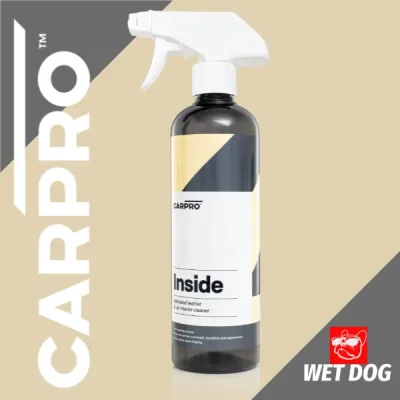
Prices are valid at publication and may change. Please refer to the product page for the latest price.
CarPro Leather Cleaner: Formulation and Best Uses
CarPro’s leather cleaning solutions are engineered specifically to address the unique physical properties of automotive leather. Most modern car leather is finished with a thin, protective polyurethane clear coat designed to resist abrasion and moisture. The leather cleaner is formulated to gently lift surface oils, sweat, dust, and dye transfer from this protective layer without stripping the underlying material or drying out the hide. For vehicles with perforated leather seats—often found in models equipped with ventilated seating systems—the cleaner must be applied with care to prevent liquid from pooling inside the perforations, which can saturate the underlying foam cushion and cause mold or structural deterioration.

The cleaning mechanism relies on surface-active agents (surfactants) that encapsulate dirt particles, allowing them to be wiped away easily with a clean microfiber towel. According to product guidelines, the cleaner should be agitated gently using a soft-bristled leather brush to work the lather into the natural grain and pores of the material. However, there are strict operational boundaries to observe. Unless explicitly stated on the product label, leather cleaners should not be used on unfinished, open-pore leathers like aniline or nubuck, nor should they be applied to suede or Alcantara. Using a leather-specific surfactant on these highly absorbent, napped surfaces can cause permanent staining, matting of the fibers, and severe discoloration.
CarPro Fabric Cleaner: Formulation and Best Uses
CarPro’s fabric and carpet cleaning products are formulated to penetrate deep into the woven fibers of textile surfaces. Unlike leather, which is non-porous and requires surface-level cleaning, fabrics act like a sponge, trapping dirt, liquid spills, and odors deep within their weave. The fabric cleaner is designed to break the chemical bonds between stubborn stains and textile fibers, lifting contaminants to the surface through capillary action and surfactant suspension so they can be extracted or wiped away. This makes it highly effective for high-wear areas such as woven cloth seats, floor mats, and trunk carpets.
However, the high absorbency of textile materials introduces specific application risks that require strict adherence to manufacturer instructions. When cleaning delicate areas like the vehicle’s headliner, excessive moisture must be avoided at all costs. Headliners are typically constructed from a thin layer of fabric glued to a foam backing; oversaturating this area can dissolve the adhesive, leading to unsightly sagging or complete delamination of the fabric. Furthermore, precautions must be taken around sensitive cabin components. Never spray fabric cleaner directly near electronic switches, seat adjustment controls, or seatbelt pretensioner mechanisms. Moisture ingress into these electrical and mechanical safety systems can cause corrosion, short circuits, or component failure.
Direct Comparison: Leather vs Fabric Cleaner
To choose the correct product, it is helpful to contrast how these two formulations operate, their required tools, and their post-cleaning demands. Leather cleaners are designed for low-moisture, surface-level agitation, requiring soft brushes or foam applicators to prevent scratching the delicate polyurethane topcoat. Fabric cleaners, on the other hand, often require stiffer nylon brushes to agitate woven fibers and may require a wet-vacuum extractor or damp microfiber towels to fully rinse and remove the suspended dirt from deep within the textile.
The post-cleaning process also differs significantly. Leather cleaning must always be followed by an inspection of the surface dryness, followed by the application of a dedicated conditioner or barrier cream to restore lost moisture and protect against UV damage. Fabric cleaning requires a thorough drying phase, often requiring the car doors to be left open in a well-ventilated area to prevent musty odors from developing in the damp fibers.
Below is a comparison table summarizing these key differences based on standard product label instructions:
| Feature | Leather Cleaner | Fabric Cleaner |
|---|---|---|
| Primary Target Materials | Coated leather, synthetic leather, vinyl | Woven cloth, carpets, floor mats, headliners |
| Application Tool | Soft-bristled detailing brush, foam applicator | Medium-to-stiff nylon brush, microfiber towel |
| Action Mechanism | Surface surfactant encapsulation | Deep fiber penetration and stain suspension |
| Rinsing Requirement | Wipe clean with a dry or slightly damp microfiber | Wipe with damp towel or extract with wet-vacuum |
| Post-Care Step | Apply leather conditioner or protective sealant | Allow to air-dry completely; apply fabric protectant |
| Key Avoidance Zones | Suede, Alcantara, unfinished aniline leather | Electronic switches, headliner adhesives, seatbelts |
How to Choose the Right CarPro Cleaner for Your Car
Selecting the correct cleaner requires a systematic evaluation of your vehicle’s interior surfaces. You should choose the Leather Cleaner if your seats, steering wheel, and door inserts are verified as genuine leather, synthetic leather, or vinyl, and the product label explicitly confirms compatibility with these surfaces. This formulation will safely maintain the matte finish of your leather without degrading the protective topcoat.
Conversely, you should choose the Fabric Cleaner if your cabin features woven textile seats, cloth door inserts, or standard carpeted floor mats. This product is designed to lift deep-seated dirt and organic stains from porous fibers that a leather cleaner cannot effectively penetrate.
You must verify first and consult professional advice if your vehicle features mixed-material upholstery, such as leather seats with Alcantara inserts, or specialized delicate suedes. In these scenarios, using a general leather or fabric cleaner without verifying compatibility can ruin the texture of the adjacent material. Finally, keep in mind that neither product is suitable if you are cleaning hard plastics, glass, or specialized electronic displays. These surfaces require dedicated interior detailers or screen cleaners to prevent scratching, clouding, or chemical etching.
Safe Application and Pre-Testing Guidelines
Regardless of the product you select, establishing strict safety boundaries is critical to protecting your vehicle’s interior. Before applying any chemical cleaner to a visible area, you must perform a spot test in an inconspicuous location, such as the underside of a seat or a hidden corner of the footwell. Apply a small amount of the cleaner, agitate gently according to the instructions, and wipe it away. Check the test spot for any signs of color transfer onto your microfiber towel, changes in texture, or unexpected discoloration. If any adverse reaction occurs, stop using the product immediately.
If you find that the instructions on the CarPro product label conflict with the care guidelines outlined in your vehicle owner’s manual, always defer to the vehicle manufacturer’s instructions or consult a certified automotive detailing professional. When applying the cleaners, practice safe application techniques. Avoid spraying products directly onto surfaces near sensitive areas; instead, spray the cleaner onto your microfiber towel or brush first to control the application. Never spray cleaners onto seatbelt webbing, as the chemical surfactants can degrade the high-tensile synthetic fibers and compromise the belt’s structural integrity during an impact. Similarly, avoid oversaturating airbag deployment seams along the dashboard and pillars to prevent moisture from affecting the deployment mechanisms.
Frequently Asked Questions (FAQ)
Can I use CarPro Leather Cleaner on synthetic leather or vinyl?
Yes, but you must verify the product label first. Many modern leather cleaners are formulated to be safe on synthetic alternatives like polyurethane (PU) leather, vinyl, and leatherette, as these materials share a similar non-porous surface structure with coated genuine leather. However, synthetic materials can vary widely in chemical resistance depending on the manufacturer. Always check the physical bottle for explicit compatibility with vinyl or synthetic leather, and perform a localized spot test on an inconspicuous area before proceeding with a full application to ensure the cleaner does not alter the material’s sheen or texture.
Is CarPro Fabric Cleaner safe for Alcantara or suede-like materials?
Alcantara and genuine suede are highly sensitive, napped materials that require specialized care. Standard fabric cleaners are often too aggressive or contain surfactants that can cause the delicate fibers to mat together, stiffen, or discolor permanently. Before attempting to clean Alcantara or suede-like trims, check both the CarPro product label and your vehicle manufacturer’s manual for specific cleaning instructions. These materials typically require dedicated, ultra-gentle suede cleaners and specialized soft-bristled brushes designed to restore the nap without introducing excessive moisture.
Do I need to apply a protectant after using these cleaners?
Yes, applying a protectant is highly recommended. Dedicated cleaners are designed to strip away dirt, oils, and contaminants, but in doing so, they also remove any existing protective barriers or conditioners. Leaving leather unprotected after cleaning can lead to premature drying, cracking, and UV damage, especially in hot, sunny climates. Similarly, cleaned fabric fibers are highly susceptible to rapid re-soiling and liquid absorption. Once the surfaces are completely clean and dry, refer to the product labels to select a compatible leather conditioner or fabric guard to restore the material’s protective barrier.
Community discussion
Share your experience or ask a question. Comments are reviewed before publication.