
Polishing corrects paint defects, waxing provides temporary sacrificial protection, and ceramic coating offers long-term chemical resistance. The right choice depends entirely on whether your vehicle needs defect correction, short-term gloss enhancement, or long-term environmental shielding. While search terms like “nano polish car” often blend these concepts, understanding the distinct mechanical and chemical functions of each treatment is essential before investing time or money into your vehicle’s exterior.
Many car owners mistake these three distinct treatments for interchangeable options. Applying a wax to a heavily scratched car will not remove the scratches, while polishing a car without applying a subsequent protective layer leaves the vulnerable clear coat exposed to rapid degradation. To achieve a professional-grade finish and protect your vehicle’s exterior, you must align your choice of product with your paint’s current condition and your long-term maintenance habits.
Core Functions of Polish, Wax, and Ceramic Coatings
Car polish is a corrective compound, not a protective sealant. It contains microscopic abrasives that physically shave down a microscopic layer of your vehicle’s clear coat. By leveling the uneven edges of micro-scratches, swirl marks, and water spots, polish restores a perfectly flat surface. This flat surface allows light to reflect evenly, which is what creates the optical clarity and deep gloss associated with a newly detailed vehicle. Because polishing removes paint material, it should only be performed when correction is genuinely necessary.
Products mentioned in this guide
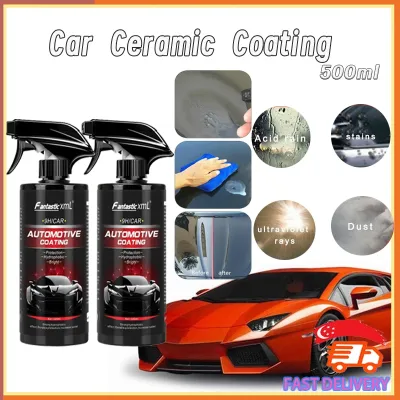
![[SG In Stock]Car Ceramic Coating Automotive Coating Nano Car Care Polish 500ML Nano Ceramic Coating Spray/Automotive Care](https://img.lazcdn.com/g/p/83567248d0f46fa4511871a48952c5d4.jpg_400x400q80.jpg_.webp)

Prices are valid at publication and may change. Please refer to the product page for the latest price.
Car wax, by contrast, is a purely protective and cosmetic layer that sits on top of the clear coat. Whether formulated from natural carnauba wax or synthetic polymers (often referred to as paint sealants), wax fills in minor microscopic imperfections to create a smooth, hydrophobic barrier. This barrier prevents water, road grime, bird droppings, and ultraviolet rays from making direct contact with the paint. Wax does not correct paint defects; it merely covers them temporarily and provides a sacrificial layer that degrades over time under environmental exposure.
Ceramic coatings represent a more advanced chemical approach to paint protection. These liquid polymers, which often utilize silicon dioxide (SiO2) or titanium dioxide nanotechnology, chemically bond with the factory clear coat at a molecular level. Once cured, they form a semi-permanent, glass-like barrier that is significantly harder and more durable than any traditional wax. This layer offers exceptional hydrophobic properties, chemical resistance against acidic contaminants, and long-term UV protection, though it requires meticulous surface preparation to bond correctly.
Comparing Protection, Durability, and Visual Finish
The differences in durability, protection, and visual appearance among these three treatments dictate how and when they should be used. Car polish offers zero protective lifespan because its sole purpose is to abrade and level the paint; once the polishing oils are wiped away, the paint is completely bare. Traditional car wax typically lasts anywhere from a few weeks to a few months, depending on weather conditions, washing habits, and whether the vehicle is garaged. Ceramic coatings, when applied correctly and maintained properly, can provide protection lasting from one to several years.

In tropical climates like Singapore, where vehicles face intense UV radiation, high humidity, and frequent heavy downpours, traditional waxes degrade much faster than they would in temperate regions. Under these harsh conditions, a standard wax might only offer protection for a few weeks, whereas a ceramic coating provides the robust chemical resistance needed to withstand acidic rain and environmental fallout.
The visual finish also varies distinctly between these options. A polished surface provides the primary foundation of clarity because it physically removes the defects that scatter light. When you apply a high-quality wax over this polished surface, it adds a warm, deep, and slightly wet-looking glow that is highly favored for classic cars and show vehicles. Ceramic coatings, on the other hand, deliver a hard, glassy, and highly reflective shine that behaves almost like an extra layer of clear coat, emphasizing sharp body lines and metallic flakes with intense gloss.
The table below summarizes the primary characteristics of each treatment to help you compare their practical attributes:
| Treatment Type | Primary Function | Expected Longevity | Main Visual Benefit |
|---|---|---|---|
| Car Polish | Corrects paint defects and levels clear coat | None (requires immediate protection) | Restores optical clarity and removes swirls |
| Car Wax | Provides a temporary sacrificial barrier | 1 to 3 months | Adds a warm, deep, wet-look glow |
| Ceramic Coating | Creates a semi-permanent chemical bond | 1 to 5 years (depending on formula) | Delivers a hard, glassy, high-gloss shine |
Assessing Your Car's Current Paint Condition
Before purchasing any detailing products, you must evaluate the actual state of your vehicle’s paint. Begin by thoroughly washing and drying the car in a shaded area to remove all loose dirt and dust. Once dry, inspect the paint under direct sunlight or using a high-intensity LED detailing light. Look closely at the flat panels, such as the hood and trunk, for spiderweb-like swirl marks, fine scratches, water spots, or a dull, cloudy appearance known as oxidation. If these defects are highly visible, your paint requires polishing before any protective layer can be applied.
Next, perform a tactile inspection to check for bonded contaminants that a standard wash cannot remove. Wrap a clean, thin plastic sandwich bag over your hand and gently slide your fingertips across the dry paint surface. If the paint feels rough, gritty, or like fine sandpaper, it has embedded contaminants such as industrial fallout, brake dust, tree sap, or overspray. These contaminants must be removed using a detailing clay bar before you attempt to polish the paint or apply a ceramic coating, as polishing over grit will drag those particles across the paint, causing severe scratches.
It is also critical to recognize when paint is too compromised for DIY treatment. If you observe clear coat peeling, deep cracks, or areas where the paint has worn completely through to the primer or bare metal, abrasive polishing will only worsen the damage. Thin paint, often indicated by a dull matte appearance on older vehicles, requires professional measurement with a paint depth gauge. If you suspect your clear coat is dangerously thin or heavily oxidized, seek a professional assessment before attempting any mechanical correction.
Application Requirements and Safety Boundaries
Applying these treatments requires varying levels of preparation, skill, and environmental control. You must never apply a wax or ceramic coating directly to dirty or unpolished paint if you want optimal results. For a ceramic coating to bond chemically, the paint surface must be completely free of oils, polishing residues, and old wax. This requires a thorough decontamination process, including a clay bar treatment and an isopropyl alcohol (IPA) wipe-down. Applying a coating without this preparation will cause the product to fail prematurely, leaving patchy, ineffective protection.
The risks associated with DIY application increase significantly with the complexity of the treatment. Using a dual-action machine polisher to apply car polish carries the risk of burning through the clear coat, especially on sharp body creases, plastic bumpers, or areas with pre-existing thin paint. With ceramic coatings, the primary risk is the formation of “high spots.” These are areas where excess coating was not buffed away during the flashing window, leaving dark, cloudy, or rainbow-colored streaks that harden and can typically only be removed by machine polishing.
To protect your vehicle’s exterior, establish clear safety boundaries. If you encounter deep scratches that catch your fingernail, holograms from previous improper machine polishing, or if you are unsure of your paint’s thickness, stop and consult a qualified professional detailer. Always read the manufacturer’s labels to verify that the product is safe for your specific paint type, plastic trim, or rubber seals. Ensure your work area is well-ventilated, shaded, and free of airborne dust before starting any application.
Decision Framework: Choosing the Right Treatment
To select the correct path for your vehicle, evaluate your goals, budget, and willingness to perform regular maintenance. Your decision should be guided by clear, conditional rules based on the current state of your vehicle’s paint and your long-term expectations.
Choose Polish if your paint has visible swirls, light scratches, water spots, or oxidation that dulls the finish. Polishing is a corrective step, not a final protective step, so you must always follow it with a wax, sealant, or ceramic coating to lock in the corrected finish and protect the bare clear coat from environmental damage.
Choose Wax if you want an affordable, user-friendly way to protect your car and enhance its gloss without a steep learning curve. Waxing is highly forgiving, requires minimal specialized tools, and can be easily stripped and reapplied every few months. It is ideal for car enthusiasts who enjoy spending a weekend afternoon maintaining their vehicle’s shine.
Choose Ceramic Coating if you want robust, long-term protection against UV rays, chemical stains, and road grime, and you are willing to invest the time or money required for thorough surface preparation. Ceramic coatings are best suited for newer or freshly polished vehicles where the owner wants to minimize washing effort and maintain a glassy appearance for years.
Verify first if you are considering a product marketed as a “nano polish” or “ceramic polish.” Check the manufacturer’s label carefully to confirm whether the product is a corrective abrasive designed to remove scratches, or a protective sealant designed to leave a hydrophobic layer. Some hybrid products combine mild abrasives with synthetic sealants, but they rarely perform either task as effectively as dedicated, single-purpose products.
Frequently Asked Questions (FAQ)
Can I apply wax over a ceramic coating?
While you can physically apply wax over a ceramic coating, it is generally not recommended. Traditional waxes have a lower surface energy than ceramic coatings, meaning the wax will struggle to bond properly and will wash away quickly. Furthermore, applying a wax layer covers the ceramic coating, masking its superior hydrophobic and self-cleaning properties with the less efficient water-beading characteristics of the wax. If you want to boost the gloss or slickness of your ceramic coating, use a dedicated, ceramic-compatible maintenance spray or topper recommended by the coating’s manufacturer instead.
Does car polish remove deep scratches?
Car polish cannot remove deep scratches that have penetrated through the clear coat. To determine the depth of a scratch, gently run your fingernail across it; if your nail catches in the groove, the scratch is too deep to be polished out safely. Polish works by removing a microscopic layer of the surrounding clear coat to level it with the bottom of shallow scratches. If a scratch goes down to the color coat or primer, attempting to polish it flat will completely remove the remaining clear coat, leading to paint failure. These deep scratches require touch-up paint or professional repair.
How do I maintain a ceramic coating after application?
Maintaining a ceramic coating requires proper washing techniques to prevent premature degradation and micro-scratching. Always wash the vehicle using a pH-neutral car wash shampoo that does not contain added waxes or gloss enhancers, as these additives can leave residues that clog the coating’s hydrophobic pores. Use the two-bucket wash method with high-quality microfiber wash mitts to minimize friction. Additionally, apply a ceramic-compatible detail spray or silica-based topper every few months after washing to replenish the hydrophobic top layer and maintain the coating’s self-cleaning performance.

Community discussion
Share your experience or ask a question. Comments are reviewed before publication.