
Using a cordless blower like a Keelat model to dry your vehicle after a wash can be highly effective, particularly for clearing water from intricate areas like side mirrors, grilles, and door jambs where towels cannot easily reach. However, whether a cordless blower can completely replace your traditional microfiber drying towels depends heavily on the specific model’s airflow velocity, battery capacity, and the size of your vehicle. While a blower offers a contactless drying method that significantly reduces the risk of swirl marks on your clear coat, lower-powered utility blowers may struggle to clear large, flat panels efficiently. For most car owners, understanding how to evaluate these tools and combining them with a hybrid drying technique yields the fastest, safest, and most spot-free finish.
What Effective Car Drying Requires from a Blower
To dry a vehicle effectively without damaging the paint, a blower must overcome the surface tension holding water droplets to the clear coat. This process requires a careful balance of air velocity and air volume. Air velocity, often measured in kilometers per hour, acts as a shearing force that slices through the water’s boundary layer, forcing it to bead up and move. Air volume, measured in cubic feet per minute (CFM), determines how much total air is delivered to sweep those beads completely off the panels. Without sufficient volume, a blower will simply scatter water into smaller droplets rather than clearing them from the vehicle.
Another critical factor is the cleanliness of the air being projected. A car drying blower must draw in surrounding air and direct it at high speeds toward your wet paint. If the blower’s intake is positioned close to a dusty driveway or lacks basic filtration, it can easily suck up fine grit, sand, or debris and blast it directly onto your vulnerable, wet clear coat. This can lead to immediate micro-marring and fine scratches that ruin an otherwise perfect wash.
Products mentioned in this guide
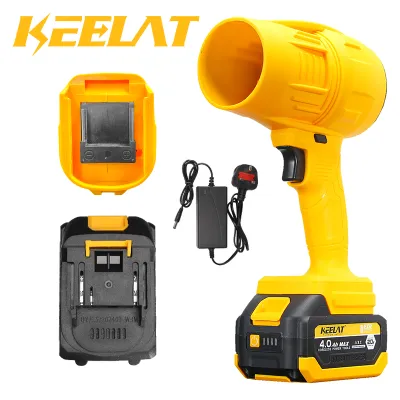
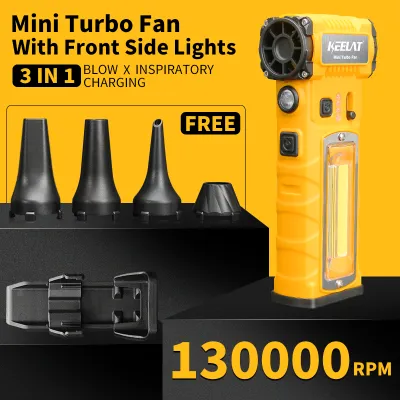
Prices are valid at publication and may change. Please refer to the product page for the latest price.
Furthermore, the speed of the drying process is vital, especially in warm, humid climates like Singapore, where tap water evaporates rapidly on hot body panels. If the drying process takes too long, the dissolved minerals in municipal tap water will dry onto the paint, leaving behind stubborn hard water spots. These spots can etch into the clear coat over time and often require chemical spot removers or machine polishing to correct. An effective blower must work quickly enough to clear standing water before ambient heat can cause it to evaporate on the surface.
Evaluating the Keelat Cordless Blower for Automotive Use
Because cordless utility blowers are designed for a variety of household and workshop tasks, you must carefully evaluate your specific Keelat cordless blower to determine if it is up to the task of automotive detailing. The brand offers several configurations, ranging from compact, hand-held workshop blowers to larger garden leaf blowers. To ensure your tool is safe and effective for your car, you should perform a targeted inspection of its technical specifications and physical design before bringing it to your driveway.

Start by locating the manufacturer’s specification label, which is typically affixed to the side of the motor housing, or consult the official user manual that came in the box. You will need to cross-reference the tool’s rated output against the physical demands of drying a vehicle. Additionally, inspect the battery pack’s rated capacity and the physical construction of the nozzle attachment to prevent accidental damage during use.
Checking Airflow Metrics and Nozzle Safety
When reviewing your Keelat blower’s specifications, look closely at the rated wind speed and CFM. For automotive drying, a blower needs to generate enough force to push water off horizontal surfaces like the hood and roof. If the specifications only list a high wind speed but a very low CFM, the tool may produce a narrow, high-pressure stream that is excellent for clearing dust from a workbench but too localized to dry a car panel efficiently. Look for models that offer variable speed triggers, allowing you to dial down the power around delicate trim and blast it on high for flat panels.
Nozzle safety is equally critical when working in close proximity to your vehicle’s paintwork. Most standard utility blowers come equipped with rigid, hard plastic nozzles. If you lose your grip or get too close to the body panels, an accidental bump from a hard plastic tip can easily gouge your clear coat or scratch your window glass. Before using the blower on your car, verify if your model includes a soft, rubberized nozzle tip. If it does not, consider wrapping the end of the plastic nozzle with a soft silicone guard, a thick rubber band, or a clean microfiber cloth secured with a zip tie to act as a protective bumper.
Assessing Battery Runtime for Your Vehicle Size
Drying a car is a continuous, high-demand task that requires running your cordless blower at its maximum speed setting for extended periods. Lower speed settings are rarely powerful enough to break the surface tension of water on automotive paint, meaning your battery will drain much faster than it would during light workshop dusting. You must check the Ampere-hour (Ah) rating on your Keelat battery pack to estimate how much continuous runtime you can realistically expect.
The size of your vehicle dictates the battery capacity you will need. A compact hatchback or sedan can generally be dried within 5 to 10 minutes of continuous blower use, which a standard 2.0Ah or 4.0Ah battery can typically handle on a single charge. However, if you are drying a large SUV, MPV, or station wagon, the process can easily take 15 to 20 minutes due to the massive surface area and extensive trim lines. For larger vehicles, you may need to invest in a higher-capacity battery pack or keep a secondary, fully charged battery on standby to avoid being left with a half-wet car.
Cordless Blower vs. Microfiber Towels: Comparing Drying Methods
Choosing between a cordless blower and traditional microfiber towels involves weighing the trade-offs of speed, safety, and convenience. Microfiber drying towels are exceptionally efficient at absorbing large sheets of water from flat, open surfaces like the hood, roof, and doors. A high-quality, high-pile towel can dry a flat panel in a single pass. However, towels have a major limitation: they cannot easily reach into tight crevices, such as behind side mirrors, inside door jambs, around emblem lettering, or within complex front grilles. Water trapped in these areas inevitably drips out later as you drive, leaving unsightly mineral streaks down your freshly washed paint.
A cordless blower excels precisely where towels fail. The high-velocity air stream easily forces trapped water out of every nook and cranny, allowing you to dry wheels, brake calipers, and intricate grilles without ever making physical contact. This contactless nature is the blower’s greatest advantage regarding paint safety. Even the softest microfiber towel carries a risk of scratching; if any microscopic dirt or road grit was missed during the wash phase, dragging a towel across the paint will trap those particles and grind them into the clear coat, creating fine swirl marks. A blower eliminates this friction-based wear entirely.
Despite these advantages, relying solely on a blower can be time-consuming on vehicles that do not have a protective ceramic coating or wax. On unprotected paint, water tends to “sheet” and cling flatly to the surface, making it difficult for a blower to push away. For the most efficient and safest results, many detailers adopt a hybrid approach. They use the cordless blower to clear out all the tight crevices, grilles, wheels, and mirrors first, and then gently use a clean, plush microfiber towel to pick up any remaining fine mist on the large flat panels.
Practical Steps for Drying Your Car with a Cordless Blower
To get the best results from your Keelat cordless blower, you should follow a structured drying sequence that maximizes efficiency and protects your vehicle’s components. Always begin drying from the top of the vehicle and work your way down. Start with the roof, then move to the glass, the hood, the trunk, the upper side panels, and finally the lower rocker panels and wheels. This top-to-bottom method ensures that gravity assists the water runoff, preventing water from blowing back onto sections you have already dried.
As you work, maintain a safe distance and angle with the blower nozzle. Hold the nozzle at a 45-degree angle relative to the car’s surface, keeping it roughly 10 to 15 centimeters away from the paint. This angle creates a sweeping action that rolls the water beads forward and off the panel. Avoid pointing the nozzle directly perpendicular to the paint, as this will simply splatter the water in all directions rather than clearing it.
Be mindful of sensitive automotive components. Do not force high-pressure air directly into delicate weather stripping, window seals, or aftermarket electronic housings, such as parking sensors or backup cameras. Excessive air pressure at close range can force water past rubber seals and into electrical connectors, potentially causing short circuits or corrosion. Keep the air moving continuously rather than focusing on a single spot for too long.
Finally, keep a clean, dry microfiber towel draped over your shoulder during the process. Once you have blown the majority of the water off the vehicle, use the towel to perform a quick, light wipe-down of any residual fine mist or stray droplets. This hybrid method ensures a flawless, spot-free finish in a fraction of the time it would take using towels alone.
Frequently Asked Questions (FAQ)
Can a cordless blower scratch my car's paint?
The air stream generated by a cordless blower cannot scratch your car’s paint on its own. However, scratches can occur if the vehicle was not washed thoroughly and dirt particles remain on the surface, as the high-velocity air can drag these abrasive particles across the clear coat. Additionally, if the blower has a hard plastic nozzle, accidentally bumping it against the paint can cause deep scratches. To prevent this, always ensure the car is completely clean before drying, and consider using a soft rubber nozzle tip or wrapping the nozzle end in a protective microfiber buffer.
Do I still need a drying towel if I use the Keelat blower?
Yes, it is highly recommended to keep a clean microfiber drying towel on hand, even when using a cordless blower. While the blower is incredibly effective at clearing water from crevices, grilles, wheels, and mirrors, it can leave behind a fine mist of tiny water droplets on large, flat panels like the hood and roof. A quick, gentle pass with a high-quality microfiber towel will absorb this residual moisture instantly, preventing any potential water spotting and ensuring a perfectly clean, streak-free finish.
Community discussion
Share your experience or ask a question. Comments are reviewed before publication.