
Finding the correct tire pressure for your bicycle is not just about a smooth ride; it directly influences your safety, handling, and tire longevity. Bicycle tire pressure requirements vary dramatically depending on the style of your bike, ranging from a low 20 PSI on a mountain bike to upwards of 120 PSI on professional road bikes. This wide variance means that a one-size-fits-all approach to buying an inflation tool does not work. To choose the right electric bicycle pump, you must first understand the specific pressure demands of your tires and match those needs to the pump’s mechanical capabilities.
How to Find the Correct PSI and Bar for Your Bicycle Tires
Before evaluating any electric pump, you must identify the exact pressure requirements of your bicycle’s tires. Tire pressure is commonly measured in two units: PSI (pounds per square inch) and Bar. The relationship between these two units is straightforward, where 1 Bar is approximately equal to 14.5 PSI. Most modern electric pumps and tire pressure gauges allow you to toggle between these two units with the press of a button, but knowing how to read both ensures you can interpret any tire’s specifications.
To find your tire’s specific pressure requirements, physically inspect the tire sidewall. Manufacturers mold the recommended inflation range directly into the rubber. This marking typically lists a minimum and maximum pressure (for example, “Min 50 – Max 85 PSI / 3.4 – 5.8 Bar”). This sidewall rating is the absolute authority for your specific setup and overrides any general guidelines or advice you might find online.
Products mentioned in this guide
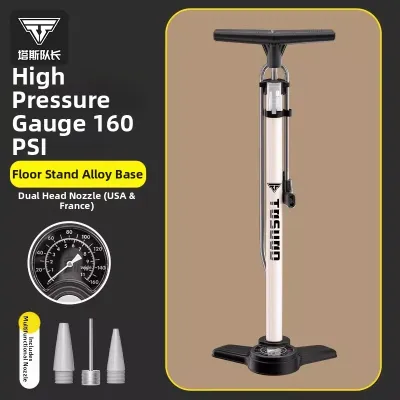
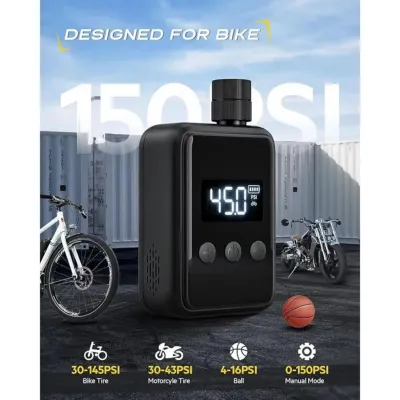
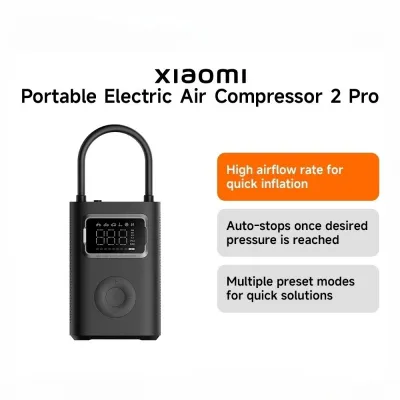
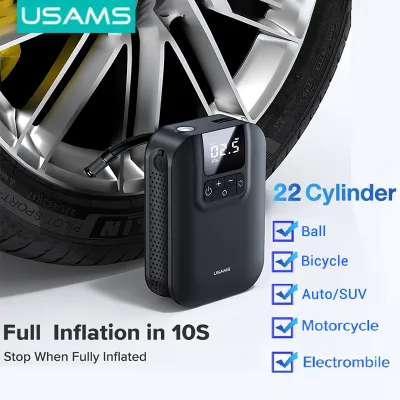
![[SG Stock] Air Pump Car Inflator Compressor Portable Ball Bike Bicycle Rechargeable Basketball Soccer Volleyball Tyre Wheel Tire 12V LED Fast Auto Shut-off Emergency](https://img.lazcdn.com/g/p/cc7d92c566c3860fbbfa1d535cc6f3bb.jpg_400x400q80.jpg_.webp)
Prices are valid at publication and may change. Please refer to the product page for the latest price.
While you should always follow your tire’s markings, understanding common pressure ranges provides helpful context for your riding style:
- Road Bikes: Typically require high pressure, ranging from 80 to 120 PSI (5.5 to 8.3 Bar), to minimize rolling resistance on smooth asphalt.
- Gravel Bikes: Operate in a moderate range of 40 to 80 PSI (2.8 to 5.5 Bar) to balance speed with off-road compliance.
- Mountain Bikes: Use much lower pressures, often between 20 to 45 PSI (1.4 to 3.1 Bar), to maximize traction and tire deformation over rocks and roots.
- City Commuters and E-Bikes: Generally require a stable middle ground of 50 to 75 PSI (3.4 to 5.2 Bar) to handle extra weight and varied urban pavement.
As a critical safety boundary, never exceed the maximum pressure printed on your tire sidewall or your wheel rim. Over-inflation can lead to a catastrophic blowout, which can damage your wheel rim, ruin the tire bead, and cause severe accidents. Always consult your bicycle’s user manual and the tire manufacturer’s official guidelines before adjusting pressures, especially if you are using tubeless systems or aftermarket carbon rims.
Key Electric Bicycle Pump Specs Decoded
When shopping for an electric bicycle pump, technical specifications can easily become overwhelming. Understanding how these specs translate to real-world performance will help you avoid buying an underpowered tool or overpaying for features you do not need.

The most prominent specification is the pump’s maximum pressure rating. It is highly recommended that the pump’s maximum rated pressure comfortably exceeds your tire’s maximum requirement. If your road bike tires require 110 PSI, a compact pump rated for exactly 110 PSI will struggle, run hot, and potentially stall as it nears that target. Choosing a pump rated for 120 to 150 PSI ensures the internal motor operates within its optimal performance envelope without excessive strain.
Another critical trade-off exists between high pressure and high volume, which is determined by the pump’s cylinder size and flow rate. Pumps designed for high pressure use smaller internal cylinders. These cylinders compress air efficiently against high resistance but move a lower volume of air per stroke, resulting in slower inflation times for large tires. Conversely, high-volume pumps utilize larger cylinders to move more air quickly but struggle to push against the high resistance of narrow road tires.
Valve compatibility is another essential factor to verify before purchase. Bicycle tires primarily use three valve types: Presta (thin, with a lock nut, common on road and gravel bikes), Schrader (wider, identical to car tire valves, common on mountain and commuter bikes), and Dunlop (found on some utility and classic city bikes). Ensure your chosen electric pump includes a dual-head chuck or high-quality brass screw-on adapters to match your valve type without leaking air during inflation.
When comparing models, remember that certain specifications matter less than marketing suggests. An ultra-high rating of 150+ PSI is practically useless if you only ride mountain or commuter bikes. Similarly, secondary accessory features—such as built-in flashlights, power bank capabilities, or complex colored screens—should not drive your purchase decision if the core battery capacity, motor reliability, and valve connectors are sub-par.
Matching Pump Specifications to Your Bike Type
Selecting the right electric pump requires aligning the pump’s strengths with your primary riding discipline. Different bikes demand different inflation characteristics, and choosing accordingly prevents frustration on the road or trail.
If you ride road or gravel bikes, you are dealing with high-pressure, low-volume systems. Your priority should be a pump that can reliably reach 90 to 120+ PSI without overheating. For these setups, look for pumps that emphasize digital gauge accuracy and secure, threaded Presta valve connections. Because the volume of air needed is relatively small, raw inflation speed is secondary to pressure capability and precise calibration.
For mountain and fat bike riders, the equation is reversed. You deal with low-pressure, high-volume systems. A pump that tops out at 50 PSI is perfectly adequate, but it must have a high flow rate (measured in liters per minute) to fill large-volume tires in a reasonable timeframe. Look for a robust cylinder design that can move air quickly so you do not spend ten minutes on the trail waiting for a top-up.
Commuter and e-bike riders require a balanced, general-purpose pump. Because commuter tires have moderate volume and pressure requirements (50 to 80 PSI), battery capacity is your primary consideration. A pump with a larger lithium-ion battery ensures you can perform multiple weekly top-ups on a single charge, which is highly practical for daily riders navigating urban routes or Singapore’s Park Connector Network (PCN) in hot, humid conditions that naturally affect tire pressure stability.
It is important to note a major limitation regarding tubeless tire setups. Seating a tubeless tire bead onto a rim requires an instantaneous, high-volume blast of air to force the tire bead outward into the rim hooks. Compact, portable electric bicycle pumps lack the instantaneous flow rate required for initial tubeless installation. While they are excellent for maintaining pressure in an already-seated tubeless tire, you will still need a dedicated tubeless floor pump, a CO2 inflator, or an air compressor for the initial setup.
Practical Features for Everyday Use and Safety
Beyond basic pressure and volume specifications, several practical features directly impact usability, equipment safety, and pump longevity.
An automatic shutoff feature is highly recommended. This allows you to preset your desired target PSI or Bar on the digital screen; the pump runs until it detects this pressure and then automatically cuts power. This prevents accidental over-inflation, protects your tires from damage, and conserves battery life.
Thermal management is another critical safety consideration. Small electric pumps generate substantial heat during operation due to rapid air compression inside a compact housing. High-quality pumps feature built-in cooling fins, ventilation slots, or automatic thermal cut-offs that pause operation if the motor gets too hot. When using these pumps, always monitor the temperature; if the housing feels excessively warm, turn the unit off and let it cool down before resuming.
Lastly, prioritize display accuracy. While digital gauges offer clear, easy-to-read numbers, they can experience sensor drift over time. Additionally, a minor amount of air naturally escapes when you disconnect the pump hose from the tire valve. To ensure your safety and optimal tire performance, periodically verify your electric pump’s readings with a standalone, high-quality mechanical or digital tire pressure gauge.
Frequently Asked Questions (FAQ)
Can I use a car electric pump for my bicycle tires?
Yes, you can use a car electric pump, but you must take specific precautions. Car pumps are designed for high-volume, low-pressure automotive tires and typically feature Schrader connectors. If your bicycle uses Presta valves, you will need a brass adapter. Because car pumps move a large volume of air, they can inflate small bicycle tires extremely fast, creating a high risk of sudden over-inflation and blowouts. Always monitor the pressure gauge closely or use a precise auto-shutoff setting to prevent tire damage.
Why does my electric pump stop before reaching the target PSI?
If your electric pump shuts down prematurely, it is usually due to thermal protection or battery limitations. High-pressure inflation puts a heavy load on the pump’s motor, generating rapid heat and draining the battery quickly. When the internal temperature exceeds safe limits, thermal sensors will shut the unit down to prevent motor damage. Alternatively, a drop in battery voltage under heavy load can trigger a low-power shutdown. To resolve this, let the pump cool down for 10 minutes, ensure the battery is fully charged, and verify that the tire valve is not blocked.
Community discussion
Share your experience or ask a question. Comments are reviewed before publication.