
Choosing the right aftermarket accessories to protect your Mazda 3 carpet involves balancing aesthetic appeal with uncompromising safety. In Singapore’s tropical climate, where sudden downpours translate to wet shoes and high cabin humidity, a high-quality full-surround floor mat is essential to prevent moisture, dirt, and debris from ruining your vehicle’s floorboards. However, the “best” full-surround mat is not simply the one that covers the most surface area. Instead, it is the one that achieves a flawless, millimeter-perfect fit around your car’s specific footwell geometry without compromising safety.
To identify the ideal full-surround floor mat for your Mazda 3, you must use a conditional decision framework based on your driving habits, safety priorities, and aesthetic preferences. If your primary concerns are absolute safety, long-term durability, and effortless cleaning, precision-molded 3D Thermoplastic Elastomer (TPE) mats are the superior choice. These mats use advanced digital scanning to map the exact contours of the footwell, ensuring rigid edges and zero interference with the pedals. On the other hand, if you prioritize a luxury cabin aesthetic, superior sound dampening, and maximum vertical coverage, custom-tailored 5D or 7D leather-and-coil mats are highly appealing—provided they are explicitly patterned and manufactured for the Right-Hand Drive (RHD) layout of the Mazda 3. Under no circumstances should you install universal, “trim-to-fit” full-surround mats; their lack of structural rigidity and poor compatibility with factory retention anchors pose severe risks of pedal interference and sudden slippage.
Beyond fitment and safety, protecting the original Mazda 3 carpet requires a mat that does not trap moisture underneath. Singapore’s high humidity can easily turn trapped dampness into a breeding ground for mold, mildew, and persistent cabin odors. A truly compatible full-surround mat must feature a breathable or highly secure backing that prevents water from seeping through, while remaining easy to remove and dry during routine car care.
Products mentioned in this guide
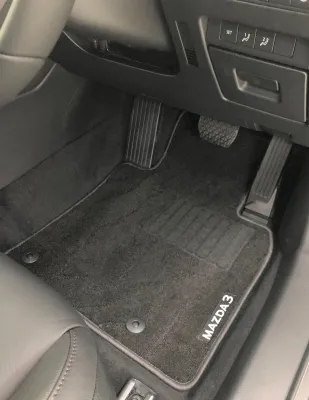
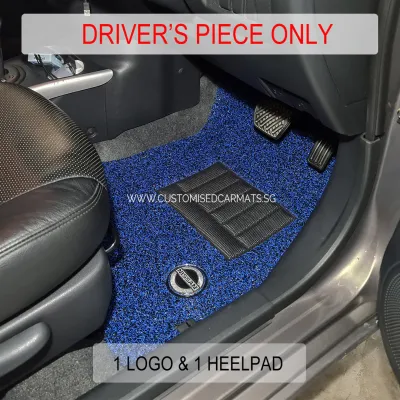
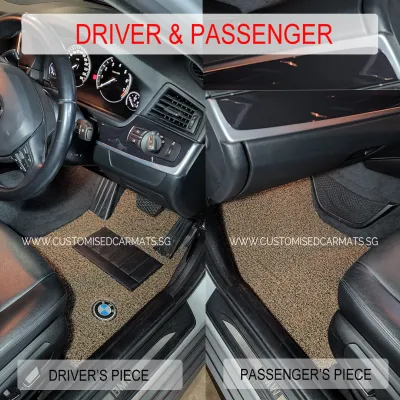
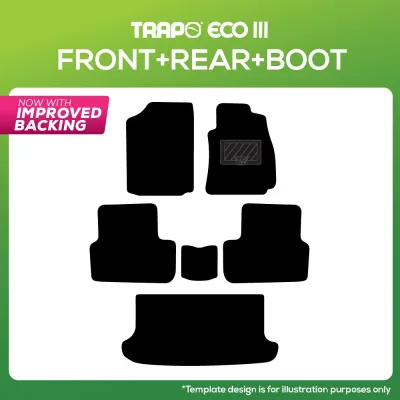
Prices are valid at publication and may change. Please refer to the product page for the latest price.
Mazda 3 Interior Contours: What Makes a "Perfect Fit"?
Achieving a perfect fit in a Mazda 3 requires a deep understanding of the vehicle’s unique interior geometry. Unlike many standard compact cars, the Mazda 3—particularly the fourth-generation (BP) model popular in Singapore—features highly specific footwell contours that present distinct challenges for floor mat manufacturers. The driver’s side floor plan is engineered with tight tolerances, meaning that any slight deviation in a mat’s pattern can lead to unsafe driving conditions or premature wear of the interior trim.
In Singapore’s Right-Hand Drive (RHD) market, the driver’s pedal box geometry is exceptionally compact. The space between the accelerator pedal and the plastic trim of the center console is narrow. Because the Mazda 3 utilizes a floor-mounted, organ-style accelerator pedal (hinged at the bottom) rather than a suspended pedal, the clearance behind and around the pedal base is incredibly tight. Poorly designed or generic mats often feature thick materials that bunch up in this exact area, which can prevent the accelerator from fully depressing or, far worse, catch the edge of the pedal and hold it open. A perfect-fit mat must have a dedicated, low-profile cutout or a highly precise contour that wraps around the base of the organ pedal without touching its moving parts.
Furthermore, the driver’s footwell includes a prominent dead pedal (footrest) on the far right and a steeply sloping transmission tunnel on the left. A premium full-surround mat must cover the dead pedal completely to protect the underlying Mazda 3 carpet from wear, but it must do so using a rigid or highly structured material. If the material is too soft or lacks precise molding, it will sag, curl, or slide down over time, creating a physical obstruction under the driver’s feet. The mat must also conform tightly to the transmission tunnel’s curve without bowing outward, which would otherwise interfere with the driver’s legroom or catch on the passenger’s shoes.
Security is another critical factor. Mazda equips the driver and front passenger footwells with specific factory retention clips (floor anchors) designed to lock the mats in place. A true custom-fit full-surround mat must feature integrated, matching retention grommets that align perfectly with these factory pegs. If a mat relies solely on its weight or generic anti-slip backings without utilizing these physical anchors, it is highly prone to shifting forward under heavy braking.
Finally, the rear passenger footwell presents its own design hurdles. The Mazda 3 features rear passenger air conditioning vents located under the front seats. A properly engineered full-surround mat must extend under the seats to protect the floorboards, but it must feature precise cutouts or lowered vertical walls around these vent openings. If the mat blocks these vents, it will restrict cabin airflow and cause cold air to blow directly onto the underside of the mat, leading to localized condensation, dampness, and eventual mold growth on the original Mazda 3 carpet.
Key Comparison Dimensions for Full-Surround Floor Mats
When comparing different brands and listings of full-surround floor mats for your Mazda 3, it is easy to get lost in marketing buzzwords. To make an objective, safety-first decision, you should evaluate candidates across three critical physical dimensions: edge height, pedal clearance, and material stability.

Edge Height and Contour Mapping
The primary appeal of a full-surround mat is its ability to protect the vertical surfaces of the footwell, not just the flat floor. However, the height of these vertical walls must be carefully balanced. High-quality mats feature edges that follow the exact slope of the Mazda 3’s inner door sills and center console, rising just high enough to contain spills and dirt without encroaching on other cabin components.
When evaluating a mat, verify that the vertical edges do not interfere with the front seat adjustment tracks. If the mat’s side walls are too thick or tall, they can get caught in the seat rails, restricting seat travel or damaging the mat material when the seats are slid forward or backward. Additionally, the outer edges of the mat must sit flush against the plastic door sill trims. If they flare outward, they can interfere with the rubber door seals, potentially allowing rainwater to seep into the cabin during Singapore’s heavy downpours.
Pedal Clearance and Safety Margins
No design feature is more critical than pedal clearance. The safety margin between the upper edge of the mat and the fully depressed accelerator, brake, and clutch pedals (if manual) must be absolute. Because the Mazda 3’s organ-style accelerator pedal moves in an arc close to the floor, the mat must provide a clear, unobstructed path for this movement.
When shopping online or at local car accessory shops, look for manufacturers that explicitly state their patterns are verified for RHD Mazda 3 models. Many sellers use generic product photos of Left-Hand Drive (LHD) vehicles, which have mirrored footwell layouts. A mat designed for an LHD vehicle will not fit an RHD Mazda 3 and will cause severe, highly dangerous pedal interference if forced into place. Always verify that the manufacturer has engineered a dedicated RHD pattern with verified safety margins.
Material Stability and Anti-Slip Properties
A floor mat must remain completely stationary under all driving conditions. To achieve this, the backing of the mat must interact effectively with the original Mazda 3 carpet. Different brands utilize various backing technologies, ranging from aggressive plastic nibs to Velcro-style hook-and-loop fasteners and specialized textured fibers.
Heavy, multi-layer mats (such as 5D or 7D styles) carry significant physical mass. Under sudden, emergency braking, the forward momentum of the driver’s feet and the mat itself can cause the entire unit to slide forward if the backing is inadequate. If the mat slides even a few centimeters, it can jam the brake pedal or prevent the accelerator from returning to its idle position. Therefore, a premium mat must combine robust, high-friction backing materials with secure attachment to the factory floor anchors.
Evaluating Full-Surround Mat Types Available in Singapore
Singaporean car owners have access to a wide array of aftermarket floor mats, ranging from premium imported brands to budget options found on online marketplaces. Understanding the practical pros and cons of each primary category is essential to finding the right match for your Mazda 3.
Precision-Molded 3D TPE Mats
Precision-molded 3D TPE (Thermoplastic Elastomer) mats represent the gold standard for safety and durability. These mats are manufactured using advanced 3D laser scanners to capture every millimeter of the Mazda 3’s footwell. The TPE material is then injection-molded or pressure-formed into a rigid, semi-flexible tray that matches the car’s floor perfectly.
- Pros: TPE is highly durable, completely waterproof, non-toxic, and odorless. Because of their rigid, pre-formed shape, these mats never sag, curl, or shift. They feature precise, molded cutouts for the factory retention clips and provide the safest, most reliable clearance around the organ-style accelerator pedal. Cleaning is incredibly simple: they can be taken out, hosed down, wiped dry, and reinstalled within minutes.
- Cons: TPE mats generally have a more industrial, sporty, or utilitarian appearance, which some owners feel detracts from the Mazda 3's upscale, elegant cabin design. Additionally, their molded vertical walls are typically lower (usually 2 to 4 centimeters) than those of soft 5D/7D mats, meaning they offer slightly less coverage on the upper vertical carpet walls.
Custom 5D/7D Leather and Coil Mats
Custom 5D and 7D mats are designed for drivers who want to enhance their vehicle’s interior luxury. These mats feature a multi-layer construction, typically consisting of a synthetic polyurethane (PU) leather top layer, a soft ethylene-vinyl acetate (EVA) foam core for cushioning, and a non-slip bottom layer. 7D mats add a removable, textured PVC “coil” or “noodle” mat on top of the leather base for added dirt trapping.
- Pros: These mats offer an incredibly luxurious, executive look with diamond-stitched patterns that can be color-matched to your Mazda 3's upholstery. They provide maximum vertical coverage, often extending high up the sides of the footwell to cover almost all visible original carpet. The thick, multi-layer construction also provides excellent acoustic insulation, noticeably reducing road noise entering through the floorboards.
- Cons: Because they are thick and flexible, they are highly dependent on the quality of the manufacturer's laser-cutting pattern. If the pattern is off by even a fraction of an inch, the thick layers can bunch up near the pedal box, creating a severe safety hazard. They are also much heavier, more difficult to clean, and prone to holding onto water. In Singapore's humid climate, wet shoes can saturate the coil layer, leading to trapped moisture, damp smells, and mold if not dried thoroughly.
Universal "Trim-to-Fit" Full-Surround Mats
Universal full-surround mats are budget-friendly options designed to be cut down to size by the buyer using household scissors. They are widely sold as a one-size-fits-all solution for various vehicle makes and models.
- Pros: They are highly affordable and readily available.
- Cons: Universal mats are highly discouraged for the Mazda 3. Because they are flat, trying to force them to cover the vertical walls of the footwell requires folding and tucking the material, which creates dangerous bulk near the pedals. They lack compatible factory retention clip holes, meaning they will slide and shift constantly. Furthermore, the cut edges of these mats are prone to fraying, curling, and catching on your shoes, making them a severe driving hazard. The risk of making an incorrect cut near the sensitive floor-mounted accelerator pedal is simply too high to justify the cost savings.
How to Verify Fit and Pedal Safety Before Driving
Your safety on the road depends entirely on the correct installation and fitment of your floor mats. Before taking your Mazda 3 out for a drive with newly installed full-surround mats, you must perform a rigorous, step-by-step safety and fitment verification. Always refer to your Mazda 3 owner’s manual for factory floor mat installation guidelines and safety warnings. If you are ever unsure about the fitment or safety of an aftermarket accessory, consult a qualified automotive professional before operating the vehicle.
Step 1: Pre-Installation and Alignment Check
Before placing the mats in the car, inspect them thoroughly for any manufacturing defects, such as warped edges, torn backing, or loose stitching. Ensure you have correctly identified the driver-side mat (which will feature the specific heel pad and pedal cutouts for an RHD vehicle).
When placing the mat into the driver’s footwell, align the mat’s retention holes directly over the factory floor pegs. Push down firmly until you hear or feel the clips click securely into place. The mat must lay completely flat against the floorboards without any bowing, lifting, or tension. If you have to force, stretch, or bend the mat to get the clips to align, the pattern is incorrect for your specific Mazda 3 model year, and you should not proceed with the installation.
Step 2: The Mandatory Pedal Travel Test
With the vehicle’s engine completely turned off and the handbrake securely engaged, sit in the driver’s seat. Reach down and press both the brake pedal and the accelerator pedal through their absolute full range of motion by hand.
- Accelerator Pedal: Press the organ-style pedal slowly until it bottoms out against the floor. Verify that there is at least 15 to 20 millimeters of clear space between the sides and back of the pedal and the edge of the mat. Release the pedal slowly and ensure it returns smoothly to its resting position without catching, rubbing, or dragging against the mat material.
- Brake Pedal: Depress the brake pedal with maximum force. Ensure that the pedal does not press into or compress the edge of the mat. There must be no physical contact between the brake arm or pad and the floor mat at any point during its travel.
Step 3: The Heel-Pivot Test
While sitting in the driving position, place your right heel on the mat’s heel pad. Simulate the natural foot movements of driving by rapidly pivoting your foot back and forth between the accelerator and the brake pedal.
Apply firm downward pressure with your heel as you pivot. Observe the mat to ensure it does not slide forward, bunch up, or lift at the rear. The mat must remain completely stationary. If you feel your heel catching on any raised ridges or if the mat shifts even slightly, the anti-slip backing is insufficient or the factory clips are not holding the unit securely.
Step 4: Establish a Safety Boundary
If you detect any interference, rubbing, catching, or shifting during these tests, stop using the mat immediately. Do not attempt to trim, cut, or modify the mat yourself to “make it fit,” as altering the structural integrity of the mat can cause it to warp or fail unexpectedly while driving. Remove the mat and contact the manufacturer or retailer for a refund or replacement. Driving with an ill-fitting floor mat is an unacceptable safety risk that can lead to a loss of vehicle control.
Frequently Asked Questions (FAQ)
Do full-surround mats block the rear air vents in the Mazda 3?
If you purchase high-quality, precision-patterned custom mats designed specifically for your Mazda 3 generation, they will not block the rear air vents. Properly engineered mats feature precise cutouts or lower vertical walls that sit flush beneath the vent openings under the front seats. However, poorly designed or generic mats often lack these cutouts, which can block airflow, reduce rear passenger comfort, and cause condensation to pool under the mat. Always visually inspect the under-seat area after installation to ensure the vents are completely clear.
Should I remove the original factory carpets before installing full-surround mats?
No, you should never attempt to remove the original factory-installed carpet, as it is a permanent structural component of your vehicle’s cabin that provides essential insulation and sound dampening. Full-surround mats are designed to be installed directly over this factory carpet. However, you must remove any existing aftermarket flat mats, rubber mats, or dealer-provided carpet mats before installing your new full-surround mats. Stacking floor mats alters the floor height, prevents the factory retention clips from locking securely, and severely increases the risk of dangerous pedal interference.

Community discussion
Share your experience or ask a question. Comments are reviewed before publication.