
Whether the A810S dash cam is compliant with Singapore’s Land Transport Authority (LTA) regulations depends on its specific hardware features, wireless certifications, and how it is installed in your vehicle. While the dash cam itself is a popular recording device, Singapore law enforces strict rules regarding driver visibility, wireless transmission, and prohibited signal-detection technologies. To ensure your setup is fully legal, you must verify that your specific A810S unit lacks active radar or laser detection capabilities, carries the necessary local telecommunications approval, and is mounted in a position that does not obstruct your view of the road.
In Singapore, vehicle modifications and aftermarket accessories are closely monitored during periodic vehicle inspections at authorized centers. Installing an unapproved or improperly positioned device can lead to inspection failures, fines, or complications with your motor insurance policy. Understanding the intersection of LTA guidelines and your dash cam’s specifications is essential before making a purchase or proceeding with an installation.
Core LTA Requirements for Dash Cams in Singapore
The Land Transport Authority (LTA) establishes strict guidelines for any aftermarket accessories installed on vehicles operating on public roads in Singapore. The primary objective of these regulations is to maintain road safety by ensuring that drivers have an unobstructed view of the road and that vehicle electronics do not interfere with critical safety systems or public telecommunications.
Products mentioned in this guide
![[NEW] 70mai A810S Dash Cam 4K Resolution + HDR | 4G Connectivity | Built-in GPS & ADAS | Dual SONY HDR | Supercapacitor](https://img.lazcdn.com/g/p/12b3e825bd363ef619248cedda0ec9fd.jpg_400x400q80.jpg_.webp)
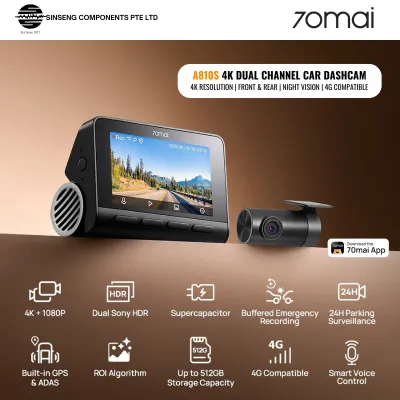
Prices are valid at publication and may change. Please refer to the product page for the latest price.
First, vision obstruction limits are a critical factor for any windshield-mounted accessory. The LTA mandates that no device, bracket, or cabling may block the driver’s direct line of sight. This rule is typically assessed using the swept area of the vehicle’s windshield wipers. Any device mounted within this critical viewing zone that impairs the driver’s ability to see traffic lights, pedestrians, or road hazards is considered non-compliant.
Second, Singapore law strictly prohibits the possession or use of hardware features designed to detect speed-tracking technologies. This includes radar detectors, laser detectors, and active jamming devices. If a dash cam includes built-in radar modules or software features designed to alert drivers to active police radar bands, the entire device is illegal to import, possess, or use within the country.
Third, because modern dash cams utilize wireless technologies like Wi-Fi, Bluetooth, or cellular data to transfer footage to smartphones, they must comply with local telecommunications transmission rules. In Singapore, the Infocomm Media Development Authority (IMDA) regulates all radio frequency-emitting devices. Any dash cam sold or used locally must meet specific frequency standards and carry the appropriate local approval labels to ensure they do not cause harmful interference to public or emergency communication networks.
Finally, any electrical work associated with installing a dash cam must adhere to strict safety boundaries. Hardwiring a camera to the vehicle’s fuse box or modifying the electrical system requires careful adherence to the original-vehicle manufacturer’s instructions. Improper electrical modifications can compromise the vehicle’s safety systems, void manufacturer warranties, or even pose a fire hazard, making qualified professional installation highly recommended for permanent setups.
Evaluating the A810S Against Compliance Standards
To determine if the A810S is suitable for your vehicle, you must conduct a thorough physical and specification check of the product before purchasing or installing it. Because different product variants and parallel imports exist in the market, you cannot assume that every unit sharing the A810S model name is identical or automatically compliant.

Begin by inspecting the product packaging, user manual, and official specifications for any prohibited detection features. Look closely for terms like ‘radar detection,’ ‘laser warning,’ or ‘speed trap detection.’ If the specific variant of the A810S you are evaluating includes active radar-receiving hardware, it is non-compliant under Singapore law. Note that passive GPS-based speed limit alerts, which rely on pre-loaded database coordinates rather than active signal detection, are generally permitted, but you must verify that the device does not actively scan for police radar frequencies.
Next, verify the presence of local telecommunications approval marks. Legally imported units intended for the Singapore market should feature an IMDA compliance label on the box or within the product documentation. If you are purchasing the device from an online marketplace or a parallel importer, check the device’s regulatory menu or consult the seller to confirm that the wireless modules operate on approved local frequencies and do not violate telecommunications standards.
You must also assess the physical dimensions and mounting mechanism of the A810S against your vehicle’s windshield layout. The A810S features a specific wedge-shaped design with an adhesive mount. Measure the area behind your rearview mirror to ensure the camera body can be positioned securely without extending downward into your primary field of vision. Since windshield angles and rearview mirror assemblies vary significantly between vehicle models and years, physical compatibility must be verified individually for your specific car.
Compliant vs. Non-Compliant Installation Scenarios
The physical installation of your dash cam is just as important as its technical specifications when it comes to legal compliance. Even a fully certified and approved dash cam can become illegal if it is mounted incorrectly on your windshield.
A compliant installation scenario involves placing the A810S high up on the windshield, ideally directly behind or adjacent to the rearview mirror. This positioning keeps the camera body outside the driver’s direct line of sight while still allowing the lens to capture a clear view of the road ahead. The cabling must be routed neatly along the headliner and down the A-pillar, completely clear of the driver’s controls and any airbag deployment zones.
Conversely, a non-compliant installation scenario occurs when the camera is mounted in the lower center of the windshield or directly in front of the driver’s face. This placement creates a physical blind spot that can obscure pedestrians or oncoming vehicles. Additionally, leaving loose cables hanging down from the camera to the cigarette lighter socket is highly discouraged, as loose wires can interfere with gear shifts, steering, or pedal operation, creating an immediate safety hazard.
When securing the device, using approved temporary adhesives or electrostatic stickers designed for automotive glass is the standard, compliant method. Avoid making permanent modifications to your vehicle’s interior, such as drilling into the dashboard or gluing brackets directly to structural panels. If your installation requires hardwiring to the vehicle’s electrical system to enable parking surveillance modes, always refer to your vehicle’s manual and seek qualified professional assistance to ensure the wiring does not interfere with the vehicle’s battery management or safety systems.
Making Your Final Purchase Decision
When deciding whether to purchase the A810S for use in Singapore, you should follow a structured decision framework based on your verification findings and your vehicle’s specific layout.
First, choose the A810S if your physical and specification checks confirm that the unit lacks active radar or laser detection hardware, carries valid local telecommunications approval labels, and can be mounted behind your rearview mirror without obstructing your view. This ensures that both the hardware and the physical setup meet all local legal standards.
Second, choose a certified alternative if the specific A810S unit you are inspecting contains prohibited active detection features, lacks clear IMDA approval markings, or is sold by a parallel importer who cannot guarantee compliance with local wireless regulations. Opting for a model officially distributed and certified for the Singapore market eliminates the risk of regulatory non-compliance.
Third, keep in mind that neither the A810S nor alternative models may fit your vehicle if the windshield layout inherently blocks legal mounting zones. Vehicles with highly compact windshields, specialized sports car glass, or commercial vehicle configurations may not have enough space behind the rearview mirror to accommodate a wedge-shaped camera without violating vision obstruction limits. In such cases, you may need to explore alternative camera form factors, such as mirror-mounted systems or discrete, ultra-compact lenses.
Finally, if you encounter any ambiguity regarding the device’s specifications, wireless frequencies, or mounting legality, always verify first with an authorized local retailer or consult the relevant transport and telecommunications authorities before finalizing your purchase. Taking the time to verify these details beforehand protects you from costly inspection failures and ensures your vehicle remains fully road-legal.
Frequently Asked Questions (FAQ)
Can I use the A810S if I physically disable its non-compliant features?
No, physically disabling or turning off non-compliant features in the software settings does not make an illegal device compliant under Singapore law. The legal framework generally focuses on the possession and installation of prohibited equipment within the vehicle. If a device contains active radar or laser detection hardware, having it mounted in your car is considered an offense, regardless of whether the feature is actively running or switched off at the time of an inspection.
What are the general consequences of using an illegal dash cam in Singapore?
Using a non-compliant dash cam can lead to several serious consequences. During your vehicle’s mandatory periodic inspection at authorized centers, an improperly mounted camera or a device with prohibited features will result in an immediate inspection failure, preventing you from renewing your road tax until the issue is resolved. Furthermore, traffic authorities can issue penalties for vision obstruction, and in the event of an accident, your motor insurance provider may reject or dispute your claim if an illegal accessory is found to have obstructed your view or interfered with vehicle electronics.
Does adding a rear camera to the A810S affect overall compliance?
Yes, adding a rear camera introduces additional compliance factors that you must manage carefully. The rear camera must be mounted in a position that does not obstruct your view through the rear-view mirror or block your rearward visibility. Additionally, you must ensure that the camera and its wiring do not damage or interfere with rear windshield defroster lines or aftermarket window tinting films. The camera should ideally be positioned within the swept area of the rear wiper, if your vehicle is equipped with one, to ensure clear footage without violating safety guidelines.
Community discussion
Share your experience or ask a question. Comments are reviewed before publication.