
Quick Answer: Is the 70mai T800 Right for Your Singapore Drive?
The 70mai T800 represents a compelling option if you prioritize high-resolution video capture, seamless mobile application connectivity, and a budget-conscious price point for your daily commute. However, whether this specific unit is the absolute best fit for your vehicle depends on your parking habits and installation preferences.
While the 70mai T800 offers robust daytime and nighttime recording capabilities, premium alternatives on the Singapore market may provide superior long-term reliability in extreme heat through dedicated supercapacitor designs and more advanced, low-draw parking surveillance modes.
If your vehicle is primarily parked in shaded locations, such as HDB multi-storey car parks or basement parking structures, the 70mai T800 delivers excellent value. Conversely, if your car is routinely exposed to direct tropical sunlight in open-air parking lots, investing in a premium, supercapacitor-powered alternative designed specifically for high-temperature endurance may be a safer and more durable choice.
Products mentioned in this guide
![[NEW] 70mai T800 3-Channel Dashcam Dual 4K Resolution + HDR | 4G Connectivity | Built-in GPS & AI Parking Surveillance](https://img.lazcdn.com/g/p/4d222cc82eebb612f5aee13f6996ec5c.jpg_400x400q80.jpg_.webp)
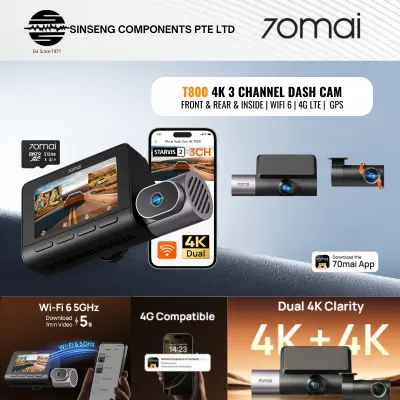
Prices are valid at publication and may change. Please refer to the product page for the latest price.
What Makes a Dash Cam LTA-Compliant in Singapore?
Before comparing specific features, every driver must ensure their chosen dash cam complies with the regulations set by the Land Transport Authority (LTA). In Singapore, the primary regulatory concern regarding aftermarket accessories on the windshield is driver visibility. Any device mounted on the front windscreen must not obstruct the driver’s direct line of sight or interfere with the safe operation of the vehicle.

To meet these mounting restrictions, the dash cam should ideally be positioned behind the rearview mirror on the passenger side. This placement keeps the device out of the driver’s immediate field of view while still allowing the lens to capture a clear, unobstructed angle of the road ahead. Additionally, the camera and its mounting bracket must not block the windshield wiper sweep area, as a dirty or wet windshield in front of an obstructed wiper path can severely compromise both the camera’s footage and the driver’s visibility during heavy downpours.
Size is another critical factor for LTA compliance. Bulky units with large screens can easily violate visibility rules. Compact, screenless designs or models with small, low-profile displays are generally easier to position within the legal mounting zones.
Data privacy is a secondary but important consideration when operating recording devices in Singapore. While recording on public roads is entirely legal and highly encouraged for insurance purposes, you must respect privacy boundaries when entering private properties or restricted areas.
Always verify the latest official LTA guidelines and vehicle inspection standards on the Singapore government’s official transport portal before proceeding with any physical installation. Regulations can be updated, and what is permitted today may be subject to stricter enforcement during your vehicle’s periodic inspection.
Core Comparison Dimensions: 70mai T800 vs. Market Alternatives
Evaluating a dash cam for use in Singapore requires looking beyond basic marketing claims. You must analyze how specific hardware components perform under local driving conditions, high thermal stress, and extended parking scenarios. Comparing the 70mai T800 against alternative brands across key technical dimensions will help you identify the most reliable system for your vehicle.
Video Resolution and Night Vision
Clear footage is vital for identifying license plates, especially during Singapore’s frequent evening rainstorms or on poorly lit side roads. The 70mai T800 is marketed with high-resolution capabilities, but you must compare its actual sensor performance against other available brands.
When evaluating image quality, do not rely solely on the advertised resolution (such as 4K or 1080p). The physical size and brand of the image sensor play a massive role in low-light clarity. Look for models equipped with high-end sensors, such as those from the Sony STARVIS series, which excel at capturing fine details in low-light environments without overexposing reflective license plates under streetlights.
Furthermore, frame rate is a crucial factor when driving at high speeds on major expressways like the Pan Island Expressway (PIE) or East Coast Parkway (ECP). A camera recording at 60 frames per second (fps) will capture smoother motion and clearer freeze-frames of moving license plates compared to a standard 30 fps camera, although 4K resolution is often limited to 30 fps on many consumer models. You should also check the lens aperture rating; a wider aperture (such as f/1.8) allows more light to reach the sensor, which significantly improves visibility during heavy downpours or night drives.
Higher resolution also comes with a practical trade-off regarding data storage. Recording in true 4K resolution generates massive video files, which will rapidly fill up a standard memory card. If you opt for a high-resolution camera like the 70mai T800, you must factor in the ongoing cost of a high-endurance, high-capacity microSD card (such as 128GB or 256GB) rated specifically for continuous write cycles in hot environments.
Heat Resistance: Supercapacitor vs. Lithium Battery
Singapore’s tropical climate poses a severe challenge to cabin electronics. When parked under the direct sun, cabin temperatures can quickly exceed 60 degrees Celsius, creating a hostile environment for any device mounted directly against the glass.
The primary differentiator in hardware longevity is the internal power storage mechanism. Dash cams typically use either lithium-ion batteries or supercapacitors to save the final video file when the car engine is turned off. Lithium-ion batteries are highly susceptible to high temperatures; over time, heat exposure can cause them to swell, leak, degrade in capacity, or in extreme cases, pose a combustion hazard.
Supercapacitors, on the other hand, are significantly more heat-resistant. They do not store energy to run the camera for long periods but provide just enough power to safely shut down the device and save the active recording when power is cut. You should carefully verify the 70mai T800’s technical specifications regarding its power source. If the local version of the T800 utilizes a lithium battery, you must weigh this against premium alternatives that exclusively use supercapacitors for superior thermal safety in Singapore’s harsh climate.
Additionally, some premium dash cams feature an automatic thermal shutdown mechanism. This safety feature monitors the camera’s internal temperature and temporarily powers down the system if it exceeds safe operating limits, protecting the processor and image sensor from permanent heat damage. When comparing models, check if the 70mai T800 or its competitors offer this level of active thermal protection to safeguard your investment.
Parking Mode and Hardwiring Requirements
For many drivers, a dash cam’s primary utility is protecting the vehicle while it is parked. Parking surveillance modes typically operate via motion detection, impact detection, or continuous time-lapse recording.
To utilize these parking modes, the dash cam cannot rely on the standard cigarette lighter port, which loses power when the ignition is turned off. Instead, the device must be hardwired directly to the vehicle’s fuse box using a dedicated hardwire kit. This kit monitors the vehicle’s battery voltage and automatically cuts power to the dash cam if the car battery drops below a safe threshold (typically 11.8V to 12V) to prevent a dead battery.
When comparing the 70mai T800 to premium alternatives, examine how the low-voltage cutoff is managed. Some premium brands offer customizable voltage thresholds directly through their physical settings or mobile apps, whereas budget-friendly options may rely on fixed-voltage hardwire kits.
You should also look into the sensitivity settings of the camera’s built-in G-sensor. In Singapore’s urban environment, heavy rain, passing heavy vehicles, or vibrations from nearby construction can trigger false parking mode recordings. A dash cam with highly adjustable G-sensor sensitivity allows you to fine-tune the system so it only records actual physical impacts, saving valuable storage space and reducing unnecessary power consumption. Improper installation or using a kit without a reliable low-voltage cutoff can permanently damage your car battery or void your vehicle’s manufacturer warranty, making professional installation highly advisable.
Feature and Specification Verification Matrix
To help you evaluate your options, the table below outlines the key technical differences between the 70mai T800 and typical premium alternatives available in the Singapore market.
| Feature Category | 70mai T800 (Verify via Specs) | Premium Alternatives (Verify via Specs) | Why It Matters in Singapore |
|---|---|---|---|
| Power Source | Verify if battery or supercapacitor | Typically supercapacitors | Determines heat tolerance and safety in parked cars. |
| Video Resolution | Up to 4K (3840×2160) | Varies (1080p to 4K) | Crucial for reading license plates in rainy or dark conditions. |
| Parking Mode Type | Time-lapse / Impact detection | Buffered parking / Radar motion detection | Protects vehicle against hit-and-run incidents when parked. |
| App Connectivity | Wi-Fi app control | Dual-band Wi-Fi / Cloud-based remote access | Allows quick footage download to your phone for insurance claims. |
| LTA Mounting Footprint | Compact adhesive mount | Varies (Adhesive or discrete cylindrical) | Ensures compliance with driver visibility regulations. |
Please note that manufacturers frequently update their product hardware and software firmware. Always check the official specification sheet provided by the manufacturer or authorized local distributors in Singapore before making a final purchase, as regional variations in hardware configurations can occur.
Decision Framework: Which Dash Cam Should You Choose?
Selecting the right dash cam requires balancing your budget against your specific driving and parking habits.
Choose the 70mai T800 if:
- You are looking for a highly cost-effective solution that offers sharp daytime and nighttime video quality without a premium price tag.
- Your daily routine allows you to park primarily in sheltered locations, such as basement office car parks or HDB multi-storey car parks, where extreme cabin heat is minimized.
- You prefer a straightforward, user-friendly mobile application interface that lets you quickly download footage over a local Wi-Fi connection directly to your smartphone.
Choose Premium Supercapacitor Brands if:
- Your vehicle is frequently parked in open-air, unshaded car parks where it is exposed to intense, all-day tropical sunlight.
- You require a highly reliable, continuous 24/7 parking mode and want to minimize any long-term risks associated with battery degradation or swelling.
- You are willing to invest a higher upfront cost for advanced features like cloud connectivity, which can send real-time impact alerts to your phone even when you are far from your vehicle.
Choose Dual-Channel Systems if:
- You want comprehensive coverage that records both front and rear traffic, which is essential for proving liability in rear-end collisions.
- You drive a larger vehicle, such as a sports utility vehicle (SUV) or a multi-purpose vehicle (MPV), which naturally has larger blind spots.
- You frequently navigate tight, winding ramps in older Singapore multi-storey car parks where side and rear scrapes are common.
Verify First if:
- You are uncertain about your vehicle's fuse box layout or compatibility with aftermarket hardwire kits.
- Your car is equipped with advanced driver-assistance systems (ADAS) or rain sensors mounted near the rearview mirror, as these sensor housings can severely restrict the available mounting space for a dash cam.
- Your vehicle's manufacturer has specific warranty clauses regarding aftermarket electrical modifications, which may require you to use an authorized installer or a specific plug-and-play harness.
Safe Installation and Maintenance in Singapore's Climate
Proper installation is just as important as choosing the right hardware. When running the power cable from the windshield to the fuse box or cigarette lighter, you must route the wire carefully along the headliner and down the A-pillar.
It is absolutely critical that the routing of the dash cam cable does not cross or obstruct any side curtain airbag deployment zones located inside the A-pillar trim. If a cable is draped directly over an airbag module, it could prevent the airbag from deploying correctly during an accident or turn the cable itself into a dangerous projectile. Always refer to your vehicle’s owner manual to locate airbag modules before routing any wires.
Maintaining your storage media is another vital step in ensuring continuous operation. High cabin temperatures combined with constant write cycles can cause microSD cards to fail unexpectedly. To prevent write errors and ensure your camera is actually recording when you need it most, format your high-endurance microSD card at least once a month using the camera’s built-in formatting tool or companion mobile app.
Additionally, you should periodically inspect the physical mount of your dash cam. Extreme heat can degrade the adhesive properties of double-sided tape or cause suction cup mounts to lose their vacuum seal. A loose dash cam can fall while the vehicle is in motion, creating a sudden distraction for the driver or damaging the unit itself.
Never attempt to modify the manufacturer-provided power cables, splice wires without proper insulation, or bypass the low-voltage protection modules included with hardwire kits. If you are not fully confident in your ability to safely access your vehicle’s electrical system, strongly consider hiring a qualified automotive electrician or visiting an authorized car accessories workshop to complete the installation.
Frequently Asked Questions (FAQ)
Can I use a dash cam with a built-in battery in Singapore?
While there is no explicit law from the Land Transport Authority (LTA) banning the use of dash cams with built-in lithium-ion batteries, doing so carries inherent risks in Singapore’s hot climate. High cabin temperatures can cause lithium batteries to swell, degrade rapidly, or fail to save files during a power loss. For enhanced safety and long-term reliability, it is highly recommended to follow Singapore Civil Defence Force (SCDF) general fire safety principles regarding battery-powered electronics in hot vehicles, and choose supercapacitor-based models instead.
Do I need to declare my dash cam to LTA or my insurance provider?
You do not need to declare your dash cam to the LTA, provided that the device is installed in compliance with safety and visibility guidelines and does not obstruct your view of the road. However, it is highly beneficial to inform your motor insurance provider. Some insurers in Singapore offer premium discounts for vehicles equipped with approved, functioning dash cams, and having clear footage can significantly expedite the claims process in the event of an accident.
Community discussion
Share your experience or ask a question. Comments are reviewed before publication.