
When evaluating the 70mai A810 against other dash cams in Singapore, the decision hinges on verifying Land Transport Authority (LTA) compliance, comparing core imaging specifications, and assessing modular features like parking surveillance. While the 70mai A810 offers a compelling set of high-resolution features on paper, choosing the right dash cam requires looking beyond basic specifications. Drivers must consider physical installation constraints, local climate challenges, and the long-term reliability of electrical integrations within their specific vehicles.
Selecting a dash cam in Singapore involves balancing advanced recording capabilities with strict local regulations and environmental conditions. High cabin temperatures from outdoor parking and the widespread use of solar films on windshields directly affect how a camera should be mounted and powered. By comparing the 70mai A810’s technical profile with alternative options, you can determine which system provides the best balance of legal compliance, image clarity, and vehicle safety.
Understanding LTA Compliance and Installation Checks
Before purchasing any dash cam, you must ensure its physical placement complies with Singapore’s Land Transport Authority (LTA) regulations. The primary legal requirement is that any aftermarket accessory mounted on the windshield must not obstruct the driver’s forward view of the road. Typically, this means the camera body should be positioned directly behind or adjacent to the rearview mirror, keeping it outside the driver’s direct line of sight while driving.
Products mentioned in this guide
![[SG Ready Stock] 70mai Flagship A810 - 4K Ultra HD Dual-Channel Dashcam - 4G Monitoring - Installation Available](https://img.lazcdn.com/g/p/8064d55d13fe6fbcb820dea7066876d2.jpg_400x400q80.jpg_.webp)
![[NEW] 70mai A810S Dash Cam 4K Resolution + HDR | 4G Connectivity | Built-in GPS & ADAS | Dual SONY HDR | Supercapacitor](https://img.lazcdn.com/g/p/12b3e825bd363ef619248cedda0ec9fd.jpg_400x400q80.jpg_.webp)
![[2026 NEW] 70mai A810 Lite Dashcam 4K Resolution + HDR | 4G Connectivity | Supercapacitor | Built-in GPS | Dual Recording](https://img.lazcdn.com/g/p/dde058960afcc39bbcd48d9d52298a3d.png_400x400q80.png_.webp)
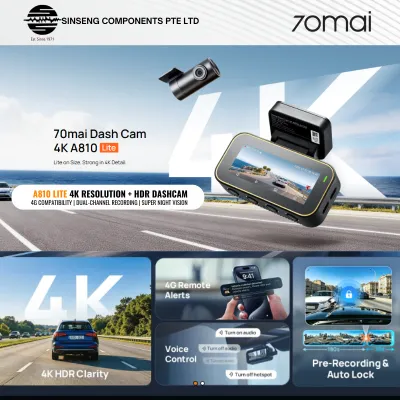
Prices are valid at publication and may change. Please refer to the product page for the latest price.
Physical dimensions and mounting mechanisms play a critical role in maintaining compliance and protecting your vehicle. The 70mai A810 features a wedge-shaped design with a built-in screen, which makes it slightly bulkier than screenless alternatives. You must measure the clearance between your rearview mirror housing and the top of the windshield to ensure the unit fits without hanging too low. Additionally, check that the camera lens sits entirely within the swept area of your windshield wipers so that footage remains clear during heavy tropical downpours.
Windshield modifications, such as solar films or ceramic tints, require careful installation planning. Mounting a heavy dash cam directly onto a solar film using strong adhesive can cause the film to bubble or peel over time. Many drivers use an electrostatic sticker between the glass and the adhesive mount to protect the tint. Before routing any cables, consult your vehicle’s owner’s manual to identify the locations of side-curtain airbags. Running wires incorrectly across these deployment zones can compromise your vehicle’s safety systems, making professional installation highly recommended.
Core Specifications to Compare
Evaluating a dash cam requires a clear understanding of imaging specifications rather than relying solely on marketing labels. True 4K resolution (3840 x 2160 pixels) provides four times the detail of standard Full HD, which is crucial for capturing legible license plates at a distance. When comparing models, verify whether the camera records in native 4K or uses software upscaling, which increases pixel count without improving actual image clarity.

Field of view (FOV) determines how much of the road ahead is captured in the frame. A wider FOV, such as 140 to 150 degrees, allows the camera to record multi-lane traffic and pedestrian walkways. However, extremely wide angles can introduce a fish-eye effect, distorting objects at the edges of the frame and making vehicles appear further away than they actually are. Look for a balanced FOV that covers your vehicle’s front corners without sacrificing central detail.
Night vision capabilities are essential for navigating dimly lit side streets or multi-storey car parks. Look for hardware indicators such as a wide aperture (such as f/1.8 or f/1.7) and High Dynamic Range (HDR) or Wide Dynamic Range (WDR) processing. These technologies allow the sensor to balance extreme light contrasts, preventing headlight glare from washing out license plates and ensuring details remain visible in dark environments.
Storage management is another critical factor when recording in high resolutions. Dual-channel setups recording in 4K front and Full HD rear generate massive amounts of data, requiring high-capacity microSD cards. Always check the manufacturer’s maximum supported storage capacity and use high-endurance cards rated for continuous write cycles. Standard memory cards often fail prematurely under the constant stress of dash cam recording and the high ambient heat of parked vehicles.
70mai A810 Feature and Specification Profile
The 70mai A810 is designed as a high-specification, modular dash cam system. It features the Sony Starvis 2 IMX678 sensor, which is engineered specifically for low-light performance and improved dynamic range. This sensor allows the camera to capture clear footage at native 4K resolution, making it easier to distinguish fine details under challenging lighting conditions.
As a modular system, the A810 can be customized based on your coverage needs. The base unit records the front view, but it can be paired with an optional rear camera module to provide dual-channel coverage. For those who require monitoring while away from the vehicle, an optional hardwire kit is available to enable parking surveillance modes. These add-ons allow you to scale the system’s capabilities depending on your budget and driving habits.
Built-in features include GPS logging and Advanced Driver Assistance Systems (ADAS). The GPS module records real-world speed and coordinates directly onto the video file, providing valuable evidence in the event of an insurance claim. The ADAS feature provides alerts for lane departures and forward collisions. However, these alerts require precise calibration through the companion mobile application and should only be used as a secondary reference, as they do not replace active driver awareness.
Evaluating Alternative Brands and Support
When comparing the 70mai A810 to other options in Singapore, it is helpful to categorize the market into premium automotive brands and budget-friendly smart device brands. Premium brands, such as BlackVue, Thinkware, or IROAD, often focus on screenless, highly discreet designs that blend seamlessly into the vehicle’s interior. These brands frequently prioritize advanced thermal management and cloud connectivity over built-in screens.
Warranty terms and local after-sales support vary significantly between brands and retail channels. Authorized local distributors in Singapore typically offer comprehensive 12-to-24-month warranties, providing direct replacements or professional troubleshooting. If you purchase a parallel-imported unit or buy from an unauthorized online seller, you may have to ship the device overseas for repairs, leaving your vehicle unprotected for extended periods.
Firmware stability and mobile application support are also critical for long-term usability. Established brands with dedicated local support tend to release regular firmware updates to address software bugs and improve compatibility with newer smartphones. Before choosing a brand, check user feedback regarding app connectivity, as a clunky interface can make retrieving footage during an emergency highly frustrating.
Decision Framework: Choosing the Right Dash Cam
To choose the right dash cam for your vehicle, evaluate your specific driving patterns and installation preferences against the strengths of each product category. The 70mai A810 is highly suitable if you prioritize maximum front-facing image resolution, prefer having an integrated screen for instant playback, and want the flexibility of a modular system that you can upgrade over time.
Conversely, established premium brands may be a better fit if you prefer a discreet, screenless design that does not distract the driver, or if you require advanced cloud features like real-time impact notifications. These premium options are also ideal if you want a complete, professionally installed package backed by a robust local warranty network in Singapore.
Before making a final decision, perform a physical audit of your vehicle. Verify that your windshield has sufficient mounting space behind the rearview mirror, check if your solar film requires an electrostatic sticker for protection, and confirm that your vehicle’s fuse box is accessible if you plan to install a hardwire kit. Taking these steps ensures that whichever dash cam you choose will operate safely and legally on Singapore’s roads.
Frequently Asked Questions (FAQ)
Can I get fined for using a non-compliant dash cam in Singapore?
Yes, you can face penalties if your dash cam is installed incorrectly. While the LTA does not issue specific product approvals for individual dash cam models, the Road Traffic Act requires that no vehicle accessories obstruct the driver’s view of the road. If an enforcement officer determines that your camera placement compromises your forward line of sight, you may be ordered to reposition the device or face a fine. Always mount the camera high up on the windshield, preferably behind the rearview mirror, and consult official LTA guidelines or professional installers if you are unsure.
Does the 70mai A810 support 24-hour parking surveillance?
The 70mai A810 supports parking surveillance, but this feature cannot run on the camera’s internal battery alone. To enable continuous monitoring when the engine is turned off, you must install a compatible hardwire kit that connects the camera directly to your vehicle’s fuse box. Before proceeding, check your vehicle’s manual regarding battery management systems, as some modern cars may trigger error messages when external devices draw power while parked. Ensure the hardwire kit is configured with a proper low-voltage cutoff to prevent draining your car battery, and consider having a qualified automotive technician perform the installation to protect your vehicle’s electrical system.
Community discussion
Share your experience or ask a question. Comments are reviewed before publication.